Why sustainable entrepreneurship matters for solopreneurs
You’ve built your business from the ground up, juggling every role and decision. Sustainability might seem like a luxury reserved for big corporations with deep pockets and dedicated teams. Yet micro and small enterprises represent a significant proportion of employment and production globally, making your choices pivotal for environmental and social outcomes. Sustainable entrepreneurship isn’t just ethical posturing. It’s a strategic advantage that boosts competitiveness, profitability, and market differentiation while creating positive impact. This guide reveals why sustainability matters for solopreneurs and small teams, the challenges you’ll face, and practical models to integrate sustainable practices without overwhelming your resources.
Table of Contents
- The Critical Role Of Micro And Small Enterprises In Today’s Economy
- Challenges And Barriers To Sustainable Entrepreneurship For Solopreneurs And Small Teams
- Practical Models And Strategies For Integrating Sustainable Entrepreneurship In Small Businesses
- Benefits Of Sustainable Entrepreneurship For Solopreneurs And Small Teams
- Empower Your Sustainable Business Journey With Starfireblast
- Frequently Asked Questions
Key takeaways
| Point | Details |
|---|---|
| MSEs drive global economies | Micro and small enterprises contribute massively to employment and production worldwide, especially in developing regions. |
| Sustainability boosts profits | Adopting sustainable practices enhances competitiveness, profitability, and customer trust while reducing costs. |
| Innovation enables sustainability | Technological tools and strategic frameworks help small businesses overcome resource constraints. |
| Leadership commitment matters | Owner dedication to sustainability motivates teams and differentiates your business in competitive markets. |
| Incremental models work | Frameworks like SCALE allow small teams to integrate sustainability step by step without major upfront investment. |
The critical role of micro and small enterprises in today’s economy
Micro and small enterprises form the backbone of economies worldwide. MSEs contribute significantly to national income and employment, particularly in developing countries where they provide livelihoods for millions. Your business might feel small, but collectively, solopreneurs and small teams shape environmental and social outcomes at massive scale. When you adopt sustainable practices, you’re part of a movement that influences industries, communities, and ecosystems far beyond your immediate operations.
Yet MSEs face distinct challenges compared to large corporations. Limited budgets, smaller teams, and fewer resources mean you can’t simply hire a sustainability officer or invest millions in green technology. These constraints demand tailored approaches that fit your reality. Understanding your economic weight and unique barriers is the first step toward making sustainability work for your business.
Consider these contributions MSEs make globally:
- Employ over 60% of the workforce in many developing economies
- Generate substantial GDP contributions across manufacturing, services, and agriculture sectors
- Drive innovation and entrepreneurship in local communities
- Provide flexible, adaptive solutions to market needs
The social and economic weight of micro and small enterprises makes their sustainability decisions fundamentally important for achieving broader environmental and social goals.
Recognizing your role in this larger ecosystem reframes sustainability from an optional add on to a strategic imperative. Productivity drives sustainable success when you align your operations with long term value creation. The challenges are real, but so are the solutions.
Challenges and barriers to sustainable entrepreneurship for solopreneurs and small teams
Adopting sustainable practices sounds great in theory. In practice, you’re wrestling with immediate pressures that make long term investments feel impossible. MSEs face substantial difficulties incorporating sustainable practices due to limited financial resources, capacity, and information access. These aren’t minor inconveniences. They’re fundamental barriers that require strategic thinking to overcome.
Here are the top five obstacles small businesses encounter:
- Financial constraints limiting investment in sustainable technologies or processes
- Limited team capacity to research, implement, and monitor sustainability initiatives
- Information gaps about which practices deliver real impact versus greenwashing
- Operational resource shortages preventing simultaneous focus on survival and sustainability
- Regulatory complexity creating confusion about compliance requirements and incentives
When you’re focused on meeting payroll and securing next month’s revenue, sustainability can feel like a distant priority. Resource constraints and knowledge gaps remain significant barriers to sustainability integration for SMEs. Short term survival instincts often override long term strategic thinking, especially during economic uncertainty or competitive pressure.
Pro Tip: Start sustainability efforts with incremental changes that reduce costs immediately, like energy efficiency improvements or waste reduction programs, leveraging your leadership commitment to inspire team buy in without major capital outlay.
Informed decision making is crucial for overcoming knowledge gaps. You don’t need to become a sustainability expert overnight. Focus on understanding which practices align with your business model and customer values. Seek credible information sources, connect with peers facing similar challenges, and test small changes before scaling investments.

Growing frameworks and models now help MSEs integrate sustainability despite these barriers. Sustainable growth strategies provide roadmaps tailored to resource constrained environments. The key is recognizing that sustainability isn’t all or nothing. Incremental progress compounds over time, building competitive advantages that larger competitors struggle to replicate.
Practical models and strategies for integrating sustainable entrepreneurship in small businesses
You need actionable frameworks, not abstract ideals. The SCALE framework offers strategic incremental steps specifically designed for SMEs to integrate sustainability effectively. This model breaks down overwhelming sustainability goals into manageable components that fit your operational reality.
| SCALE Component | Description |
|---|---|
| Strategic | Align sustainability with core business strategy and competitive positioning |
| Connected | Build networks with stakeholders, suppliers, and community partners |
| Adaptive | Remain flexible to evolving regulations, technologies, and market demands |
| Leveraged | Use existing resources creatively and seek collaborative opportunities |
| Evolutionary | Implement changes incrementally, learning and adjusting continuously |
Beyond frameworks, green dynamic capabilities support adaptation to regulatory, market, and technological shifts. These capabilities include sensing opportunities, seizing them through strategic action, and transforming your operations to embed sustainability deeply. Sensing means staying alert to customer preferences for eco friendly products or regulatory changes favoring sustainable businesses. Seizing involves acting on those insights with targeted investments or partnerships. Transforming requires embedding sustainability into your culture, processes, and value proposition.
Consider these incremental strategies to build sustainable practices:
- Demonstrate leadership commitment by publicly setting sustainability goals and tracking progress
- Leverage technological innovation through affordable digital tools for energy monitoring or supply chain transparency
- Engage stakeholders including customers, suppliers, and local communities in co creating sustainable solutions
- Implement strategic management practices that balance short term financial needs with long term sustainability objectives
Pro Tip: Use digital platforms and industry networks to strengthen green capabilities and access shared resources, overcoming individual resource limits through collaboration and knowledge exchange.
Stakeholder collaboration amplifies your impact beyond what you could achieve alone. Partner with suppliers committed to sustainable sourcing. Engage customers in feedback loops about product sustainability. Participate in industry groups advocating for supportive regulations. These connections transform sustainability from an isolated burden into a shared opportunity.
Regulatory engagement shouldn’t feel threatening. Many governments offer incentives, grants, or technical assistance for small businesses adopting sustainable practices. Stay informed about programs in your region. These models build a sustainable foundation driving competitive advantage by differentiating your business and attracting conscious consumers. Planetary productivity explained shows how economic success and ecological responsibility reinforce each other when approached strategically.
Benefits of sustainable entrepreneurship for solopreneurs and small teams
Sustainability delivers tangible business advantages, not just warm feelings. Adopting sustainable practices improves competitiveness and profitability while contributing to social and environmental well being. These aren’t competing priorities. They’re mutually reinforcing outcomes that strengthen your business foundation.
Key benefits include:
- Cost efficiency through reduced energy consumption, waste minimization, and resource optimization
- Market differentiation positioning your brand as values aligned and forward thinking
- Customer trust building loyalty among consumers prioritizing ethical purchasing decisions
- Competitive advantage attracting talent, partners, and investors seeking sustainable businesses
- Positive social and environmental impact creating legacy beyond profit margins
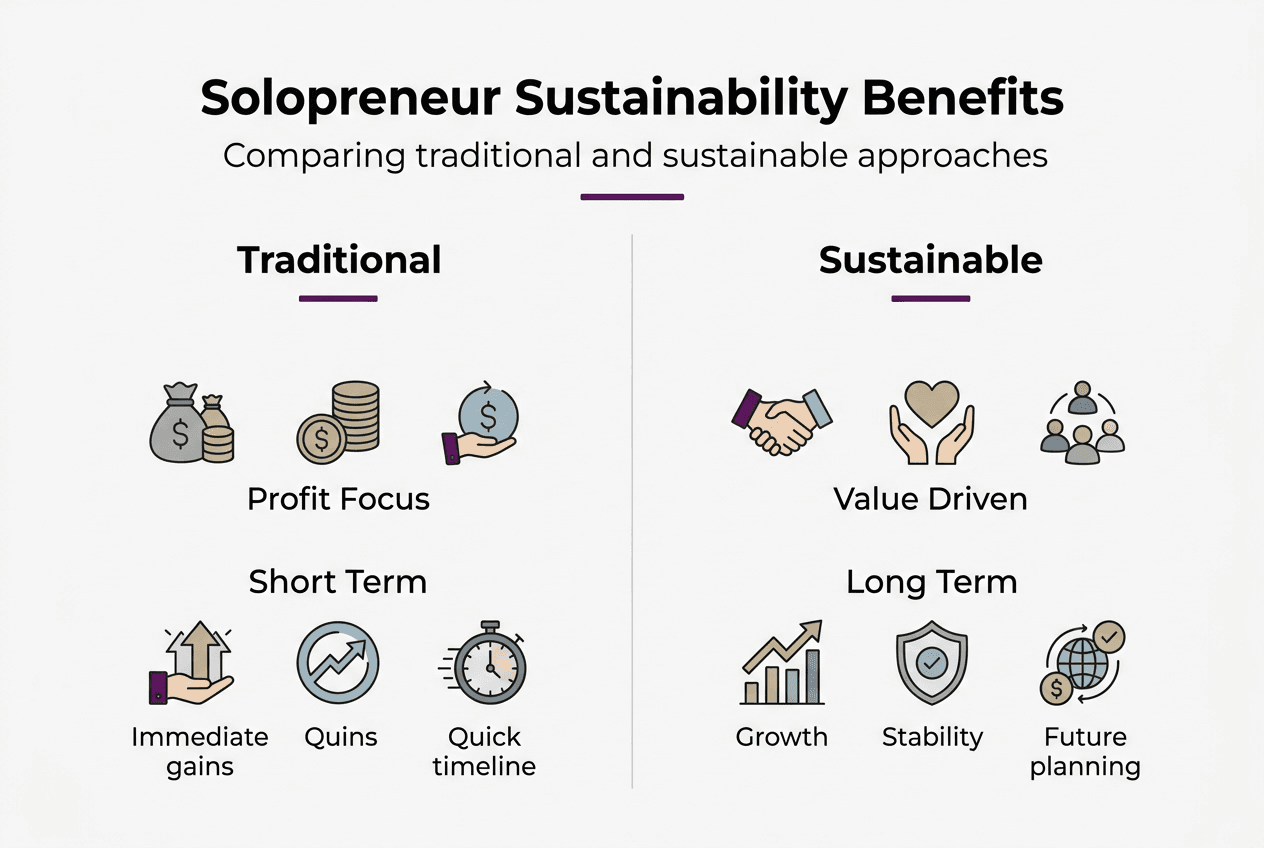
| Outcome | Traditional Entrepreneurship | Sustainable Entrepreneurship |
|---|---|---|
| Profitability Focus | Short term revenue maximization | Long term value creation balancing profit with impact |
| Social Impact | Minimal consideration beyond compliance | Proactive contribution to community well being and equity |
| Environmental Footprint | Often externalized or ignored | Actively measured, reduced, and offset |
| Customer Loyalty | Price and convenience driven | Values alignment and trust driven |
| Resilience | Vulnerable to regulatory and market shifts | Adaptive to evolving stakeholder expectations |
Entrepreneurial leadership skills foster ethical leadership and enhance corporate sustainable development in SMEs. Your commitment as a founder sets the tone for your entire organization, no matter how small. When you prioritize sustainability, you attract team members and partners who share those values, creating cultural alignment that drives consistent execution.
Real world profitability comes from efficiency gains and premium positioning. Customers increasingly pay more for sustainable products and remain loyal to brands demonstrating genuine commitment. Investors and lenders view sustainability as risk mitigation, improving access to capital. Intangible benefits like employee satisfaction and community reputation compound over years, building resilience against market volatility.
Understanding these benefits prepares you to apply insights practically. Business positioning workflow helps translate sustainability values into clear market differentiation. The question shifts from whether sustainability matters to how you’ll implement it effectively within your unique context.
Empower your sustainable business journey with Starfireblast
Building a sustainable business requires clarity about who you serve and why it matters. Starfireblast’s Customer StarMap™ AI Power Workshop helps you define your positioning, understand your audience deeply, and align your strategy with sustainable impact goals. This isn’t generic business advice. It’s tailored guidance designed for solopreneurs and small teams committed to meaningful growth.
Benefits of working with Starfireblast include:
- Tailored strategies connecting your unique value proposition with sustainability principles
- Integration support helping you embed sustainable practices into operations without overwhelming resources
- Actionable insights translating abstract sustainability goals into concrete business decisions
Pro Tip: Combining expert guidance with your unique vision maximizes sustainable impact by ensuring authenticity and strategic alignment rather than superficial greenwashing.
Explore sustainable growth strategies for entrepreneurs and discover how planetary productivity principles apply to your business. Visit the Starfireblast homepage to access workshops, tools, and community support designed for entrepreneurs building businesses that matter. Your sustainable journey starts with clarity, and Starfireblast provides the roadmap to get there.
Frequently asked questions
What is sustainable entrepreneurship?
Sustainable entrepreneurship balances economic viability with social equity and environmental responsibility. It goes beyond profit maximization to create long term value for all stakeholders, including communities and ecosystems. This approach integrates sustainability into core business strategy rather than treating it as an optional add on or marketing tactic.
What are the main barriers preventing small businesses from adopting sustainable practices?
Limited financial resources top the list, restricting investment in green technologies or process improvements. Knowledge gaps about effective practices and regulatory requirements create uncertainty. Operational pressures prioritizing immediate survival over long term sustainability compound these challenges. Small teams lack dedicated personnel to research and implement sustainability initiatives comprehensively.
What practical first steps can solopreneurs take to adopt sustainability incrementally?
Start by measuring your current environmental footprint to identify high impact improvement areas. Implement cost saving efficiency measures like reducing energy consumption or minimizing waste. Engage your customers and suppliers in conversations about sustainability preferences and opportunities. Set modest, measurable goals and track progress publicly to build accountability and momentum.
How does digital innovation support sustainable entrepreneurship outcomes?
Digital tools provide affordable access to sustainability data, monitoring systems, and best practice resources previously available only to large corporations. Cloud based platforms enable supply chain transparency and carbon tracking. Online networks connect small businesses for knowledge sharing and collaborative problem solving. Automation reduces resource consumption while improving operational efficiency.
How do sustainable practices improve competitive advantage and social impact?
Sustainability differentiates your brand in crowded markets, attracting conscious consumers willing to pay premium prices. It builds customer loyalty through values alignment and trust. Operationally, efficiency gains reduce costs and improve margins. Socially, sustainable businesses contribute to community well being, environmental health, and equitable economic development, creating legacy beyond financial returns.
How can small businesses overcome resource constraints to implement sustainable practices?
Leverage incremental models like SCALE that break sustainability into manageable steps aligned with existing operations. Use affordable digital tools to enhance green capabilities without major capital investment. Engage stakeholders including customers, suppliers, and industry groups to share resources and knowledge. Seek regulatory support through government incentives, grants, and technical assistance programs designed for small businesses.
What are the benefits of adopting sustainable entrepreneurship as a solopreneur?
Improved competitiveness through market differentiation and values based positioning attracts loyal customers and quality partners. Profitability increases via cost efficiencies and premium pricing opportunities. Enhanced customer trust builds long term relationships and referral networks. Positive social and environmental impact creates meaningful legacy while contributing to broader sustainability goals. These benefits compound over time, strengthening business resilience.
Are there frameworks or models to help small businesses integrate sustainability?
Yes, the SCALE framework provides strategic, incremental steps tailored for SMEs with limited resources. It emphasizes connectivity, adaptability, leverage, and evolutionary implementation. Green dynamic capabilities models help businesses sense market opportunities, seize them through strategic action, and transform operations to embed sustainability. Stakeholder engagement and digital tools enhance outcomes by expanding access to resources and expertise beyond individual business constraints.