What Is a Values-Based Business? Build Impact and Resilience
TL;DR:
- Purpose-driven businesses prioritize social and environmental values alongside profit for greater success.
- Embedding clear, measurable values into operations enhances retention, trust, and innovation.
- Building a values-based business starts with self-reflection, stakeholder input, and transparent impact tracking.
Most entrepreneurs are taught that profit is the primary signal of success. But purpose-driven firms show 40% higher workforce retention and 30% greater innovation compared to traditional companies, according to Deloitte research, along with measurably stronger financial performance over time. That gap is not accidental. It reflects a fundamental difference in how the business was built, what decisions it makes daily, and who it ultimately serves. This article defines what a values-based business is, explains why it outperforms conventional models, and gives you a clear, practical path to building one.
Table of Contents
- What is a values-based business?
- How values shape your business model
- The real-world impact of values-based businesses
- How to build your own values-based business
- Why values-based business isn’t just a trend—it’s a blueprint for real change
- Ready to operationalize your values?
- Frequently asked questions
Key Takeaways
| Point | Details |
|---|---|
| Values drive impact | A values-based business bakes core principles into every decision, unlocking deep social, ecological, and financial benefits. |
| Evidence supports better outcomes | Purpose-driven companies often outperform peers, with higher retention and innovation leading to stronger growth. |
| Practical integration matters | Real success comes from embedding values into daily operations, not just advertising ethics. |
| Strategic advantage | Founders who let values guide their business build resilience and strong market positioning. |
What is a values-based business?
A values-based business is one that places social, environmental, or ethical values at the center of its operating model, not as an add-on to strategy, but as the foundation from which all decisions flow. Profit remains important. It has to be, because without economic viability the mission cannot be sustained. But in a values-based business, profit is a byproduct of doing the right thing consistently, not the sole target.
This is a meaningful distinction. Traditional businesses typically optimize for margin, market share, and shareholder return first. Values-based businesses optimize for mission alignment first and trust that financial results follow. The evidence increasingly supports that this is not a naive approach. It is a strategic one.
Consider Tony’s Chocolonely, the Dutch chocolate company that has become one of the most studied examples in ethical business. Tony’s pays cocoa farmers 40% above Fairtrade standards, maintains full supply chain transparency, and uses independent governance structures to prevent value-diluting acquisitions. The result: $220 million in revenue in 2022, with 25 to 30 percent annual growth. The values did not slow the business down. They were the growth engine.
Understanding this model requires recognizing how it differs structurally from the traditional approach. Here is a direct comparison:
| Dimension | Traditional business | Values-based business |
|---|---|---|
| Primary driver | Profit and market share | Mission and stakeholder impact |
| Decision filter | Financial return | Values alignment plus viability |
| Supply chain | Lowest cost preferred | Ethical standards prioritized |
| Employee relations | Performance contracts | Culture, purpose, fair compensation |
| Customer relationship | Transactional | Community and shared values |
| Growth measure | Revenue and EBITDA | Revenue plus social and ecological outcomes |
| Governance | Shareholder-first | Multi-stakeholder accountability |
Common values that anchor these businesses include:
- Transparency: open supply chains, honest pricing, public impact reporting
- Fair compensation: living wages, farmer premiums, equitable pay structures
- Sustainability: low-waste operations, renewable energy, ecological accountability
- Community: local sourcing, reinvestment in affected communities, shared ownership models
- Inclusion: diverse hiring, accessible products, non-exploitative marketing
This framing is closely related to what we at Starfireblast call purpose-driven business. The two concepts share the same root: a belief that the why behind a business shapes the quality of everything it builds.
How values shape your business model
Defining your values is the starting point. The harder work is letting those values shape actual decisions, not just wall posters or about-page copy. Here is where most businesses fall short. They articulate values clearly but apply them inconsistently, which creates the gap between stated purpose and lived reality.
Values shape business decisions across at least four core functions:
1. Supply chain standards. A values-based business does not choose suppliers solely on price. It audits for labor practices, environmental impact, and transparency. This often costs more short term. But it reduces reputational risk, strengthens supplier loyalty, and creates a supply chain that is more stable over time. That is a form of resilient business practices that compounds in value.
2. Employee relations. Values-based businesses tend to invest more heavily in employee development, compensation equity, and psychological safety. The data supports this investment. Purpose-driven companies show 40% higher retention than conventional firms. Replacing a single employee typically costs between 50 and 200 percent of that person’s annual salary, depending on role complexity. Retaining mission-aligned staff is not just ethical. It is financially rational.

3. Community engagement. A values-based business sees the community it operates in as a stakeholder, not an audience. This might look like local sourcing, contributing to community funds, or designing products that address genuine needs rather than manufactured demand. These choices build the kind of trust that no advertising budget can replicate.
4. Environmental impact accounting. Strong values-based businesses track ecological costs alongside financial ones. They treat carbon, water, and waste as real variables in decision-making, not PR metrics. This connects directly to sustainable business practices that reduce long-term operating risk and attract values-aligned investors.
Here is a concrete look at how values influence measurable outcomes:
| Business function | Conventional approach | Values-based outcome |
|---|---|---|
| Hiring | Skills and experience match | Skills, cultural alignment, and mission fit |
| Pricing | Market-rate with margin target | Transparent cost-based pricing |
| Marketing | Persuasion-led | Education and community-led |
| Reporting | Financial statements only | Financial plus impact reports |
| Innovation | Product-market fit | Mission-product-market fit |
Pro Tip: To avoid values-washing (claiming values in marketing that are not practiced in operations), conduct a quarterly values audit. For each stated value, identify three specific decisions made in the last 90 days that reflect it. If you cannot name three, the value is aspirational, not operational. That is the gap to close first.
The real-world impact of values-based businesses
With a better understanding of how values get operationalized, the next question is: does it actually work in practice, across different markets and business types?
The evidence is consistent. Values-based businesses generate measurable improvements in retention, innovation, and long-term financial performance. But the impact extends beyond internal metrics. It reshapes industries and communities.
“Tony’s Chocolonely’s model proves that transparency, fair pricing, and ethical governance are not constraints on growth. They are the conditions for it.”
Tony’s Chocolonely is the clearest large-scale proof point. Its $220 million revenue in 2022 came alongside independent governance designed to protect the mission from external pressure. The company did not grow despite its values. It grew because of them. Its supply chain transparency created consumer trust. Its farmer premiums created supply chain stability. Its governance model created long-term resilience.
The impact on cocoa farming communities has been equally significant. By paying above Fairtrade standards and maintaining direct relationships with farming cooperatives, Tony’s reduced child labor risk in its supply chain while improving household income for farmers. That is a ripple effect that reaches far beyond any single balance sheet.
For founders, the benefits of a values-based approach are concrete:
- Long-term resilience: businesses built on genuine trust weather economic cycles better than those built on aggressive acquisition or price-cutting
- Talent quality: mission-aligned candidates self-select, reducing recruitment costs and improving team cohesion
- Customer loyalty: customers who share your values become advocates, reducing paid marketing dependency
- Industry influence: consistent values-based practices raise the standard for competitors, creating systemic change
- Personal sustainability: founders who align business decisions with personal values report lower burnout and longer business tenure
The ethical growth advantages here are not just moral. They are structural. And for solo entrepreneurs or small teams who cannot afford to absorb the cost of high turnover or reputation damage, building on values from the start is simply the more practical strategy. Exploring purpose over profit insights can help clarify how to navigate those trade-offs in your specific context.
How to build your own values-based business
Inspired by the evidence and examples, the practical question becomes: where do you actually start? Here is a five-step roadmap built on what works across real businesses.
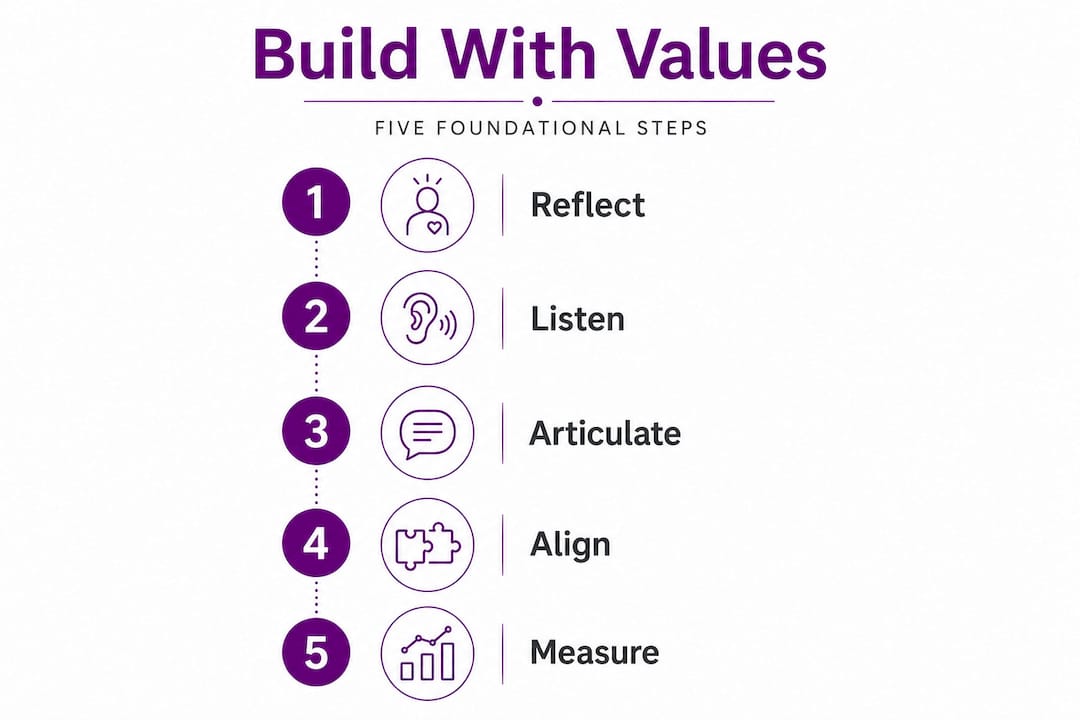
1. Self-reflection on strengths and values. Before writing a business plan, identify what you genuinely care about and where your skills create real value. Purpose lives at the intersection of strengths, world needs, and economic viability. This is not a soft exercise. It is the most important strategic input you have, because it determines whether you can sustain commitment over the long term.
2. Stakeholder listening. Talk to the people your business affects or will affect: potential customers, community members, suppliers, and employees. Understand their actual needs and constraints before you finalize your values. Many businesses build values in isolation and are surprised when they do not resonate externally.
3. Value articulation. Write your core values in specific, behavioral language. Not “we value sustainability” but “we track carbon per unit sold and reduce it by 10 percent each year.” Specific values create accountability. Vague values create theater. The purpose-driven entrepreneurship checklist is a useful framework for working through this step systematically.
4. Strategy alignment. Review every element of your business model against your articulated values. Pricing, supplier selection, hiring criteria, marketing tone, product design, and revenue model all need to reflect your values, not contradict them. This is where clarifying business purpose translates into operational decisions.
5. Transparent measurement. Build a simple dashboard that tracks both financial and impact metrics. Share it with your team and, where appropriate, your community. Public accountability is one of the strongest signals of genuine values alignment. It also creates a feedback loop that improves your decisions over time.
Pro Tip: Run a values audit before launching any major campaign, product, or partnership. Ask this single question about each decision: “Does this choice make our stated values more or less true in practice?” If the answer is “less true,” that is data worth acting on before committing resources.
Why values-based business isn’t just a trend—it’s a blueprint for real change
Conventional wisdom still treats purpose as a branding layer. Add a mission statement, run a charitable campaign, publish a sustainability report. Check the box. Move on.
That approach is increasingly out of step with what the market actually rewards. Customers have more information, more alternatives, and less tolerance for performative ethics than at any previous point in market history. Employees, especially skilled ones, have choices. They use those choices to select organizations whose stated values match their actual practices.
The businesses failing most visibly right now are not failing because of poor products. Many are failing because the gap between what they say and what they do has become impossible to ignore. Trust, once lost, is extraordinarily expensive to rebuild.
What makes values-based business genuinely different is that it is not reactive to these trends. It is structurally aligned with them. When transparency is a core value, you do not scramble to publish supply chain data under pressure. You already have it. When fair compensation is a core value, you do not face retention crises when competitors raise wages. You built loyalty before the competition started.
There is also a deeper reality here. Most guides on values-based business treat values as a retention and marketing tool. They miss the bigger point. Values are the primary driver of how you attract top talent, build lasting customer relationships, and create the kind of organizational culture that generates genuine innovation. They are not a feature of your business. They are the architecture.
The uncomfortable truth is this: you cannot bolt values onto an existing extractive business model and expect meaningful change. Values-based business requires building from a different foundation. That is harder. It is also more durable. The companies doing it seriously, including those profiled across building impactful businesses, are not just good corporate citizens. They are outperforming conventional peers on the metrics traditional investors care about most.
Ready to operationalize your values?
Building a values-based business requires more than inspiration. It requires clear tools, structured thinking, and a community that holds you accountable to your own standards. That is exactly what Starfireblast is designed to support.

The Customer StarMap™ workshop gives you a structured, AI-assisted process for identifying who you are building for, how your values connect to their real needs, and how to align your business model before you scale anything. It is built specifically for solo entrepreneurs and small teams who want to build businesses with lasting integrity, not just short-term revenue. Explore everything Starfireblast offers to support mission-driven business building at every stage of growth.
Frequently asked questions
What makes a business ‘values-based’ versus just ethical?
A values-based business embeds core values into every operational decision, supplier contract, and compensation structure, not just isolated policies or PR statements. Ethics can be a standard applied from outside; values are built into the business from the inside out.
Can values-based businesses be profitable?
Yes. Tony’s Chocolonely demonstrates this clearly, generating $220 million in revenue in 2022 with 25 to 30 percent annual growth while paying cocoa farmers above Fairtrade rates and maintaining transparent governance.
What are key benefits of a values-based approach for entrepreneurs?
Greater workforce retention, increased innovation, and stronger long-term financial performance. Purpose-driven firms report 40% higher retention and 30 percent greater innovation rates than conventional counterparts.
How do I start defining values for my business?
Start with the intersection of strengths, world needs, and economic value as your framework, then articulate each value in specific, measurable, behavioral terms rather than abstract ideals. Test each value against real decisions before you publish it anywhere.