Values-Driven Branding: 73% Trust Boost in 2026
Consumers increasingly vote with their wallets, and 73% now choose brands based on their ethical commitments. Values-driven branding is no longer optional for entrepreneurs who prioritize sustainability and well-being. It’s the strategic foundation for building trust, loyalty, and long-term growth. This article equips you with frameworks, real-world examples, and actionable steps to embed values authentically into your brand, turning purpose into your competitive advantage while avoiding the pitfalls that derail superficial efforts. Understanding the role of values in branding is the first step toward building a business that matters.
Table of Contents
- What Is Values-Driven Branding And Why It Matters
- Role Of Ecology And Well-Being In Values-Driven Branding
- Common Misconceptions About Values-Driven Branding
- Frameworks And Comparative Models For Values-Driven Branding
- Real-World Examples And Case Studies
- Implementing Values-Driven Branding For Entrepreneurs
- Unlock Your Brand’s Full Potential With Starfireblast
Key Takeaways
| Point | Details |
|---|---|
| Definition and Impact | Values-driven branding aligns your identity, culture, and practices with ethical and ecological values, building trust with 73% of consumers who prioritize ethics. |
| Financial Advantage | Purpose-led brands outperform financially by 14% annually, proving that values drive both meaning and profit. |
| Common Pitfalls | Misconceptions like treating values as static marketing copy or superficial claims lead to 60% of brand strategy failures. |
| Strategic Framework | A three-pillar approach reduces mission drift by 40% through purpose articulation, operations integration, and stakeholder engagement. |
| Actionable Implementation | Solo entrepreneurs can embed values authentically by defining core principles, auditing alignment, ensuring transparency, and evolving continuously. |
What is Values-Driven Branding and Why It Matters
Values-driven branding means aligning your brand’s identity, internal culture, and business practices with core ethical, ecological, and purpose values. It’s not a marketing tactic. It’s a strategic commitment that shapes every decision, from product development to customer communication.
Why does this matter now? 73% of consumers choose brands based on their ethical commitments, and this preference directly impacts your bottom line. Purpose-driven brands outperform financially by 14% annually compared to those focused solely on profit. Entrepreneurs who ignore this shift risk losing both trust and market share.
Values-driven branding rests on three core elements. First, authentic internal culture where your team lives your values daily. Second, transparent communication that shares both successes and challenges openly. Third, consistent product development that prioritizes sustainability and well-being over shortcuts.
The benefits extend beyond revenue:
- Enhanced consumer trust in markets saturated with empty promises
- Deeper customer loyalty that withstands price competition
- Stronger employee engagement and retention through shared purpose
- Clear competitive differentiation in crowded industries
“Values-driven brands don’t just sell products. They build movements that customers want to join and defend.”
Understanding the values role in branding helps you see how purpose becomes your strategic advantage, not just a nice-to-have addition.
Role of Ecology and Well-being in Values-Driven Branding
Ecological responsibility and human well-being aren’t separate from your brand strategy. They’re central to it. Ecological responsibility boosts customer loyalty by 20% because consumers increasingly demand that brands minimize environmental harm. Similarly, well-being focus fosters employee engagement and brand authenticity, creating internal alignment that customers sense and trust.

Planetary productivity is the principle that connects these values. It means building growth that simultaneously supports human well-being, economic viability, and ecological health. You’re not choosing between profit and planet. You’re designing systems where both thrive together.
How do these values translate into practical brand actions? Start by examining your supply chain for ecological impact. Communicate transparently about your sourcing decisions. Design products that solve real problems without creating waste. Support employee well-being through flexible work structures and mental health resources.
Here’s how to implement ecology and well-being values:
- Conduct lifecycle assessments of your products to identify environmental hotspots
- Set measurable targets for waste reduction and carbon footprint
- Share progress reports publicly, including setbacks and lessons learned
- Create workplace policies that prioritize mental health and work-life balance
- Partner with suppliers who demonstrate ecological responsibility
- Design customer experiences that educate and empower sustainable choices
These actions build the foundation for community-driven brands impact, where your customers become advocates because they see their values reflected in your business.
Common Misconceptions About Values-Driven Branding
Misunderstandings about values-driven branding lead entrepreneurs down paths that waste resources and erode trust. Let’s address the most damaging myths that prevent authentic implementation.
-
Values-driven branding is just marketing messaging. Wrong. It’s an operational commitment that starts internally. 60% of brand strategy failures result from neglecting internal values alignment. Your team must live your values before you communicate them externally.
-
Ecological claims can be vague or superficial. This leads to greenwashing accusations that destroy credibility. Consumers demand specific, verifiable evidence. Use third-party certifications and transparent reporting to back every ecological claim.
-
Brand values are timeless and never change. Static values become irrelevant as stakeholder expectations evolve. Your core principles may remain stable, but how you express and implement them must adapt to new challenges and opportunities.
-
Only large corporations can afford values-driven branding. Small entrepreneurs actually have an advantage. You can pivot faster, maintain closer customer relationships, and build authentic culture without bureaucratic friction. Size is not a barrier.
-
Ethical focus hurts financial performance. The data proves otherwise. Purpose-driven brands achieve 14% better financial results annually. Ethical commitments attract loyal customers willing to pay premium prices and stay longer.
Pro Tip: Conduct internal culture audits every quarter to identify gaps between stated values and actual practices. Ask employees anonymously whether they see your values in daily decisions. Address disconnects immediately before they become visible to customers.
Understanding why purpose matters in branding helps you avoid these pitfalls by anchoring your strategy in authentic commitment rather than superficial tactics.
Frameworks and Comparative Models for Values-Driven Branding
Strategic frameworks help you implement values-driven branding systematically, reducing risk of mission drift. The three-pillar framework provides clear structure for embedding values throughout your business.
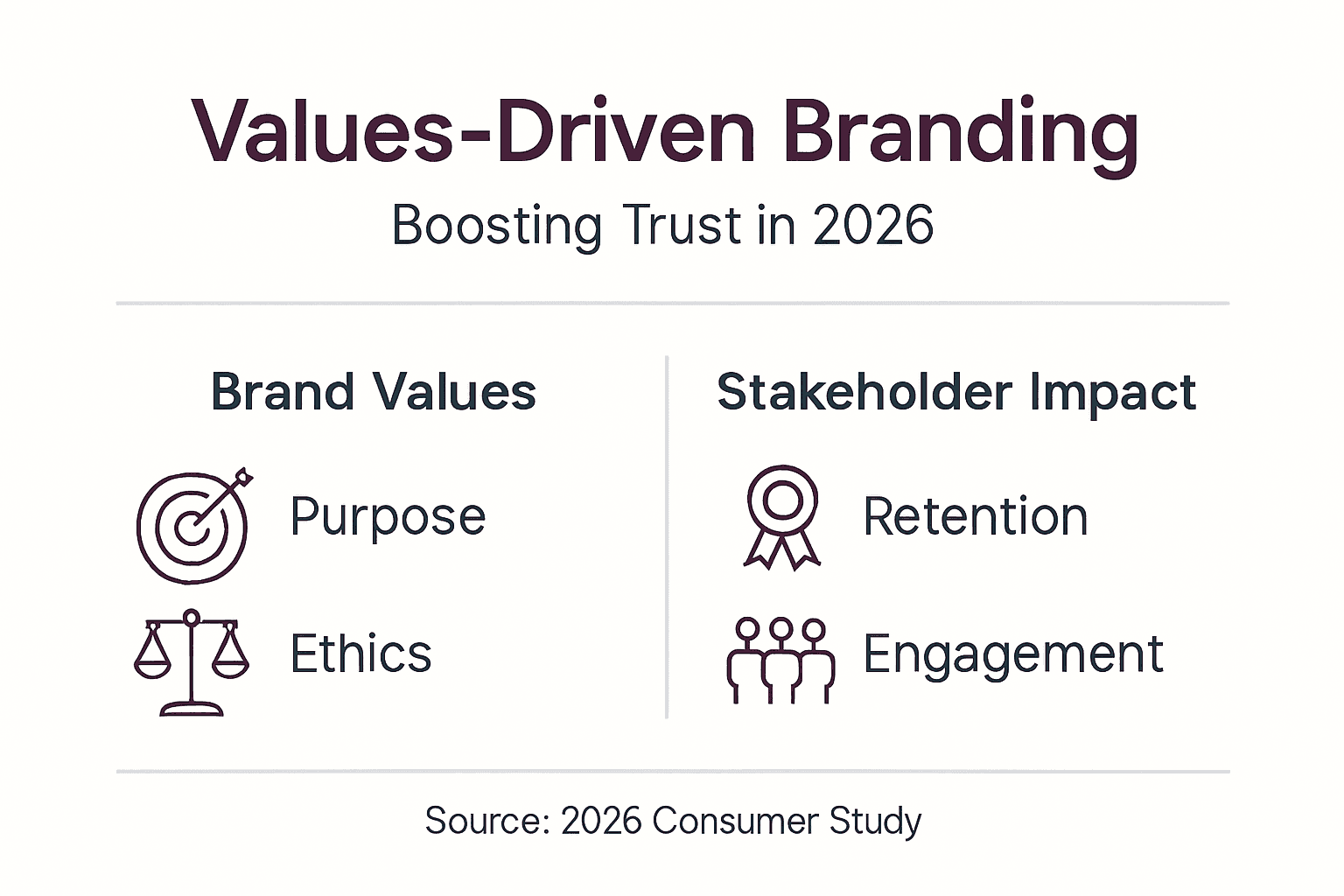
Purpose Articulation: Define your core values explicitly and communicate why they matter. Involve stakeholders in this process to ensure buy-in. Document how your values inform major decisions.
Operations Integration: Align every business function with your values. This includes supply chain selection, product design, pricing strategy, and customer service protocols. Values must shape operations, not sit in separate mission statements.
Stakeholder Engagement: Build ongoing dialogue with customers, employees, suppliers, and community members. Use their feedback to refine how you express and implement values. This prevents disconnect between intention and perception.
Framework adoption reduces mission drift by 40% by providing clear criteria for evaluating decisions and maintaining strategic focus.
| Approach | Core Focus | Implementation Depth | Stakeholder Role | Risk Level |
|---|---|---|---|---|
| Values-Driven | Comprehensive alignment across operations and culture | Deep, systemic integration | Active co-creators | Low mission drift |
| Traditional | Product quality and customer satisfaction | Surface-level positioning | Passive consumers | High irrelevance |
| Cause-Related | Marketing partnerships with nonprofits | Limited to campaigns | Recipients of messaging | High greenwashing risk |
Key actions under each pillar:
- Purpose: Host workshops where team members share personal values and identify overlap with brand mission
- Operations: Create decision matrices that evaluate options against stated values before implementation
- Engagement: Schedule quarterly stakeholder forums to gather input on values alignment and relevance
Pro Tip: Review your framework alignment every six months. Ask whether recent decisions reflect your stated values. Document any disconnects and adjust either your practices or how you communicate values to resolve the gap.
The branding process for entrepreneurs walks through implementing these frameworks step by step, ensuring you build on solid strategic foundations.
Real-World Examples and Case Studies
Patagonia demonstrates how values-driven branding translates into business success. Patagonia achieves 80%+ customer retention through its values-driven strategy, far exceeding industry averages. Their approach offers lessons for entrepreneurs at any scale.
Patagonia’s ecological practices go beyond marketing. They repair products for free, publish transparent supply chain reports, and donate 1% of sales to environmental causes. They’ve sued to protect public lands and openly opposed policies harmful to the environment. This authentic commitment builds deep customer loyalty.
Key strategies you can adapt:
- Radical Transparency: Share both successes and failures in sustainability efforts. Patagonia publishes detailed environmental impact data, including areas where they fall short.
- Product Longevity: Design for durability and repairability instead of planned obsolescence. This reduces waste and builds trust.
- Activism as Brand: Take public positions on issues aligned with your values, even when controversial. This attracts customers who share your convictions.
- Supply Chain Accountability: Audit suppliers regularly and share findings publicly. Terminate relationships that don’t meet standards.
“Patagonia’s 80% customer retention proves that authentic values commitment creates competitive advantage no marketing budget can match.”
For solo entrepreneurs and small teams, the lesson is clear. You don’t need Patagonia’s scale to implement these principles. Start by choosing one value to express authentically. Document your practices transparently. Engage your community in the journey. Build from there.
Explore authentic personal branding examples to see how individual creators apply similar principles at smaller scale with remarkable results.
Implementing Values-Driven Branding for Entrepreneurs
Ready to embed values into your brand? Follow these practical steps designed for solo entrepreneurs and small teams.
-
Define Core Values with Stakeholder Input: Don’t declare values in isolation. Host conversations with team members, early customers, and trusted advisors. Identify 3-5 principles that genuinely drive your decisions. Document why each matters and how it connects to your mission.
-
Conduct Culture and Operations Audit: Examine every business function against your stated values. Does your pricing reflect fair compensation for suppliers? Do your communication practices demonstrate transparency? Identify gaps between values and current practices. Create action plans to close them.
-
Develop Transparent Reporting Systems: Commit to regular public updates on values alignment. This might be quarterly blog posts, annual impact reports, or monthly newsletter updates. Include metrics that matter: carbon footprint, supplier standards, employee satisfaction, community investment. Pursue third-party certifications like B Corp or Fair Trade to add credibility.
-
Schedule Regular Values Reviews: Static values cause 25% decline in customer relevance over 3 years without evolution. Set calendar reminders every six months to assess whether your values still resonate with stakeholders and reflect current challenges. Adapt language and implementation while maintaining core principles.
-
Engage Customers in Co-Creation: Invite customers to shape how you express values. Run surveys asking what matters most to them. Create feedback loops where they can report alignment gaps. Share how their input influences your decisions. This builds ownership and loyalty.
Pro Tip: Keep values dynamic by treating them as living commitments, not static declarations. When circumstances change or you discover better ways to serve your mission, communicate the evolution openly. Customers respect authentic adaptation more than rigid adherence to outdated positions.
The purpose-driven entrepreneurship checklist and action planning for entrepreneurs provide detailed frameworks for implementing these steps systematically.
Unlock Your Brand’s Full Potential with Starfireblast
You’ve learned the frameworks, seen the examples, and mapped your implementation path. Now it’s time to turn knowledge into action. Starfireblast helps purpose-driven entrepreneurs like you clarify messaging, map ideal customers, and build sustainable brands that align values with growth. Our platform combines customer understanding tools, brand strategy clarity, and practical AI-assisted resources designed specifically for solo entrepreneurs and small teams who refuse to sacrifice meaning for scale.
Access expert-led workshops that walk you through defining your brand strategy for lasting impact. Follow our proven branding process for entrepreneurs that ensures values alignment at every step. Explore growth strategies for sustainable brands that prioritize community over algorithms. Join entrepreneurs who are building businesses that matter, without burning out or gaming systems. Your values deserve a brand that reflects them authentically.
Frequently Asked Questions
What are the first steps to start values-driven branding as a solo entrepreneur?
Begin by identifying 3-5 core values that genuinely drive your decisions, not values you think sound good. Involve early customers or trusted advisors in this process to ensure authenticity. Then audit your current practices against these values to identify gaps, and create a simple action plan to align operations with stated principles.
How can small brands avoid greenwashing while promoting ecological values?
Back every ecological claim with specific, measurable evidence and third-party verification. Share transparent reports that include both progress and setbacks. Never make vague statements like “eco-friendly” without explaining exactly what you mean and how you measure it. Customers respect honesty about limitations more than perfect but unverifiable claims.
Why must brand values evolve over time instead of staying fixed?
Stakeholder expectations, environmental challenges, and social contexts constantly change. Static values become irrelevant, causing up to 25% decline in customer relevance over three years. Your core principles may remain stable, but how you express and implement them must adapt to remain meaningful and responsive to current realities.
How do I measure the success of my values-driven branding efforts?
Track customer retention rates, employee satisfaction scores, and stakeholder engagement levels alongside traditional financial metrics. Monitor brand sentiment through customer feedback and social listening. Measure progress on specific values commitments like carbon reduction targets or supply chain standards. Success means both business growth and advancing your stated values.
Can values-driven branding improve employee well-being and retention?
Absolutely. When employees see their personal values reflected in business decisions, engagement and retention improve significantly. Well-being focused brands create workplace cultures where people feel their work contributes to meaningful outcomes beyond profit, reducing burnout and attracting talent who prioritize purpose alongside compensation.