10 sustainable business practices every entrepreneur can use
TL;DR:
- Small businesses can adopt practical, low-cost sustainability practices without large budgets.
- Setting clear goals, measuring impact, and engaging staff are key to sustainable growth.
- Sustainability and profitability often reinforce each other, emphasizing integration into daily operations.
Growing a business while keeping it genuinely responsible is not simple. You face pressure to cut costs, move fast, and still honor your values around people, planet, and profit. Many entrepreneurs assume sustainability requires large budgets or specialized expertise. It does not. Sustainable business practices can be broken into clear, repeatable steps that fit a small operation. This article covers 10 practical approaches, organized by where to start, what to change, who to involve, and how to track real progress over time.
Table of Contents
- Set clear sustainability goals
- Audit your operations for hidden impact
- Implement high-impact sustainable practices
- Engage your team and community
- Track, report, and adapt your progress
- The uncomfortable truth about sustainable business
- Build your sustainable business with Starfireblast
- Frequently asked questions
Key Takeaways
| Point | Details |
|---|---|
| Goal setting matters | Clear sustainability goals drive actionable change and better outcomes. |
| Employee and community buy-in | Sustainability succeeds when staff, suppliers, and customers are engaged in the process. |
| Track your impact | Regular tracking and reporting ensures progress and keeps your efforts accountable. |
| Sustainability boosts profit | Sustainable practices are proven to improve financial performance and community well-being. |
Set clear sustainability goals
Sustainability without direction produces activity, not results. The first step is defining what responsible business actually means for your specific operation, your suppliers, your customers, and your community.
Start by writing a short sustainability vision statement. One or two sentences that connect your business purpose to a measurable environmental or social outcome. Then build goals around it using the SMART framework: Specific, Measurable, Achievable, Relevant, and Time-bound.
Here is a simple process to follow:
- List your current environmental and social impacts (energy, waste, sourcing, community).
- Choose two or three priority areas where change is both feasible and meaningful.
- Set a target for each area, such as reducing emissions by 20% within five years.
- Assign ownership so someone on your team is accountable for each goal.
- Schedule a quarterly check-in to review progress.
Key metrics worth tracking from day one include energy consumption (kWh), waste sent to landfill (kg), supplier certifications, and water usage. These numbers give you a baseline. Without a baseline, you cannot measure improvement.
“A sustainability goal without a number attached is just a wish.”
Pro Tip: Run a basic sustainability audit before setting goals. Walk through your space and list every input and output. You will spot quick wins, like switching to LED lighting or eliminating single-use packaging, that cost little but move your metrics fast. Use measuring sustainability objectives as a reference for structuring your first audit.
Audit your operations for hidden impact
With goals in place, the next step is to understand your current impact. Many small businesses are surprised by where their biggest sustainability gaps actually sit. It is rarely just the obvious stuff.
Break your operations into four categories:
- Energy: Lighting, heating, cooling, equipment, and digital infrastructure.
- Materials: What comes in (packaging, supplies, raw inputs) and what goes out (waste, recycling, compost).
- Supply chain: Where your vendors are located, how they operate, and what certifications they hold.
- Digital footprint: Server energy use, cloud storage, email volume, and website hosting.
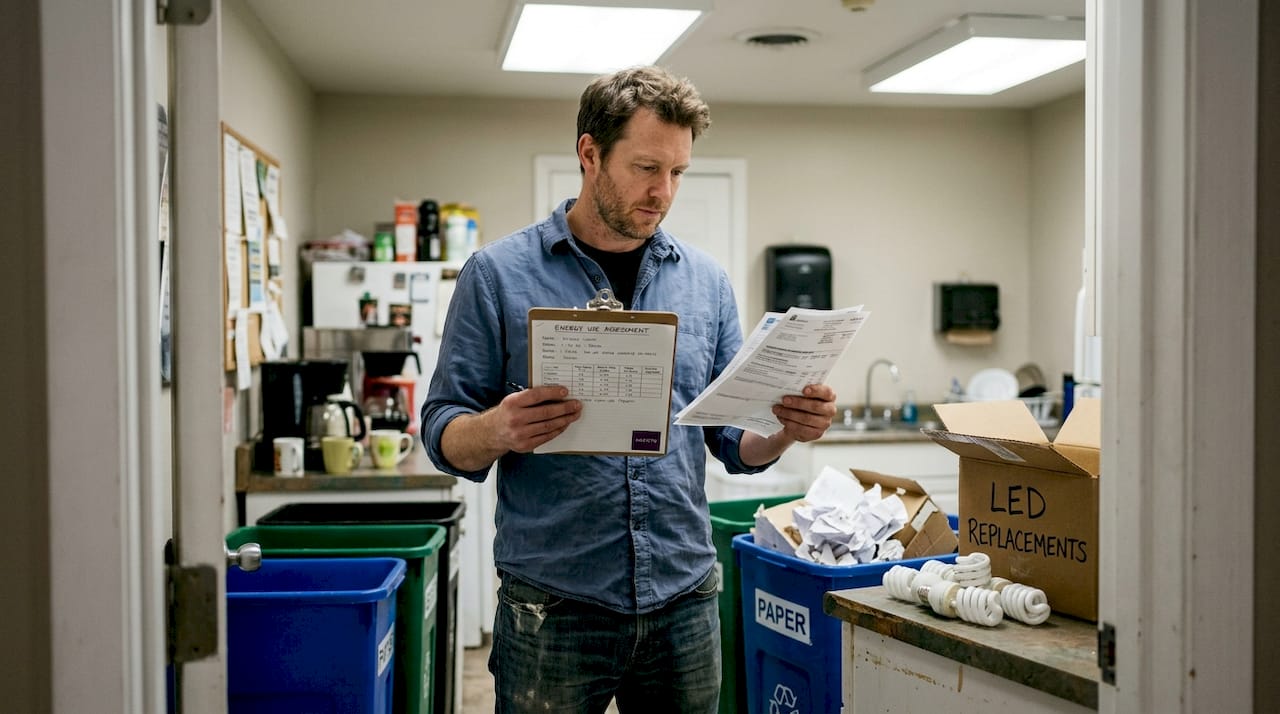
Hidden impacts are common in areas like water use in cleaning or production, professional service sustainability examples such as printed materials, and the carbon cost of business travel or shipping.
| Audit area | Before improvement | After improvement |
|---|---|---|
| Office lighting | Fluorescent bulbs | LED, 40% less energy |
| Paper use | 500 sheets/month | Digital docs, 80% reduction |
| Web hosting | Standard shared server | Green hosting provider |
| Packaging | Single-use plastic | Recycled cardboard |
Pro Tip: Start with the areas easiest to measure. Energy bills and waste invoices give you hard numbers immediately. Use resources for tracking sustainability metrics to find low-cost tools that automate data collection.
A sustainability audit covering energy, waste, and supply chain does not need to be complex. A simple spreadsheet with current state and target state for each category is enough to start.
Implement high-impact sustainable practices
Now that you know your impact areas, it is time to get specific about what to change. Not every practice fits every business, but the following list covers the highest-leverage options for most small operations.
- Renewable energy: Switch to a clean power provider or install solar panels. Many utility providers now offer green energy plans with no setup cost.
- Waste reduction: Set up recycling and composting stations. Audit what you throw away and find circular alternatives, like reusable containers or refillable supplies.
- Ethical sourcing: Vet suppliers for labor practices, local proximity, and environmental certifications. Shorter supply chains reduce emissions and support local economies.
- Digital sustainability: Move to green cloud hosting, reduce unnecessary email storage, and cut printed materials. Digital tools replace paper-heavy workflows with no loss in productivity.
- Responsible purchasing: Buy used equipment, choose durable goods over disposable ones, and consolidate orders to reduce shipping frequency.
Research on strategic orientation and environmental performance shows that a sustainable strategic orientation improves both ecological outcomes and business performance simultaneously. This is not a trade-off. It is an alignment.
Pro Tip: Ask your team for ideas before rolling out changes. Staff who work with materials, equipment, or customers daily often know the fastest paths to improvement. Their buy-in also increases adoption speed and reduces resistance. Digital transformation for sustainability is easier when the people using the tools helped choose them.
Implementing practices like renewable energy, recycling, and responsible sourcing does not require a full operational overhaul. Start with one change per quarter.
Engage your team and community
Solid practices alone are not enough. They must be adopted and owned by people. Sustainability that lives only in a policy document does not produce real change.
Here are practical ways to build internal and external engagement:
- Hold a monthly sustainability check-in where staff report on their area’s metrics.
- Create a simple suggestion system for employees to submit ideas.
- Partner with local organizations, schools, or suppliers on shared sustainability projects.
- Host a quarterly workshop or focus group to co-design solutions with your team.
- Recognize and reward staff who lead or contribute to sustainability wins.
“Entrepreneurial orientation drives impact even for resource-limited SMEs.”
This applies directly to how you approach community engagement. You do not need a large budget. You need a clear ask and a consistent follow-through. Stakeholder engagement for sustainability works best when it is specific and two-way, not just a newsletter update.
Engaging employees, suppliers, and customers in sustainability multiplies your impact without multiplying your costs. Each person who understands the goal becomes a multiplier.
Pro Tip: Share your wins publicly. Post a short update on your website or social channels when you hit a milestone. Community-driven brands grow through transparency, not just marketing. And for solo operators, sustainable entrepreneurship for solopreneurs covers how to do this without a dedicated team.
Track, report, and adapt your progress
Once engaged, businesses need proof that their investments create real change. Tracking does not have to be complex or expensive.
Here is a numbered process for building a simple sustainability reporting system:
- Choose three to five core metrics aligned with your goals (energy use, waste volume, supplier certifications).
- Record baseline data for each metric before any changes.
- Update your tracking spreadsheet or dashboard monthly.
- Review results quarterly and compare against your SMART targets.
- Adjust goals annually to reflect business growth, new opportunities, or changed circumstances.
| Tracking method | Cost | Best for |
|---|---|---|
| Manual spreadsheet | Free | Businesses just starting out |
| Google Looker Studio | Free | Visual dashboards, small teams |
| Dedicated sustainability software | Paid | Larger operations, reporting to investors |
| Utility provider portals | Free | Energy and water tracking |
Use tools for tracking and reporting that match your current capacity. A free spreadsheet beats an expensive platform you never open.
Share your results with your team and your customers. Internal sharing builds accountability. External sharing builds trust. Both support long-term retention and loyalty.
Pro Tip: Set a formal annual review of your sustainability goals. As your business grows, your impact areas shift. What mattered in year one may not be the priority in year three. Use action planning for tracking to structure your review process.
The uncomfortable truth about sustainable business
Most sustainability content focuses on what to do. Few articles address why so many businesses start strong and then stall.
The real barrier is not cost or complexity. It is the gap between intention and system. Entrepreneurs who treat sustainability as a project complete it once and move on. Entrepreneurs who treat it as an operating principle build it into every decision, every hire, and every supplier conversation.
The businesses that make the most progress are not the ones with the biggest budgets. They are the ones with the clearest internal accountability. One person owns each metric. Reviews happen on a fixed schedule. Wins get shared. Gaps get addressed without blame.
Another overlooked factor: sustainability and profitability reinforce each other more than most small business owners realize. Reduced waste means reduced cost. Local sourcing means shorter lead times and fewer disruptions. Energy efficiency means lower utility bills. The financial case is already there. The work is connecting it to your specific numbers.
Start narrow. Pick one area, set one goal, track one metric. Build the habit before you build the system. That sequence works. The reverse rarely does.
Build your sustainable business with Starfireblast
Putting sustainable practices into action requires more than a checklist. It requires clarity on who you are building for, what outcomes matter, and how to measure progress without getting lost in complexity.
Starfireblast is built for entrepreneurs who want to grow with purpose. The platform combines strategy tools, AI-assisted planning, and a community of like-minded builders to help you move from intention to consistent action. Whether you are setting your first sustainability goals or refining a system that already exists, Starfireblast gives you the structure to make it real. Explore the platform and start building a business that works for people, profit, and planet at the same time.
Frequently asked questions
What are the easiest sustainable practices to start with?
Switching to renewable energy, recycling, and responsible sourcing are low-cost first steps that produce measurable results quickly. Digital tools for tracking energy and waste add structure without significant overhead.
How do I measure if my sustainability efforts are working?
Track changes in energy use, waste output, and supplier practices using simple audits and reporting tools. Compare monthly data against your baseline to confirm real progress.
Is sustainable business more expensive?
Research on strategic orientations and firm performance shows most sustainable practices yield a net positive return on investment, even for small businesses with limited resources. Reduced waste and energy costs typically offset upfront changes.
How can I get my team involved in sustainability?
Invite staff input through regular check-ins, offer recognition for contributions, and engage employees, suppliers, and customers by sharing progress stories that connect their work to real outcomes.
Recommended
- 6 Practical Business Resilience Tips for Entrepreneurs – Starfireblast
- 10 growth mindset exercises for entrepreneurs in 2026 – Starfireblast
- 6 Creative Entrepreneurship Tips for Solopreneurs – Starfireblast
- 7 Essential Steps for a Resilient Entrepreneur Mindset List – Starfireblast
- 7 Insights on Sustainable Business Cards: What Matters vs. Marketing – BcardsCreation