Strategic clarity for purpose-driven growth in 2026
TL;DR:
- Strategic clarity helps small teams make faster decisions and align messaging effectively.
- Over-clarity can cause rigidity, while false clarity leads to misalignment and confusion.
- Regularly using core questions and habits maintains clarity and supports adaptable growth.
More planning does not always mean better results. Many solo entrepreneurs add more frameworks, more goals, and more documents, yet still feel stuck. The real problem is rarely a lack of plans. It is a lack of strategic clarity, meaning a clear, shared understanding of who you serve, why your work matters, and what to do next. Strategic clarity enhances customer understanding and brand alignment, and without it, even the most detailed roadmap leads nowhere useful. This guide explains what strategic clarity is, why it matters for solo entrepreneurs and small teams, and how to apply it starting today.
Table of Contents
- What is strategic clarity and why does it matter?
- The three pillars of strategic clarity: Clarity, focus, action
- Avoiding the pitfalls: Over-clarity, false clarity, and ambiguity
- Putting strategic clarity to work: Practical frameworks and daily habits
- A fresh perspective: Why strategic clarity is your best insurance against uncertainty
- How to accelerate clarity in your business
- Frequently asked questions
Key Takeaways
| Point | Details |
|---|---|
| Clarity unlocks growth | Getting clear on your purpose, customer, and value accelerates growth and alignment. |
| Balance clarity and adaptability | Too much detail can make teams fragile, so leave room for strategic adjustments. |
| Use practical frameworks | Apply the Clarity-Focus-Action pillars and daily habits to make clarity part of your routine. |
| Avoid false or rigid plans | Don’t mistake lengthy decks for working strategy—focus on what guides daily decisions. |
What is strategic clarity and why does it matter?
Strategic clarity is not a business plan. It is not a mission statement on a wall. It is the ability to answer, quickly and consistently, three questions: Who are you building for? Why does your work matter to them? What is the most important thing to do next?
Why clarity matters in business is straightforward. Without it, decisions slow down, messaging drifts, and energy scatters across tasks that do not connect to outcomes. With it, you move faster, communicate better, and grow with less friction.
For solo entrepreneurs and small teams, clarity is especially important. You do not have large departments to absorb confusion. Every misaligned decision costs real time and money.
Here are the key benefits of strategic clarity for small teams and solopreneurs:
- Faster decisions: You know what fits your direction and what does not.
- Stronger customer understanding: You can describe your customer’s problem more precisely than they can.
- Consistent brand voice: Every message reflects the same core purpose.
- Sustainable growth: You build on what works instead of chasing every trend.
- Reduced founder dependency: Team members can act without waiting for approval on every choice.
“Strategic clarity enhances customer understanding and brand alignment, giving small teams the foundation they need to grow with purpose rather than noise.”
Brand clarity for solo entrepreneurs often starts with recognizing the signs of its absence. Common signals include inconsistent messaging across platforms, difficulty explaining your offer in one sentence, and team members pulling in different directions. Sustainable entrepreneurship depends on clarity as a foundation, not as a luxury you add later.
Strategic clarity is not about having all the answers. It is about knowing which questions matter most right now.
The three pillars of strategic clarity: Clarity, focus, action
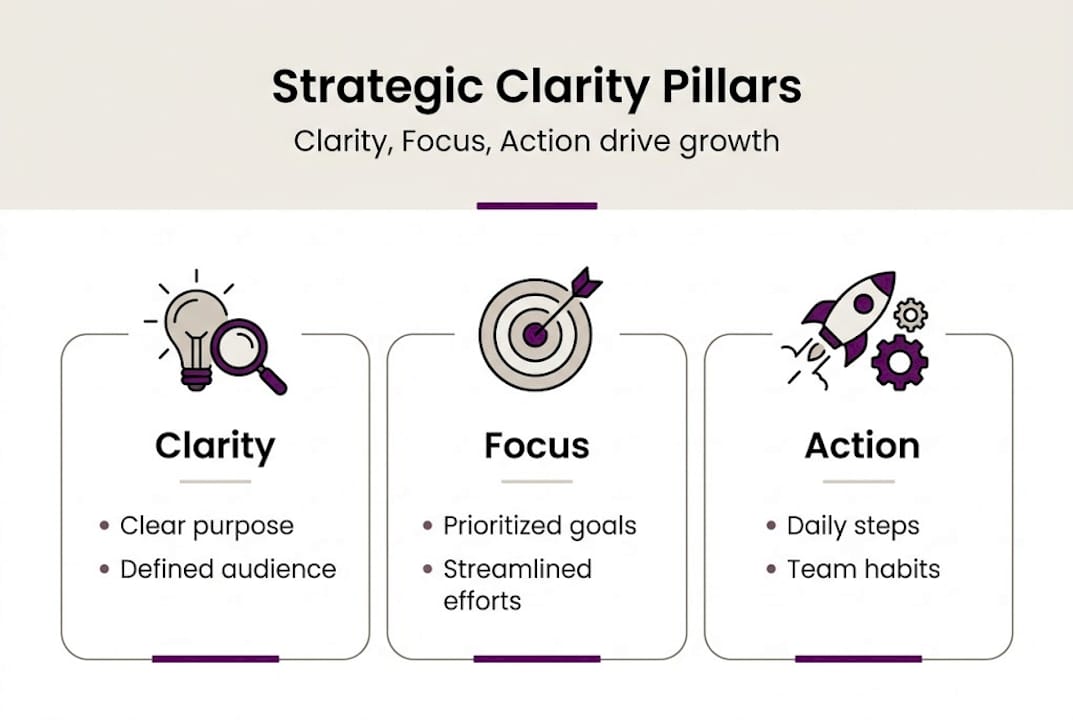
Strategic clarity is built on Clarity, Focus, and Action for small teams. These three pillars are not independent. They reinforce each other, and neglecting any one of them weakens the whole structure.

The brand clarity framework maps directly onto these pillars. Here is how each one functions and what happens when it breaks down:
| Pillar | Role in your business | Risk if neglected |
|---|---|---|
| Clarity | Defines who you serve and why your work matters | Vague positioning, inconsistent messaging |
| Focus | Narrows your energy to the highest-value activities | Scattered effort, slow progress, burnout |
| Action | Converts understanding into specific, timed next steps | Analysis paralysis, missed opportunities |
To audit your current approach using these pillars, follow these steps:
- Write your core customer problem in one sentence. If you cannot do this without qualifiers, your Clarity pillar needs work.
- List your top three priorities for this week. If they do not connect directly to your customer problem, your Focus is off.
- Identify one specific action you will complete in the next 48 hours. If you cannot name it, your Action pillar is missing.
- Ask a team member or peer to repeat your positioning back to you. The gap between what they say and what you intended reveals your clarity deficit.
- Review last month’s decisions. Count how many were reactive versus intentional. A high reactive count signals weak strategic clarity overall.
Pro Tip: After any major setback or pivot, run through these five steps before doing anything else. It takes less than 30 minutes and resets your direction faster than any planning session.
Creative entrepreneurship tips often emphasize action, but action without clarity and focus is just motion. The three pillars only work together.
Avoiding the pitfalls: Over-clarity, false clarity, and ambiguity
Clarity is powerful. But over-clarity can cause fragility in uncertain environments, and false clarity leads to confusion. Knowing the difference between genuine clarity and its counterfeits is a practical skill.
False clarity happens when a team agrees on words but not on meaning. Everyone nods at “we serve purpose-driven entrepreneurs,” but each person imagines a different customer. The language sounds clear. The understanding is not.
Over-clarity happens when you define every process, rule, and decision tree so tightly that the team cannot adapt when conditions change. This is common in solo businesses that scale too fast without building flexibility into their systems.
Here is a comparison of symptoms and risks:
| Condition | Symptoms | Risk |
|---|---|---|
| Over-clarity | Rigid processes, slow adaptation, rule-following over judgment | Fragility when markets shift |
| False clarity | Surface agreement, repeated misalignments, inconsistent output | Wasted effort, eroded trust |
| Healthy ambiguity | Flexible principles, judgment-based decisions, fast pivots | Occasional inconsistency, manageable |
Common signs your current plan suffers from ambiguity or confusion:
- You explain your offer differently in every sales conversation.
- Your team asks for approval on decisions that should be routine.
- Your marketing message changes every quarter without a strategic reason.
- You feel busy but cannot point to clear progress toward a defined goal.
Pro Tip: Use intentional ambiguity in areas where conditions change fast, such as pricing experiments or new market entry. Keep firm clarity on your core customer and core problem. This combination gives you agility without losing direction.
Founder dependency grows directly from unclear strategy. When only the founder understands the real direction, every decision flows back to one person. The brand clarity checklist helps teams identify where clarity is solid and where it is assumed. Use it to clarify business vision before confusion becomes a structural problem.
Putting strategic clarity to work: Practical frameworks and daily habits
Strategic clarity enhances customer fit and drives brand alignment with tools like the purpose pyramid and 7 core questions. These are not abstract concepts. They are practical tools you can use in your next team meeting or customer conversation.
The 7 essential questions for strategic clarity are:
- What specific problem do we solve?
- Who experiences this problem most acutely?
- Why does our approach work better for them than alternatives?
- What does success look like for our customer in 90 days?
- What is the one thing we must not compromise on?
- What would we stop doing if we had to cut 30% of our activities?
- How does our work connect to a larger purpose beyond revenue?
Answering these questions regularly keeps your strategy grounded in reality, not assumption.
Daily and weekly habits that maintain clarity:
- Start each week by restating your core customer problem. Write it in one sentence. If it shifts, investigate why.
- End each day with a single priority for tomorrow. One clear next step beats a long to-do list.
- Review customer feedback weekly. Look for language your customers use that you are not using in your own messaging.
- Run a monthly clarity check using the 7 questions above. Note what has changed and what has not.
- Schedule a quarterly strategy review to assess whether your focus and actions still match your core purpose.
Pro Tip: Build the 7 questions into your team meetings as a standing agenda item. Even a five-minute review keeps everyone aligned without requiring a full strategy session.
Clarifying brand purpose is not a one-time event. It is a recurring practice. Action planning for entrepreneurs works best when it connects directly to a clear strategic foundation. And balancing business priorities becomes easier when you know which priorities actually matter.
A fresh perspective: Why strategic clarity is your best insurance against uncertainty
Conventional wisdom treats strategy as a plan you build once and follow. That framing is wrong for most solo entrepreneurs and small teams. Markets shift. Customers change. Your own understanding deepens over time.
The most adaptable purpose-driven teams are not the ones with the most detailed plans. They are the ones with the deepest clarity for growth. When you know your core customer and your core purpose with precision, you can change tactics without losing direction. That is real resilience.
Strategic clarity does not prevent change. It gives you the orientation to navigate change without panic or drift. Think of it less as a destination and more as a compass you recalibrate regularly.
The uncomfortable truth is that most uncertainty in small businesses is not external. It is internal. It comes from not knowing clearly enough who you serve and why. Fixing that is not a planning exercise. It is a clarity practice. Start there, and the rest of your strategy becomes easier to build and easier to adjust.
How to accelerate clarity in your business
If the frameworks and habits in this article resonated with you, the next step is applying them with structure and support.

Starfireblast is built specifically for solo entrepreneurs and small teams who want to move from confusion to clarity without burning out or outsourcing their direction. The Customer StarMap™ Power Workshop is a focused, facilitated experience that helps you define your customer, sharpen your positioning, and build a strategic foundation you can act on immediately. Explore the full range of Starfireblast solutions to find the right entry point for where you are right now. Clarity is not a luxury. It is the starting point for everything that follows.
Frequently asked questions
How does strategic clarity help solo entrepreneurs grow?
Strategic clarity enhances customer understanding for small teams, making it easier to align actions with purpose and build focused growth plans without wasted effort.
What are the biggest risks of not having strategic clarity?
Founder dependency and confusion result from unclear strategy, leading to brand misalignment, scattered priorities, and teams that cannot function without constant direction from one person.
Should my strategy leave space for ambiguity?
Yes. Some strategic ambiguity prevents fragility in uncertainty, allowing your team to adapt and make judgment-based decisions when conditions shift quickly.
What questions help define true strategic clarity?
Clarity comes from answering seven core questions about the problem you solve, who you solve it for, why your approach works, and how you deliver unique value.
How often should I review my strategy for clarity?
Review your strategic clarity at least quarterly or immediately after any major shift in your business model, customer base, or market conditions.