Startup strategy for solo founders: 78% win faster
TL;DR:
- Strategy guides resource use, decision-making, and sustainable growth for solo founders.
- Effective frameworks like Lean Canvas and OKRs enable quick, focused planning and validation.
- Purpose-driven startups outperform traditional ones by building loyalty, resilience, and community trust.
Most solo founders believe the fastest path to traction is simply to build and ship. Move fast, figure it out later. But strategy in startups guides resource allocation, decision-making, and sustainable growth by aligning purpose, value creation, and scalable processes. Without it, you are not moving fast. You are moving in circles. This article covers evidence-backed frameworks, practical steps, and purpose-driven models that help solo entrepreneurs and small teams build businesses that last, not just businesses that launch.
Table of Contents
- Why strategy matters most for startups and solo founders
- Frameworks for effective startup strategy: What actually works
- Designing purpose-driven, sustainable startups: Moving beyond profit
- Getting it wrong: Pitfalls, myths, and what winners do differently
- Practical steps: One-page plans, execution habits, and leveraging AI
- Our take: Strategy is your startup’s greatest multiplier
- Accelerate your strategy with expert guidance
- Frequently asked questions
Key Takeaways
| Point | Details |
|---|---|
| Strategic clarity wins | Solo founders succeed faster with focused, actionable strategies guiding every decision. |
| One-page plans work best | Simple frameworks like Lean Canvas and OKRs help you move quickly without getting lost in details. |
| Purpose drives performance | Anchoring your strategy in purpose and community leads to sustainable, outsized growth. |
| Learn, test, adapt | Frequent validation and AI-powered iteration can give you the edge over larger, slower startups. |
Why strategy matters most for startups and solo founders
Hustle is visible. Strategy is not. That is why so many founders default to action over thinking. But the data tells a different story.
78% of companies fail to scale beyond $10M ARR because they lack strategic bridges between early traction and sustainable growth. Scaling stalls not from lack of effort, but from lack of direction. For solo founders, this gap is even more dangerous because there is no team to catch the drift.
Here is what strategy actually prevents for solo and small teams:
- Wasted time on the wrong customers. Without a clear positioning strategy, you spend months targeting people who will never buy.
- Feature overload. Building what feels useful instead of what solves a validated problem.
- Revenue delays. Solo founders with systematic lean planning achieve revenue in 90 days versus 8 or more months without a plan.
- Burnout from reactive decisions. Every day without a framework means every decision starts from scratch.
- Missed market timing. Strategy surfaces competitive windows. Without it, you often move too late.
“The resource-constrained founder benefits most from decisive planning. You cannot afford to test everything. Strategy tells you what to test first.”
For solo entrepreneurs, strategy is not a luxury. It is a force multiplier on limited time and energy. You do not need a 40-page business plan. You need a clear answer to three questions: Who are you building for? What problem does it solve? How does it create value that others cannot easily copy?
Exploring sustainable growth strategies built for small teams shows how founders use focused frameworks to move faster with fewer resources. The purpose-driven checklist is a practical starting point for founders who want clarity before complexity.
Pro Tip: Block two hours this week to answer those three questions in writing. You will make better decisions in the following two weeks than you did in the previous two months.
Frameworks for effective startup strategy: What actually works
Not all frameworks are built for solo founders. Many are designed for corporate teams with dedicated strategy departments. Here are the ones that actually work at your scale.
Key methodologies include the HBS Value Stick, McKinsey Three Horizons, Lean Canvas, and OKRs. Each serves a different purpose.
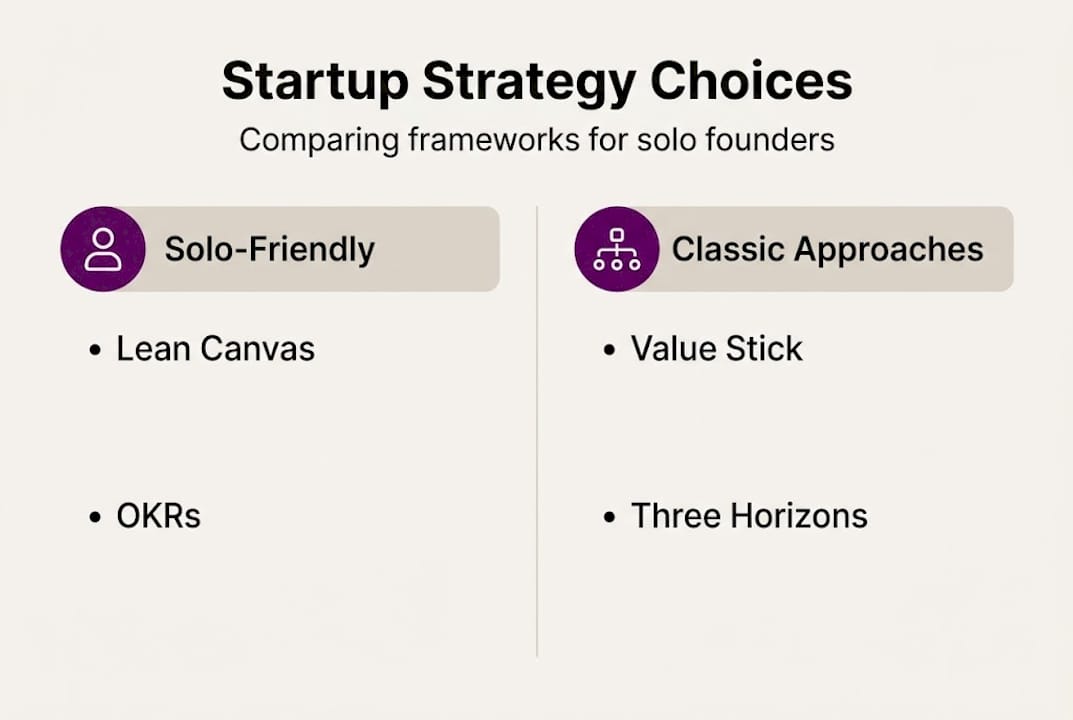
| Framework | Best for | Time to apply |
|---|---|---|
| HBS Value Stick | Pricing and customer value clarity | 2 to 3 hours |
| McKinsey Three Horizons | Balancing now vs. future innovation | Half day |
| Lean Canvas | One-page business model clarity | 1 to 2 hours |
| OKRs | Weekly and quarterly execution focus | 30 minutes |
Here is how to use each one as a solo founder:
- HBS Value Stick. Map the gap between what your customer is willing to pay and what it costs you to deliver. Widen that gap and you have a sustainable business model.
- McKinsey Three Horizons. Use the Three Horizons model framework to separate what you are doing today (Horizon 1), what you are building toward in 12 to 24 months (Horizon 2), and what you are exploring long-term (Horizon 3). Most solo founders only live in Horizon 1.
- Lean Canvas. One page. Nine boxes. Fill it in one sitting. It forces clarity on your problem, solution, unique value proposition, channels, and revenue model at once.
- OKRs. Limit yourself to two objectives per quarter. Each objective gets two to three measurable key results. More than that and nothing gets done.
- Minimum viable validation. Before building, test the assumption. A landing page, a short survey, or five customer conversations can save three months of development.
Pro Tip: Use the Lean Canvas as a living document. Revisit it monthly. If your answers have not changed at all, you are not learning. If they change every week, you are not focused.
For founders building with purpose at the center, building impactful businesses shows how these frameworks connect to real-world outcomes. Pairing them with mission-driven strategies adds the directional clarity that pure tactics often miss.
Designing purpose-driven, sustainable startups: Moving beyond profit
Profit is necessary. It is not sufficient. Startups that build around purpose tend to outperform those that do not, and the data is clear on this.

B-Corps outperform traditional companies by 28%, and purpose-driven firms see 52% achieving over 10% annual growth. These are not feel-good numbers. They reflect real market advantages: stronger customer loyalty, lower churn, and more resilient teams.
The triple bottom line model gives you a practical lens:
- People. How does your business improve the lives of customers, employees, and community members?
- Planet. What is the ecological footprint of your operations, supply chain, and product lifecycle?
- Profit. Is the business economically viable without extracting value from people or the environment?
Purpose-driven design is not just ethical. It is strategic. Here is why:
| Benefit | Traditional startup | Purpose-driven startup |
|---|---|---|
| Customer loyalty | Transactional | Values-based, higher retention |
| Team motivation | Salary-driven | Mission-driven, lower turnover |
| Community growth | Paid acquisition | Organic, word-of-mouth |
| Resilience | Market-dependent | Purpose-anchored, adaptable |
Circular economy models, impact SaaS products, and B-Corp certification are not just branding moves. They are structural choices that reduce dependency on paid advertising and build compounding community trust over time.
For solo founders, embedding purpose early means your positioning is harder to copy. A competitor can match your features. They cannot match your values, your community, or your story.
The purpose-driven business guide covers how to design this into your model from day one. The guide to sustainable growth breaks down what balanced, responsible growth looks like in practice.
Getting it wrong: Pitfalls, myths, and what winners do differently
Most startup advice is built around the myth that speed beats everything. Ship fast, break things, figure out strategy later. This works for well-funded teams with room to absorb mistakes. For solo founders, it is a fast path to wasted months.
“Champions pass 4 or more of McKinsey’s 10 Tests. Solo pitfalls include overbuilding, skipping validation, and making science-led choices that hurt short-term revenue but build long-term strength.”
Why great innovations fail to scale comes down to execution gaps, not idea gaps. The idea is rarely the problem. The missing link is a clear path from insight to repeatable action.
Here are the most common traps solo founders fall into:
- Overbuilding before validating. Spending 90 days on a product before confirming anyone wants it.
- Treating strategy as bureaucracy. Skipping planning because it feels slow, then spending months fixing avoidable mistakes.
- Chasing complexity. Adding features, channels, and audiences before mastering one of each.
- Ignoring edge cases. Edge cases as strategic assets for resilience show that the unusual customer or use case often reveals the most defensible market position.
- Confusing activity with progress. Posting daily, attending every event, and staying busy without a clear conversion goal.
What separates startups that break through? They make strategy resonate across every decision, not just in planning documents. Strategy becomes a filter, not a folder.
The business evolution explained resource shows how successful founders adapt without losing direction. And startup community growth evidence from 160,000 startups confirms that community-driven models consistently outperform ad-driven ones in retention and referral.
Practical steps: One-page plans, execution habits, and leveraging AI
You do not need a strategy consultant. You need a system. Here is a simple playbook built for solo founders and small teams.
Solo and small teams should use a one-page Lean Canvas plus OKRs, dedicate five hours per week to marketing, and use AI for validation and MVP testing. That is the baseline.
- Define your purpose. Write one sentence: who you serve, what problem you solve, and why it matters. This is your north star for every decision.
- Draft your Lean Canvas. Fill all nine boxes in one sitting. Do not overthink it. A rough draft beats a blank page.
- Choose one to two OKRs for the quarter. Each gets two to three measurable key results. Review them weekly.
- Block five hours per week for marketing and testing. Use this time to talk to customers, run small experiments, and review what is working. Consistency beats intensity.
- Use AI for validation. Tools like ChatGPT or Claude can simulate customer objections, generate survey questions, and help you stress-test your assumptions before you build.
- Start ultralight. The leanest version of your model that generates real feedback is more valuable than a polished product with no users.
Pro Tip: Use the founder marketing guide to structure your five weekly hours. It breaks down where solo founders get the most traction with the least effort.
For founders who want to connect strategy to brand identity, purpose in branding is a direct next step. And business sustainability fundamentals covers the operational layer that supports long-term viability.
Our take: Strategy is your startup’s greatest multiplier
Most advice tells solo founders to move faster. We think that is the wrong instruction. The real edge is moving clearer.
The founders who win are not the ones who ship the most. They are the ones who know exactly who they are building for and why, and they use that clarity to filter out everything else. Strategy is not a planning exercise. It is a decision-making filter that runs every day.
Ultralight plans beat complex ones every time at the solo scale. A one-page Lean Canvas you actually use is worth more than a 30-slide deck you revisit once a quarter. The discipline is not in the document. It is in the habit of asking: does this decision move us toward the goal or away from it?
Feedback and fit matter more than speed and size. The founders who break through are not the fastest. They are the most responsive to what the market is actually telling them. That responsiveness comes from having a clear baseline to measure against, which is exactly what a simple strategy gives you.
Exploring purpose-driven impact shows how this plays out in real businesses built with clarity at the center.
Accelerate your strategy with expert guidance
Reading about strategy is a start. Applying it with structure is where real progress happens.
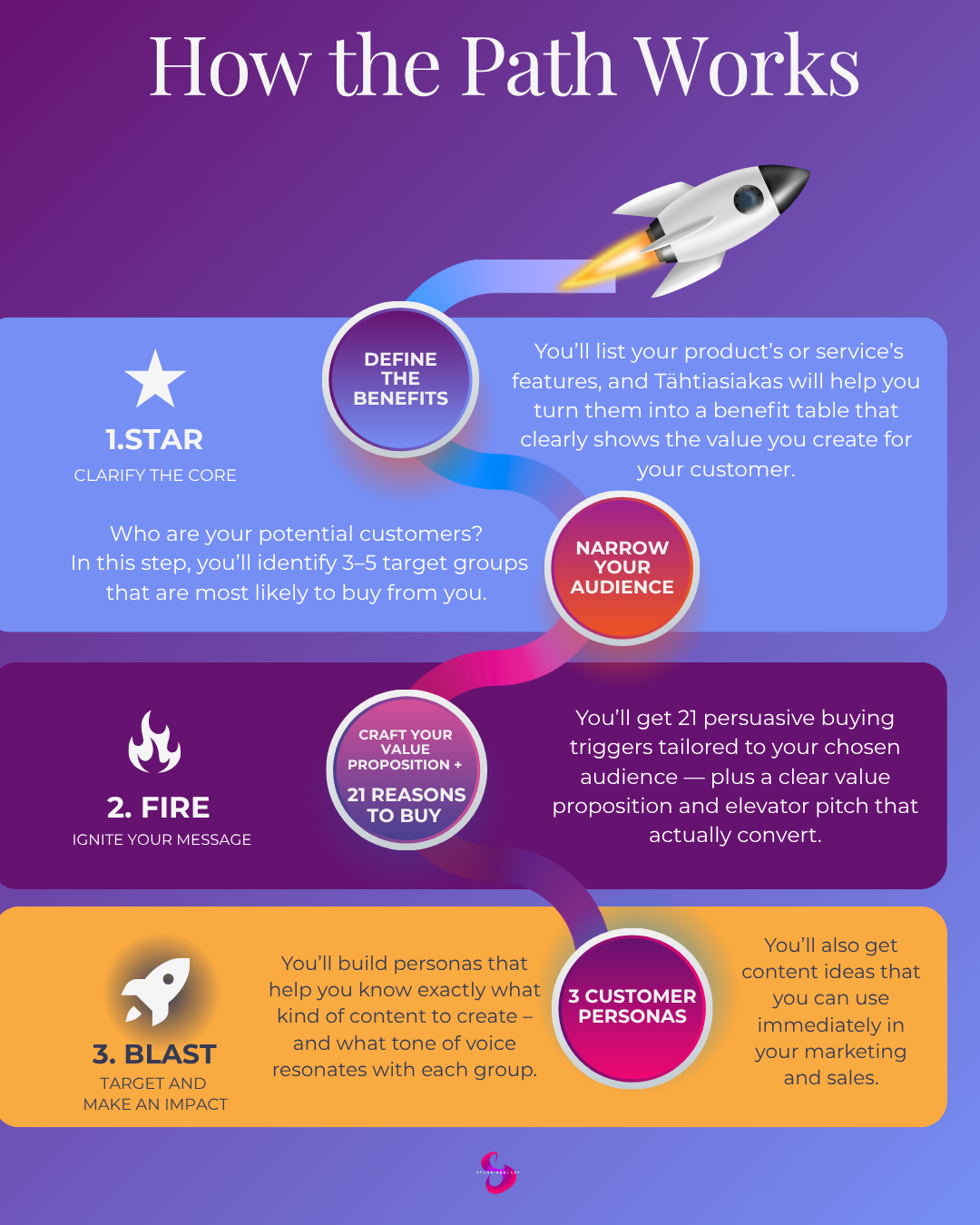
The Customer StarMap™ strategy workshop on Starfireblast is built specifically for solo founders and small teams who want to move from idea to clear, executable strategy without the noise. It combines customer understanding, positioning clarity, and practical frameworks into a focused session that replaces months of guesswork. If you are ready to stop reacting and start building with direction, this is the next step. Strategy does not have to be complex. It has to be clear.
Frequently asked questions
What is the main role of strategy in a startup?
Strategy in startups aligns limited resources with a clear purpose, guiding decisions for sustainable growth and faster learning. It is the framework that prevents reactive, costly trial and error.
Which strategic frameworks are best for solo entrepreneurs?
Lean Canvas, OKRs, and the HBS Value Stick are proven frameworks tailored for solo founders seeking simplicity and focus. They are fast to apply and easy to revisit as your business evolves.
How does purpose-driven strategy boost performance?
Purpose-driven startups that focus on people, planet, and profit outperform conventional companies in both growth rate and long-term sustainability. The 28% outperformance of B-Corps reflects structural, not just cultural, advantages.
What are the most common strategic mistakes in early startups?
Solo founders often overbuild and skip validation, pursuing complexity instead of actionable focus. This leads to slow or stalled growth that feels like a product problem but is actually a strategy problem.
Can AI support effective startup strategy and execution?
Yes. AI for validation and MVP testing helps solo founders iterate fast and cheaply, reducing the cost of learning before committing to a full build.
Recommended
- Founder-led strategy: how hands-on leadership drives growth – Starfireblast
- Startup community growth: 160,000 startups prove it works – Starfireblast
- 6 Creative Entrepreneurship Tips for Solopreneurs – Starfireblast
- Founder Vision Drives 40% More Community Growth in 2026 – Starfireblast
- Strategy - 40Q