Role of Mission in Branding: Building Authentic Impact
Every business founder eventually faces the struggle to stand out while staying true to their purpose. In Central Europe, where authenticity and long-term commitment earn trust, your brand mission is the foundation connecting every choice and conversation. This guide unpacks what a real mission means, how it shapes branding decisions, and why integrating it across your organization builds resilience and genuine loyalty.
Table of Contents
- Defining Brand Mission And Its Importance
- Types Of Brand Missions And Key Differences
- Integrating Mission Into Everyday Branding
- Common Pitfalls And How To Avoid Them
- Mission-Driven Strategies For Sustainable Growth
Key Takeaways
| Point | Details |
|---|---|
| Importance of a Brand Mission | A clear brand mission articulates purpose, values, and goals, helping attract customers aligned with those values. |
| Differentiation and Consistency | Your mission differentiates you in crowded markets and ensures consistency in your messaging and operations. |
| Types of Brand Missions | Understanding whether your mission is functional, emotional, or transformational helps tailor your approach to resonate with your audience. |
| Integration Across Touchpoints | A mission should be visibly integrated into every aspect of your branding and operations to build trust and loyalty. |
Defining Brand Mission and Its Importance
Your brand mission answers a fundamental question: why does your business exist?
It’s not about what you sell. It’s about the change you want to create in the world. A mission articulates purpose, values, and goals that customers actually care about.
For solo entrepreneurs and small teams, this matters more than you might think. Your mission becomes the thread connecting every decision you make.
Why Mission Matters More Than You’d Expect
A clear mission does several things at once:
-
Attracts the right customers. People buy from businesses aligned with their values, not just products or services.
-
Guides your team and yourself. When you’re tired or uncertain, mission reminds you why you started.
-
Differentiates you in noisy markets. Competitors can copy your product. They can’t copy your authentic purpose.
-
Creates consistency. Your messaging, pricing, partnerships, and content all flow from one source of truth.
A clear mission serves as the backbone of your business, providing both direction and motivation that resonates with customers who share similar values.
Your mission is what separates a sustainable business from one that burns out chasing every trend.
Mission vs. Tactics: The Critical Difference
Here’s where many entrepreneurs get stuck. They confuse mission with their current business model or marketing strategy.
Your mission is permanent. Your tactics change constantly. If your market shifts or your audience evolves, tactics adapt but mission remains.
This distinction matters especially for understanding why purpose matters in branding when you’re building something that lasts longer than the next quarterly goal.
What a Real Mission Looks Like
A solid mission statement:
-
States the change or impact you want to create (not the product itself)
-
Reflects your core values and non-negotiables
-
Addresses a real problem your audience experiences
-
Feels authentic to you and your team (not borrowed from competitors)
It doesn’t need to be perfect prose. It needs to be true.
Pro tip: Write your mission by answering this: “I do this because the world needs…” The answer to that question is your starting point for authentic branding that actually connects with people who value what you value.
Types of Brand Missions and Key Differences
Not all missions look the same. Different businesses need different mission types based on what they’re trying to achieve and how they want to connect with their audience.
Understanding these categories helps you choose what actually works for your situation. You’re not building a generic mission—you’re building one that fits your specific goals and values.
The Three Main Mission Types
Missions fall into distinct categories based on their primary focus:
-
Functional missions focus on what you do and how you solve a practical problem. These appeal to customers who value efficiency, reliability, and tangible results.
-
Emotional missions focus on how you make people feel and the values you share with your audience. These create deeper connections with customers who care about belonging and meaning.
-
Transformational missions focus on the bigger change you want to create in society or culture. These attract customers and team members who see themselves as part of a movement.
Most successful brands actually blend all three, but they lead with one.
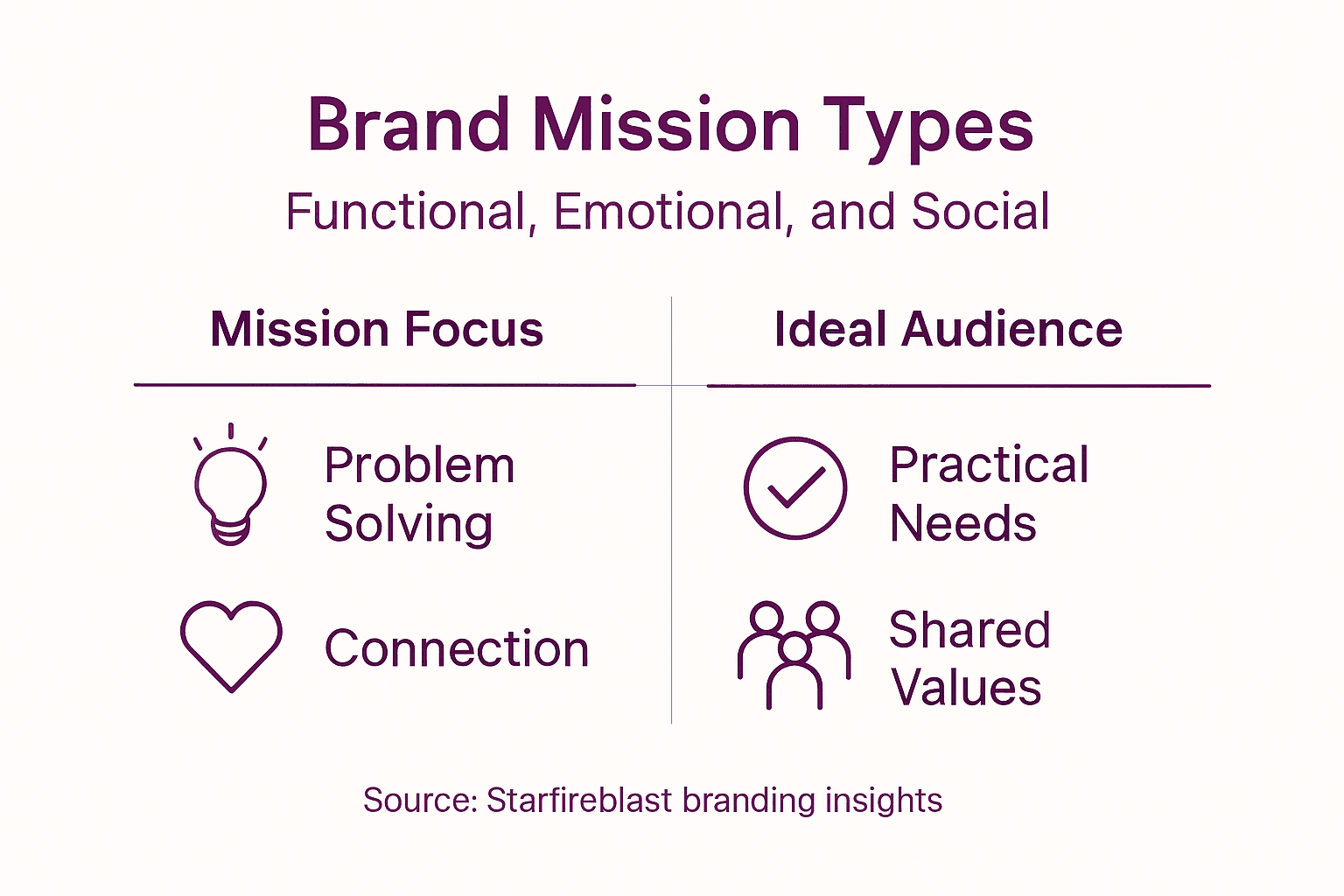
Below is a summary of the main brand mission types and how they relate to audiences:
| Type | Core Focus | Ideal Audience | Example Motivation |
|---|---|---|---|
| Functional | Solving practical problems | Value reliability/efficiency | “Get things done better” |
| Emotional | Shared values, belonging | Seek connection/meaning | “Feel part of a community” |
| Transformational | Broad positive change | Want to create an impact | “Join a movement for good” |
Why Mission Type Matters for Your Branding
Your mission type directly shapes how you communicate, who you attract, and what partnerships make sense.

A functional mission works well if you’re solving a concrete problem efficiently. An emotional mission works if people choose you because of shared values. A transformational mission works if you’re asking people to be part of something larger.
The research shows that missions vary by organizational goals and stakeholder engagement, meaning your specific context determines which approach resonates most with your audience.
Choosing the wrong type wastes energy on messaging that doesn’t connect.
Mission vs. Vision: A Critical Distinction
Your mission is what you do now to create value. Your vision is what you’re working toward in the future.
Think of mission as concrete plans for achieving your vision. Missions focus on present operations while vision addresses future direction, which means they need different language and different communication strategies.
Many entrepreneurs mix these up, creating confusion in their messaging.
Here’s how mission, vision, and tactics differ:
| Aspect | Mission | Vision | Tactics |
|---|---|---|---|
| Time Horizon | Present-focused, ongoing | Future-oriented, long-term goals | Short-term, adaptable actions |
| Primary Role | Expresses brand purpose | Describes desired future state | Details steps to reach goals |
| Adaptability | Rarely changes, stable | May evolve with ambition | Changes frequently |
| Communication | Action-driven, practical messaging | Inspirational, aspirational messaging | Specific instructions |
Your mission is action-oriented. Your vision is aspirational. Both matter, but they serve different purposes.
Identifying Your Mission Type
Here’s a quick exercise:
Write down why your customers actually choose you. Are they picking you because:
-
You solve a specific problem better than others?
-
They share your values and feel part of something?
-
They believe in the larger change you’re creating?
Your answer reveals your natural mission type. Build from there instead of forcing a type that doesn’t fit your reality.
Pro tip: Document your mission type explicitly and share it with your team. When everyone knows whether your mission is primarily functional, emotional, or transformational, all your decisions—from pricing to partnerships to content—become clearer and more consistent.
Integrating Mission Into Everyday Branding
Having a mission statement means nothing if it stays locked in a document. Real integration means your mission shows up in every decision, every piece of communication, and every interaction your audience has with your brand.
This is where most solo entrepreneurs and small teams struggle. They write a mission, then operate like it never existed. The gap between stated values and actual practice destroys credibility faster than almost anything else.
Where Mission Lives in Your Brand
Your mission needs to appear consistently across all touchpoints:
-
Visual identity. Colors, fonts, imagery, and design choices should reflect your mission’s spirit.
-
Messaging and copy. Every email, social post, and conversation should trace back to your core purpose.
-
Product or service delivery. How you actually work matters more than what you say.
-
Hiring and team culture. Who you bring on and how you treat them reveals your real mission.
-
Partnerships and collaborations. Who you work with signals what you actually stand for.
Consistent application across all organizational touchpoints ensures your brand’s core purpose is visible and reinforced continuously to both internal and external audiences. When mission appears everywhere, it builds authentic loyalty instead of skepticism.
The Problem With Selective Consistency
Many entrepreneurs show their mission in marketing but ignore it in operations. They talk about sustainability while using wasteful packaging. They claim community focus while providing poor customer support.
Your audience notices these contradictions immediately. Trust evaporates.
Authentic integration means your mission guides decisions when no one’s watching, not just when you’re in front of customers.
When building your brand strategy, using your mission as a guiding star for all messaging ensures alignment with your organization’s core purpose and maintains authenticity over time.
Practical Integration Steps
Start here:
-
Write down your mission in plain language, not corporate speak.
-
Audit current practices. Where does your mission actually show up? Where does it vanish?
-
Identify one change. Pick one touchpoint where integration is weakest and strengthen it first.
-
Involve your team. Ask them how they see mission reflected (or not) in daily work.
-
Create a checklist. Before major decisions, ask: Does this align with our mission?
Integration doesn’t happen overnight. Start small and expand from there.
Mission Integration and Community Building
When people experience your mission consistently, they become advocates. They see themselves as part of something meaningful, not just customers of a business.
This is especially powerful in Central Europe, where people value transparency and authenticity over slick marketing. Your mission integration either proves you’re genuine or proves you’re performing.
Building authentic community means creating community-driven brands that demonstrate your values through consistent action rather than polished words alone.
Pro tip: Assign one person (could be you) responsibility for “mission coherence checks.” Before launching any major marketing piece, partnership, or internal policy change, ask them: Does this contradict our mission? This single accountability measure prevents drift better than anything else.
Common Pitfalls and How to Avoid Them
Mission-driven branding fails not because the mission is weak, but because entrepreneurs make predictable mistakes during execution. Knowing these pitfalls ahead of time saves you months of wasted effort and credibility damage.
Most of these mistakes stem from one root cause: assuming your mission speaks for itself. It doesn’t. It needs intentional, consistent communication and alignment across everything you do.
Pitfall 1: Neglecting Your Actual Audience
You define a beautiful mission, then market it to everyone. Generic messaging reaches no one.
Your mission only matters if it resonates with people who actually care. Deeply understanding audience needs prevents the mistake of pushing a message no one wants to hear, which wastes both time and credibility.
Before launching any mission-based messaging, identify exactly who benefits from your purpose. What problem does your mission solve for them? Why should they care?
Specificity wins. Vagueness loses.
Pitfall 2: Inconsistency Across Channels
You talk about sustainability on your website but use single-use packaging. You claim customer-first values while making customers jump through hoops to get support.
Inconsistency destroys trust faster than outright dishonesty. People forgive mistakes. They don’t forgive hypocrisy.
Maintaining uniform visual and verbal branding ensures your mission shows up coherently everywhere your audience encounters your brand. This means auditing everything regularly.
One contradiction in your operations cancels out a hundred marketing messages.
Pitfall 3: Forgetting the Story
Mission statements are abstract. Stories are concrete. People connect with stories, not bullet points.
Your mission needs a narrative. Why does it matter to you personally? What experience led you to this purpose? What transformation do customers experience?
Without storytelling, your mission feels corporate and hollow, even if it’s authentic.
Common Mistakes to Watch For
-
Making it about you instead of your audience. Your mission solves their problem, not yours.
-
Changing direction constantly. Consistency builds recognition; frequent pivots destroy it.
-
Focusing only on sales. Relationship building and mission alignment matter more than immediate revenue.
-
Ignoring feedback. Your audience will tell you if your mission resonates. Listen.
The Integration Test
Here’s how to catch pitfalls before they damage your brand:
-
Review one piece of content. Check if your mission is clearly visible in the narrative and values expressed.
-
Ask a customer. Without prompting, can they articulate why your mission matters?
-
Check your operations. Does how you actually work reflect what you claim?
-
Listen to your team. Do they see your mission in daily decisions, or just in marketing materials?
If any answer feels weak, you’ve found a pitfall to address.
Pro tip: Schedule a quarterly “mission audit” where you review 3-5 customer touchpoints (website, email, product experience, support interactions) and grade each one on how clearly your mission comes through. This one recurring practice catches drift before it becomes damage.
Mission-Driven Strategies for Sustainable Growth
Sustainable growth and mission-driven business aren’t opposites. They’re deeply connected. When you build growth strategies rooted in authentic purpose, you create something that lasts instead of something that burns out.
The key difference is thinking long-term. Quick wins feel good temporarily. Sustainable growth compounds over years because it’s built on real value and genuine connection with your audience.
Alignment Creates Sustainability
Sustainable growth starts with aligning your mission across every layer of your organization. Mission-driven objectives embedded in policies that support career flexibility and professional growth ensure your team stays engaged and committed to your purpose.
When your team understands how their work connects to your mission, they make better decisions. They’re motivated by more than a paycheck. They become stakeholders in the outcome.
Sustainable growth comes from people who believe in what they’re building, not just people executing tasks.
The Three Pillars of Mission-Driven Growth
Building sustainability requires balance across three areas:
-
People and culture. Invest in team development, flexibility, and recognition beyond just sales metrics. Burned-out teams kill growth.
-
Authentic storytelling. Share the real impact you’re creating, not inflated claims. Trust builds slowly and breaks quickly.
-
Systems and consistency. Build repeatable processes that reflect your mission. Don’t rely on heroic individual effort.
When all three are strong, growth becomes self-reinforcing. Your reputation attracts better customers and team members. Those people help you grow further.
Why This Matters in Central Europe
Central European audiences value stability, authenticity, and long-term thinking over flashy short-term gains. They’re skeptical of hype and responsive to genuine purpose.
Mission-driven businesses that build sustainable growth often outcompete larger competitors in this region because they offer something more valuable: trustworthiness and genuine impact.
Understanding mission-driven startups that fuel sustainable impact helps you see what’s actually working in your market.
Building Your Growth Strategy
Start with these concrete steps:
-
Map your mission to business outcomes. How does your purpose directly create customer value?
-
Define success beyond revenue. Include customer satisfaction, team retention, and actual impact metrics.
-
Make mission decisions visible. When you choose a partner or launch a product based on mission alignment, explain why.
-
Measure what matters. Track metrics that reflect both business health and mission fulfillment.
-
Adjust based on feedback. Listen to your audience and team about whether growth strategies feel authentic.
Sustainable growth takes longer than aggressive scaling. But it’s the kind that survives market shifts and sustains you personally.
Pro tip: Create a simple “mission impact scorecard” tracking 3-4 metrics that matter (customer retention, team satisfaction, actual lives impacted, financial health). Review quarterly. This forces you to optimize for sustainability rather than just revenue, which is the difference between a business that lasts and one that burns out.
Elevate Your Brand Mission with Purpose-Driven Clarity
Many entrepreneurs struggle with making their mission more than just words on a page. You might feel the frustration of seeing your values disconnected from daily decisions or messaging that does not truly resonate with your audience. This challenge of mission integration and authenticity can hold back sustainable growth and genuine impact.
At Starfireblast, we understand how critical it is to clarify who you are building for and why it matters before scaling marketing or sales. Our platform supports solo entrepreneurs and small teams in transforming their brand mission into consistent action through customer understanding, brand clarity, and practical AI-assisted tools. If burnout and noise from generic strategies have slowed you down, Starfireblast offers a clear path forward that honors your authentic purpose.
Discover how to embed your mission into every part of your brand and community by visiting Starfireblast. Align your messaging, operations, and growth strategy to build lasting connections and thrive sustainably. Take the first step now toward owning a mission-driven brand with Brand and Strategy Clarity and practical tools designed specifically for meaningful impact. Start your journey at https://starfireblast.com and create a brand that truly lives its mission.
Frequently Asked Questions
What is the significance of having a clear brand mission?
A clear brand mission articulates the purpose, values, and goals of your business, helping to attract the right customers, guide decision-making, and differentiate you in a competitive market.
How can a brand effectively integrate its mission into everyday operations?
A brand can integrate its mission by ensuring that all touchpoints—such as visual identity, messaging, product delivery, and employee culture—reflect its core purpose consistently.
What types of brand missions exist and how do they differ?
There are three main types of brand missions: functional (focused on solving practical problems), emotional (centered on feelings and shared values), and transformational (aimed at creating broader societal change). Each type attracts different audiences based on their needs and motivations.
How does a brand’s mission contribute to sustainable growth?
A brand’s mission contributes to sustainable growth by aligning team and organizational values around a shared purpose, leading to better decision-making, genuine customer connections, and stronger community engagement.