Purpose-driven strategy guide for entrepreneurs 2026
You’ve probably heard the myth that building a purpose-driven business means sacrificing profit. That’s not true. Purpose-driven strategy integrates your mission with business growth, creating sustainable success without burnout. This guide provides clear definitions, practical frameworks, and real examples to help you align authentic purpose with measurable results.
Table of Contents
- Understanding Purpose-Driven Strategy
- How Purpose-Driven Strategy Drives Sustainable Business Growth
- Common Misconceptions About Purpose-Driven Strategy
- Frameworks And Mental Models To Develop Purpose-Driven Strategies
- Avoiding Burnout Through Purpose-Driven Strategy
- Real-World Case Studies Illustrating Purpose-Driven Strategy
- Practical Steps To Implement A Purpose-Driven Strategy
- Discover Tools To Build Your Purpose-Driven Business
- Frequently Asked Questions
Key takeaways
| Point | Details |
|---|---|
| Purpose-driven strategy balances social, environmental, and economic goals | It integrates mission into core operations rather than treating purpose as an afterthought. |
| It drives sustainable growth and customer loyalty | Authentic purpose builds brand equity and differentiates you from competitors. |
| Common myths include sacrificing profit or confusing purpose with cause marketing | True purpose enhances profitability and embeds into daily business decisions. |
| Frameworks like the 3 Ps help implement authentic purpose | People, Planet, Profit provides a balanced mental model for strategy development. |
| Aligning purpose helps avoid burnout and build motivation | Clear mission creates meaning in daily work and sustainable business rhythms. |
Understanding purpose-driven strategy
Purpose-driven strategy means building your business around a clear mission that addresses real problems for your target audience while creating positive social and environmental impact. Unlike traditional profit-only approaches, this integrates what you stand for into every decision.
The difference matters. Traditional strategies optimize for short-term gains. Purpose-driven approaches balance immediate needs with long-term value for customers, communities, and the planet. This isn’t about choosing between profit and purpose. It’s about recognizing that sustainable business practices enhance both.
The 3 Ps framework — People, Planet, Profit gives you a practical mental model. People focuses on your customers and community impact. Planet addresses environmental responsibility. Profit ensures economic viability. When balanced, these create resilient businesses that meet modern market demands and ethical expectations.
Every entrepreneur should clarify these elements:
- Who you’re building for and why their problems matter
- Your core mission beyond making money
- Specific impact areas where you create positive change
- How you measure success across all three dimensions
- Daily practices that embed purpose into operations
This foundation helps you build what matters. Understanding purpose-driven business definition clarifies how mission and growth connect. When you integrate purpose in branding, you attract customers who share your values.
How purpose-driven strategy drives sustainable business growth
Purpose builds authentic customer loyalty because people buy from businesses they believe in. When your mission resonates, customers become advocates. They return, refer others, and pay premium prices for meaningful value.

This strengthens brand equity in ways traditional marketing can’t match. You differentiate based on what you stand for, not just what you sell. Competitors can copy products. They can’t replicate authentic purpose embedded in your culture and operations.
Profitability follows when you deliver purposeful value. Customers reward businesses that align with their values. Employees stay longer and work harder when connected to meaningful missions. Operational efficiency improves when decisions align with clear principles.
The purpose and growth connection works through specific mechanisms. Clear mission attracts ideal customers who need exactly what you offer. It guides product development toward real problems worth solving. It builds trust that converts casual buyers into loyal community members.
You can measure this growth through:
- Customer retention rates and lifetime value increases
- Net Promoter Scores reflecting brand advocacy
- Organic referral rates from satisfied customers
- Premium pricing power compared to generic alternatives
- Employee engagement and reduced turnover costs
These metrics prove purpose drives market success. The key is authenticity. Superficial claims erode trust. Genuine commitment builds lasting competitive advantage.
Common misconceptions about purpose-driven strategy
Many entrepreneurs believe purpose sacrifices profit and growth. This misconception stems from confusing authentic purpose with inefficient operations. Well-executed purpose-driven strategies enhance financial outcomes by creating differentiation and loyalty.
Another myth treats purpose as one-off cause marketing campaigns. Donating profits to charity or supporting social causes matters, but that’s not strategy. True purpose integrates into core business operations, product design, and customer relationships. It’s who you are, not what you sponsor.
Distinguishing purpose-driven strategy from superficial marketing requires examining consistency. Does your purpose guide daily decisions? Do customers experience it in every interaction? If purpose only appears in marketing copy, you’re doing cause marketing, not building authentic strategy.
Transparency and consistent communication separate real purpose from performative gestures. Customers spot inauthenticity instantly. When you claim values but act differently, trust evaporates. When you live your mission visibly, community grows.
Misunderstanding leads to two failure modes:
- Shallow marketing that promises purpose but delivers generic products
- Overcorrection that prioritizes ideals while ignoring business viability
- Inconsistent messaging that confuses customers about what you stand for
- Fear of stating clear values to avoid alienating potential customers
“Purpose-driven strategy isn’t about being everything to everyone. It’s about being exactly what you stand for to the people who need it most.”
The solution balances authentic commitment with business fundamentals. You can care deeply about impact while building profitable, sustainable operations. These aren’t opposing goals.
Frameworks and mental models to develop purpose-driven strategies
The 3 Ps framework provides a starting point for balanced strategy. People asks who benefits from your work and how. Planet examines environmental impact and resource stewardship. Profit ensures economic sustainability to continue creating value.
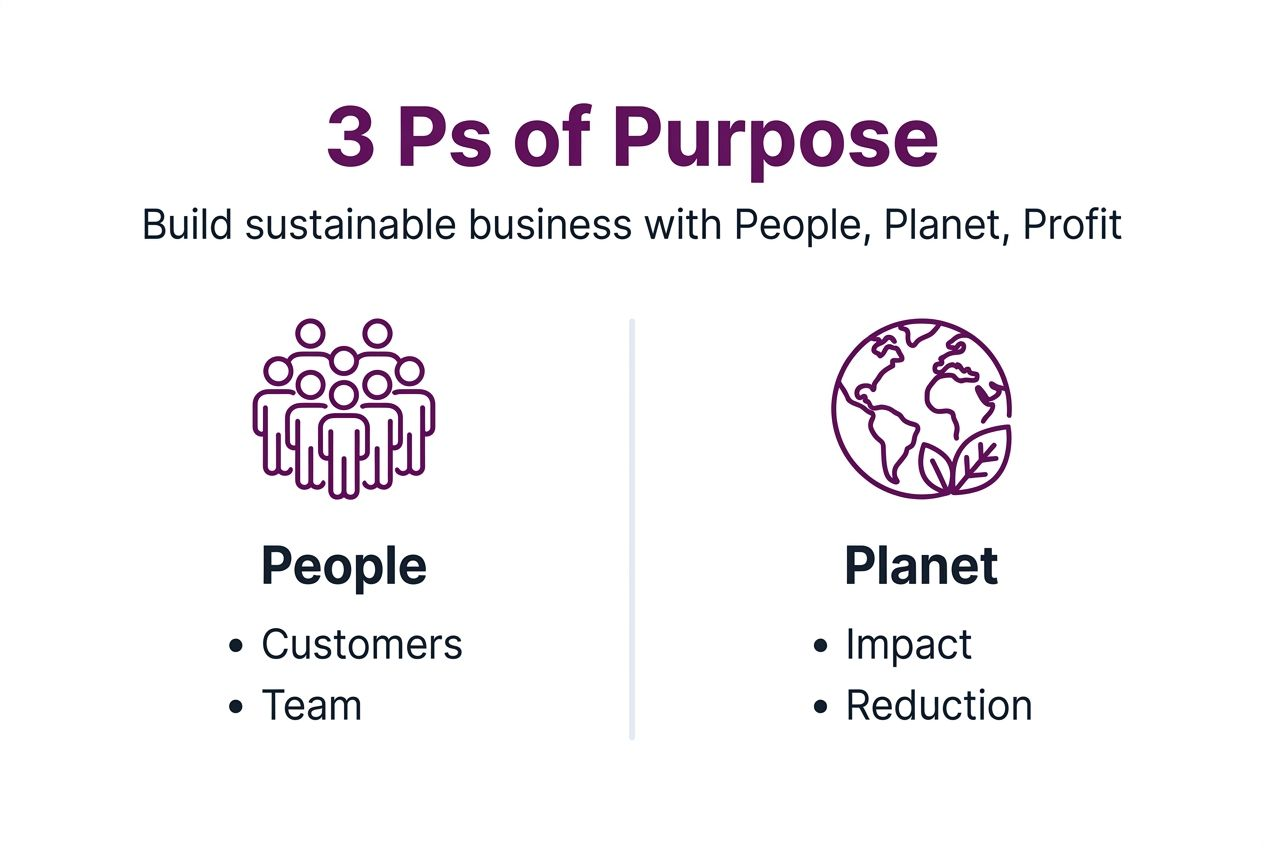
Applying this framework means setting specific, measurable goals in each area. For People, define target audience problems you solve and community impact you create. For Planet, identify how you minimize harm and contribute to ecological health. For Profit, establish revenue goals that fund continued purpose delivery.
A practical mental model for developing strategy:
- Clarify your core purpose by identifying the change you want to create
- Map how that purpose serves your target audience’s real needs
- Define measurable outcomes across People, Planet, and Profit dimensions
- Identify daily practices and decisions that embed purpose into operations
- Create feedback loops to assess impact and adjust strategy
This table contrasts purpose-driven strategy with superficial approaches:
| Aspect | Purpose-Driven Strategy | Superficial Marketing |
|---|---|---|
| Integration | Embedded in core operations and decisions | Limited to campaigns and messaging |
| Consistency | Guides all business activities | Appears only in external communications |
| Measurement | Tracks impact across People, Planet, Profit | Focuses solely on revenue metrics |
| Customer relationship | Builds community through shared values | Transactional based on product features |
| Long-term viability | Creates sustainable competitive advantage | Risks authenticity gaps and distrust |
Steps for developing your strategy:
- Interview customers to understand their values and problems deeply
- Define your mission statement focusing on the change you create
- Set specific goals for social impact, environmental stewardship, and profitability
- Design products and services that deliver on all three dimensions
- Communicate purpose transparently through actions, not just words
- Measure outcomes regularly and iterate based on what you learn
Pro Tip: Track impact continuously rather than annually. Monthly check-ins on People, Planet, and Profit metrics help you course-correct quickly and demonstrate authentic commitment to your community.
The purpose-driven strategy checklist and sustainable action planning resources provide detailed guidance for implementation.
Avoiding burnout through purpose-driven strategy
Entrepreneurs with clear purpose report lower burnout rates because meaningful work sustains motivation when challenges arise. When you know why your work matters beyond money, exhaustion becomes temporary rather than permanent.
Clear purpose creates daily motivation by connecting routine tasks to bigger impact. Responding to customer emails feels different when you’re helping someone solve real problems aligned with your mission. Product development energizes rather than drains when building solutions that reflect your values.
Sustainable rhythms emerge from purpose alignment. You work hard on what matters and say no to what doesn’t. Boundaries become easier to set because you have criteria for decisions. This prevents the scattered overwhelm that comes from chasing every opportunity.
Practical ways purpose reduces burnout:
- Mission clarity helps prioritize high-impact work over busy work
- Value alignment attracts ideal customers who energize rather than drain
- Community connection provides support during difficult periods
- Meaningful metrics replace vanity numbers that create anxiety
- Long-term thinking reduces pressure for immediate results
Pro Tip: Align daily tasks with core mission by starting each week identifying three actions that directly advance your purpose. When everything feels urgent, this filter helps you focus energy where it creates real impact.
Building a purpose-driven entrepreneurship well-being practice means integrating self-care with business operations. You can’t create sustainable impact from an unsustainable personal foundation. Purpose should fuel you, not deplete you.
Real-world case studies illustrating purpose-driven strategy
Patagonia demonstrates how embedding environmental purpose drives customer loyalty and sustained growth. Their mission to save the planet guides product design, supply chain decisions, and marketing communications. This authenticity attracts customers who pay premium prices for gear that aligns with their values.
The numbers prove purpose works. Studies show 73% of consumers will pay more for products from purpose-driven brands. Patagonia’s revenue growth consistently outpaces competitors while maintaining environmental commitments. They prove profit and purpose reinforce rather than oppose each other.
Key success factors from Patagonia’s approach:
- Transparent communication about environmental impact and challenges
- Product design prioritizing durability and repairability over planned obsolescence
- Supply chain choices that minimize ecological harm despite higher costs
- Marketing that educates customers about environmental issues, not just product features
- Consistent values across all business decisions, from hiring to partnerships
| Metric | Impact |
|---|---|
| Customer loyalty | 89% of Patagonia customers recommend the brand to others |
| Revenue growth | Consistent annual increases despite premium pricing |
| Employee retention | Significantly higher than industry average |
| Brand equity | Valued among top outdoor brands globally |
Entrepreneurs can extract lessons regardless of industry. Start with authentic commitment to solving real problems. Communicate transparently about your journey, including challenges. Design products and services that reflect stated values. Build community around shared purpose rather than transactional relationships.
The pattern repeats across purpose-driven businesses. Authenticity attracts loyalty. Loyalty drives sustainable growth. Growth funds continued impact. This cycle creates resilient businesses that thrive long-term.
Practical steps to implement a purpose-driven strategy
Implementation requires clarity, frameworks, and consistent action. These steps provide a roadmap from intention to impact.
-
Define your core purpose by identifying the specific change you want to create for your target audience. Interview customers to understand their values and problems deeply. Your purpose should address real needs while reflecting what you genuinely care about.
-
Apply the 3 Ps framework to set balanced goals. Establish measurable outcomes for People (customer and community impact), Planet (environmental stewardship), and Profit (economic sustainability). Each dimension needs specific metrics you track regularly.
-
Integrate purpose authentically into daily operations by designing processes that embed your values. This means product development decisions, customer service protocols, supplier selection, and hiring practices all reflect stated purpose. Authenticity requires consistency across all business activities.
-
Communicate transparently to build trust with your community. Share both successes and challenges in living your purpose. Customers appreciate honesty more than perfection. Regular updates on impact metrics demonstrate commitment beyond marketing claims.
-
Continuously measure and iterate your strategy based on what you learn. Set monthly check-ins to review progress across People, Planet, and Profit dimensions. Adjust tactics when results don’t match intentions. Purpose-driven strategy evolves as you understand your impact more deeply.
The purpose-driven implementation steps provide detailed guidance for each phase. For deeper clarity on mission, brand purpose clarification walks through proven processes that help 85% of entrepreneurs succeed within three months.
Discover tools to build your purpose-driven business
You’ve learned frameworks and strategies. Now it’s time to apply them to your specific business. The Customer StarMap™ AI Power Workshop helps you clarify exactly who you serve and why it matters.
This AI-powered workshop guides you through defining your target audience, understanding their values, and aligning your purpose with their needs. You’ll create actionable strategies that drive sustainable growth without burnout. The purpose-driven entrepreneurship checklist provides additional resources for implementation.
Building purpose-driven business requires clarity about who you serve and what change you create. These tools help you move from intention to impact with practical, measurable steps.
Frequently asked questions
What is the difference between purpose-driven strategy and cause marketing?
Purpose-driven strategy integrates mission into core business operations, product design, and daily decisions. Cause marketing involves short-term campaigns or donations separate from how you actually run your business. Purpose builds authentic brand identity. Cause marketing risks appearing performative if not backed by consistent values.
How can a solo entrepreneur avoid burnout using purpose-driven strategy?
Clear purpose provides motivation and meaning that sustains you through challenges. When you align daily tasks with your mission, work feels energizing rather than draining. Purpose also helps you set boundaries by clarifying what matters most, reducing the scattered overwhelm that causes burnout.
What are practical first steps to start a purpose-driven strategy?
Define who you serve and why their problems matter to you personally. Use the 3 Ps framework to set balanced goals across People, Planet, and Profit. Then embed purpose into daily decisions by asking how each choice serves your mission. Communicate your purpose transparently and measure impact regularly to stay accountable.
Recommended
- Purpose-Driven Entrepreneurship: Building Impactful Businesses – Starfireblast
- Sustainable growth strategies for entrepreneurs in 2026 – Starfireblast
- 7 Steps to a Purpose-Driven Entrepreneurship Checklist – Starfireblast
- Purposeful growth for sustainable entrepreneurs 2026 – Starfireblast
- Master Effective Content Marketing Strategies for 2025 - Paul Baguley