Purpose-Driven Entrepreneurship: Building Impactful Businesses
Building a business that puts people and the planet first can feel at odds with traditional advice about growth and profit. In Central Europe, more solo entrepreneurs and small teams are seeking ways to redefine success by aligning work with values and real impact. This article cuts through the buzzwords to clarify purpose-driven entrepreneurship, showing what sets it apart, why it matters, and how it can support both sustainability and meaningful well-being.
Table of Contents
- Purpose-Driven Entrepreneurship Defined and Debunked
- Types of Purpose-Driven Business Models
- Key Traits and Daily Practices
- Sustainability, Well-Being, and Profitability
- Common Pitfalls and How to Avoid Them
Key Takeaways
| Point | Details |
|---|---|
| Purpose-Driven Entrepreneurship Redefines Success | It integrates social and ecological goals into business strategy, viewing positive change as central to the mission. |
| Diverse Business Models Exist | Models like social enterprises and regenerative businesses challenge traditional profit-focused approaches. |
| Key Traits Influencing Success | Purpose-driven entrepreneurs possess relational intelligence, ethical resilience, and systemic thinking to navigate challenges. |
| Avoiding Common Pitfalls | Entrepreneurs must be vigilant against mission drift and financial fragility by establishing robust governance and alignment with social goals. |
Purpose-Driven Entrepreneurship Defined and Debunked
Purpose-driven entrepreneurship is more than a trendy buzzword - it’s a fundamental reimagining of business success. Emerging research reveals a transformative approach where entrepreneurs simultaneously pursue financial viability and meaningful societal impact.
At its core, purpose-driven entrepreneurship challenges traditional business models by integrating social and ecological goals directly into commercial strategy. Unlike traditional corporate social responsibility approaches that treat impact as an afterthought, these entrepreneurs view positive change as central to their business mission. Commercial ventures increasingly recognize that purpose can coexist seamlessly with profitability.
Key characteristics of purpose-driven entrepreneurship include:
- Prioritizing systemic solutions over short-term gains
- Measuring success through multiple bottom lines (financial, social, environmental)
- Creating innovative approaches to complex societal challenges
- Designing business models that inherently generate positive externalities
- Viewing stakeholder well-being as crucial as shareholder returns
However, purpose-driven entrepreneurship isn’t without misconceptions. Many entrepreneurs mistakenly believe that pursuing purpose means sacrificing financial performance. In reality, integrating meaningful goals can enhance competitive advantage, attract talent, and create more resilient business models.
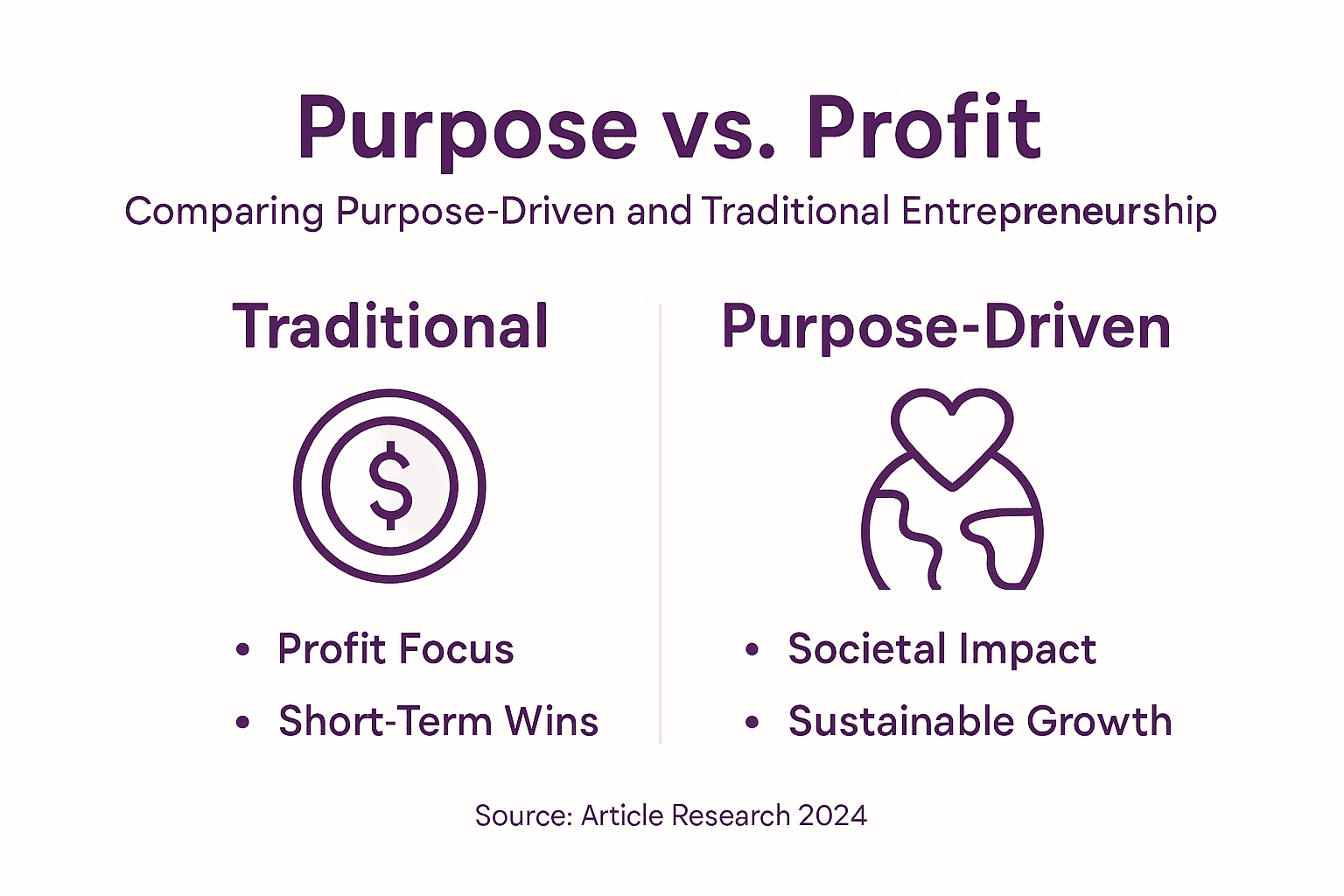
Here’s how traditional and purpose-driven entrepreneurship differ in key aspects:
| Aspect | Traditional Entrepreneurship | Purpose-Driven Entrepreneurship |
|---|---|---|
| Primary Goal | Maximize profit | Profit and societal impact |
| Success Metrics | Financial returns only | Triple bottom line |
| Model Flexibility | Profit-focused | Balances profit, purpose |
| Stakeholder Focus | Shareholders | All stakeholders |
| Competitive Edge | Market share, cost | Innovation, mission-driven loyalty |
Pro tip: Start by identifying one specific societal challenge your business can genuinely address, then design your business model to create tangible, measurable impact.
Types of Purpose-Driven Business Models
Purpose-driven entrepreneurship encompasses a diverse range of business models that challenge traditional profit-centered approaches. Emerging research highlights multiple strategic frameworks where social and ecological impact are integrated directly into business operations.
These innovative business models can be categorized into several distinct types:
- Social Enterprise Models: Organizations that prioritize solving social problems while generating sustainable revenue
- Regenerative Business Models: Ventures designed to actively restore and improve ecological and social systems
- Hybrid Value Models: Businesses that balance commercial success with explicit social mission
- Impact-First Enterprises: Organizations where positive societal change is the primary driver of business strategy
- Stakeholder-Centric Models: Business approaches that distribute value across multiple stakeholder groups, not just shareholders
Comparative organizational strategies.pdf) reveal that successful purpose-driven models share critical characteristics. They transcend traditional boundaries between nonprofit and for-profit sectors, creating innovative approaches that integrate financial sustainability with meaningful social transformation.
Understanding these models requires recognizing that purpose-driven entrepreneurship is not about sacrificing profitability, but reimagining how businesses can generate value. By aligning economic objectives with broader societal goals, these models demonstrate that financial success and positive impact are not mutually exclusive.
Pro tip: Conduct a thorough assessment of your core competencies and potential societal challenges to identify the most suitable purpose-driven business model for your venture.
Key Traits and Daily Practices
Purpose-driven entrepreneurs demonstrate distinct personal characteristics that set them apart from traditional business leaders. These traits go beyond professional skills, encompassing a holistic approach to creating meaningful change through their entrepreneurial endeavors.
Key personal traits of purpose-driven entrepreneurs include:
- Relational Intelligence: Deep ability to understand and connect with stakeholders
- Ethical Resilience: Commitment to core values even when facing economic pressures
- Systemic Thinking: Capacity to view business challenges through interconnected lenses
- Emotional Agility: Adaptability and emotional awareness in complex business environments
- Regenerative Mindset: Commitment to creating positive impacts beyond mere sustainability
Organizational research highlights.pdf) that successful purpose-driven entrepreneurs integrate specific daily practices into their business routines. These practices typically involve transparent communication, intentional stakeholder engagement, and continuous learning about social and ecological systems.

The most effective purpose-driven entrepreneurs approach their work as a holistic practice, not just a professional pursuit. They consistently align their daily actions with their broader mission, creating a seamless integration between personal values and business strategy. This approach requires ongoing reflection, adaptability, and a genuine commitment to creating meaningful change.
Pro tip: Develop a daily reflection practice that connects your business activities directly to your core purpose, examining how each decision contributes to your broader societal impact.
Sustainability, Well-Being, and Profitability
Conscious business approaches demonstrate that sustainability, well-being, and profitability are not competing objectives, but deeply interconnected outcomes of purposeful entrepreneurship. Traditional business thinking often frames these elements as trade-offs, but emerging research reveals a more nuanced and integrated perspective.
Key strategies for balancing these critical dimensions include:
- Stakeholder Value Creation: Designing business models that generate value for all participants
- Ecological Accounting: Measuring business success through comprehensive impact metrics
- Long-Term Resilience: Prioritizing systemic health over short-term financial gains
- Regenerative Design: Creating business processes that actively restore ecological and social systems
- Holistic Performance Indicators: Developing metrics that track financial, social, and environmental outcomes
Entrepreneurial research underscores that purpose-driven ventures often outperform traditional businesses by embedding sustainability into their core strategy. This approach transforms potential constraints into opportunities for innovation, creating more robust and adaptable business models.
Successful purpose-driven entrepreneurs recognize that profitability is not diminished by prioritizing well-being and sustainability - instead, these considerations become powerful sources of competitive advantage. By aligning economic objectives with broader societal goals, these businesses create more meaningful and enduring value.
Below is a summary of strategies to balance sustainability, well-being, and profitability:
| Strategy | Business Benefit | Societal Outcome |
|---|---|---|
| Stakeholder Value | Stronger relationships | Broader well-being |
| Ecological Accounting | Long-term viability | Improved environment |
| Regenerative Design | Process innovation | Systemic restoration |
| Holistic Indicators | Informed decisions | Wider impact visibility |
Pro tip: Develop a comprehensive impact assessment framework that measures your business’s performance across financial, social, and ecological dimensions, creating a holistic view of true value creation.
Common Pitfalls and How to Avoid Them
Purpose-driven entrepreneurs face complex challenges that can derail their mission if not carefully navigated. Understanding these potential obstacles is crucial for maintaining the delicate balance between social impact and business sustainability.
Common pitfalls in purpose-driven entrepreneurship include:
- Mission Drift: Gradually moving away from original social objectives
- Financial Fragility: Prioritizing purpose at the expense of economic viability
- Stakeholder Misalignment: Creating tension between different organizational expectations
- Impact Measurement Challenges: Struggling to quantify and communicate social value
- Governance Complexity: Managing multiple competing organizational priorities
Organizational research suggests.pdf) that successful purpose-driven ventures develop robust governance structures and transparent processes to mitigate these risks. This involves creating clear frameworks that keep social mission and financial sustainability in constant dialogue.
The most effective purpose-driven entrepreneurs view these potential pitfalls not as obstacles, but as opportunities for innovation and deeper organizational learning. By developing adaptive strategies and maintaining a flexible yet principled approach, they transform potential challenges into sources of competitive advantage and meaningful impact.
Pro tip: Conduct quarterly mission alignment reviews that explicitly examine how your business activities connect to your core purpose, ensuring you remain true to your original social objectives.
Unlock the Power of Purpose-Driven Entrepreneurship Today
The article highlights a common challenge many entrepreneurs face: balancing financial success with meaningful societal impact without losing sight of their core mission. If you are committed to building a business that prioritizes purpose alongside profit, and want to avoid pitfalls like mission drift or financial fragility, you need tools that help clarify your vision and align every action with your purpose. Starfireblast empowers you with deep customer understanding, brand clarity, and practical AI-assisted tools designed specifically for purpose-driven ventures.

Start transforming your ideas into sustainable impact with Starfireblast. Join a community focused on planetary productivity — where growth supports well-being, economic viability, and ecological responsibility simultaneously. Visit Starfireblast now to discover how you can integrate your social mission with a thriving business model. Explore how to clarify your brand and strategy and take confident, purpose-aligned steps forward today.
Frequently Asked Questions
What is purpose-driven entrepreneurship?
Purpose-driven entrepreneurship is a business approach that integrates social and ecological goals into the core business strategy, aiming for both financial viability and meaningful societal impact.
How do purpose-driven entrepreneurs measure success?
Purpose-driven entrepreneurs measure success through the triple bottom line, which includes financial, social, and environmental outcomes, rather than focusing solely on financial returns.
What are some common pitfalls in purpose-driven entrepreneurship?
Common pitfalls include mission drift, financial fragility, stakeholder misalignment, challenges in impact measurement, and governance complexity, all of which can affect the balance between social impact and business sustainability.
How can a business create a positive societal impact while remaining profitable?
A business can create positive societal impact by designing stakeholder-centric models, prioritizing ecological accounting, and developing holistic performance indicators that align economic objectives with broader societal goals.
Recommended
- Clarifying Business Purpose: Pathway to Sustainable Growth – Starfireblast
- 7 Essential Steps for a Resilient Entrepreneur Mindset List – Starfireblast
- Top 8 Starblaze.co Alternatives in 2026 for Creative Teams Seeking Sus – Starfireblast
- Business Evolution Explained: Sustainable Growth for Entrepreneurs – Starfireblast