Mission-Driven Startups: Fueling Sustainable Impact
Every founder who cares about more than quick profits knows how tough it is to build a business without losing sight of your purpose. For solo entrepreneurs and small teams in Central Europe, the idea of a startup grounded in a clear sustainable mission offers a different path, one where values matter as much as growth. This guide shows what makes mission-driven startups unique and highlights the strategies and support networks that fuel sustainable progress while protecting your well-being.
Table of Contents
- Defining Mission-Driven Startups And Key Principles
- Types And Variations In Central Europe
- Mission-Driven Startup Ecosystems And Community Dynamics
- Challenges In Funding And Sustainable Growth
- Critical Factors For Lasting Impact And Avoiding Burnout
Key Takeaways
| Point | Details |
|---|---|
| Mission-Driven Focus | Mission-driven startups prioritize purpose over profit, balancing measurable social impact with viable business practices. |
| Importance of Local Context | Understanding local ecosystems and regional strengths significantly influences the success of mission-driven startups in Central Europe. |
| Funding Challenges | Navigating funding is critical; mission-driven startups may rely more on non-equity grants and backing aligned with their values, rather than traditional venture capital. |
| Preventing Burnout | To ensure lasting impact, founders should establish operational boundaries, promote self-care, and distribute workloads to avoid emotional fatigue. |
Defining mission-driven startups and key principles
Mission-driven startups exist for a reason beyond profit. They’re built on a clear sustainable mission that shapes every decision, from product design to hiring. Unlike traditional startups chasing growth at any cost, these companies embed purpose into their DNA from day one.
What sets them apart? Mission-driven startups balance three commitments simultaneously:
- Making measurable environmental and social impact
- Building a viable, profitable business
- Staying true to their stated values even when it’s harder
Think of it this way: a regular startup asks, “How do we scale?” A mission-driven startup asks, “How do we scale without compromising what we stand for?”
Here’s how mission-driven startups differ from traditional startups:
| Aspect | Mission-Driven Startup | Traditional Startup |
|---|---|---|
| Decision Focus | Purpose-driven choices | Growth-focused choices |
| Impact Measurement | Tracks ESG and social outcomes | Primarily tracks financial metrics |
| Approach to Growth | Scales without compromising values | Rapid scaling prioritized |
| Collaboration Style | Partnerships for amplified impact | Competitive, rarely collaborative |
| Leadership Role | Mission embedded in culture | Profit is primary motivation |
Core Principles That Define Them
Mission-driven organizations derive business value from clearly defined corporate purpose that drives focus, motivation, and action. This isn’t marketing language—it’s operational reality. Real mission-driven startups apply specific principles:
-
Top leadership embeds mission into strategy - The founder and leadership team don’t just talk about purpose; they make decisions that prove it daily.
-
Mission shapes the business model - Sustainable mission alignment means your revenue streams, partnerships, and product decisions all connect to your core purpose.
-
Impact gets measured, not guessed - These startups track their environmental, social, and governance (ESG) outcomes alongside financial metrics. What gets measured gets managed.
-
Collaboration replaces isolation - Mission-driven startups often work with nonprofits, communities, and other businesses to amplify their impact, knowing they can’t solve problems alone.
Why This Matters for Solo Entrepreneurs
If you’re building in Central Europe and you’re tired of the startup hustle that burns people out, mission-driven principles offer an alternative framework. They let you build a living business—one that supports your well-being while creating real value.
A mission-driven business doesn’t require you to choose between impact and viability. Both fuel growth that actually sustains you and your team.
You can clarify your business purpose and use it as your strategic compass from the beginning. This prevents the costly pivot later when you realize you’ve been building the wrong thing.
Pro tip: Write down your mission in one sentence right now—not for marketing, but for decision-making. When you’re unclear about a new opportunity, product feature, or partnership, test it against that sentence. Does it align? If not, it’s probably a distraction.
Types and variations in Central Europe
Central Europe’s mission-driven startup scene isn’t monolithic. It shifts based on local policy, industry strengths, and what each country values most. Poland, Czechia, and Hungary each foster different types of mission-driven ventures shaped by their unique ecosystems.
The variation matters because it affects what’s possible in your region. A sustainability startup in Berlin operates under different pressures than one in Warsaw. Understanding your local context helps you build smarter.
The Main Types You’ll Find
Mission-driven startups in Central Europe cluster into distinct patterns:
Here’s a quick overview of main mission-driven startup types in Central Europe:
| Startup Type | Key Characteristics | Regional Strengths |
|---|---|---|
| Tech Sustainability Firms | Uses technology to solve problems | Poland, Hungary, EU support |
| Social Enterprises | Prioritizes inclusive growth | Czechia, Hungary, local funding |
| Public Mission Innovators | Aligns with policy or government | Poland, Czechia, EU policy grants |
-
Tech-driven sustainability firms - Companies using software, hardware, or digital innovation to solve environmental problems. These thrive in countries with strong tech talent and EU green transition support.
-
Social enterprises - Startups prioritizing inclusive growth and community benefit. They’re common across the region but particularly strong where local funding supports social impact.
-
Innovation-linked to public missions - Startups aligned with government or EU policy goals around green energy, digital transition, or social services. These often access special funding.
How Regional Differences Shape What You Build
Mission-oriented innovation policies vary by country, influencing which startup types flourish locally. Poland’s ecosystem emphasizes tech talent and scaling. Czechia focuses on manufacturing innovation and sustainability. Hungary develops diverse social and tech ventures.
EU policies on green and digital transitions affect all of Central Europe, but local governments apply them differently. This creates pockets of opportunity—and constraints—depending on where you are.
What This Means for Your Startup
Your region’s innovation maturity and policy environment shape your resources, competition, and potential partners. A social impact startup might find strong nonprofit networks in one city but venture capital scarcity in another.
The good news? Central and Eastern European innovation ecosystems are actively developing. Funding mechanisms, accelerator programs, and community support are improving fast.
Your startup type matters less than understanding your local ecosystem. Know what your region supports, and build accordingly.
Instead of chasing a Silicon Valley model that doesn’t fit your context, anchor your mission to what Central Europe needs and what your local infrastructure can support.
Pro tip: Before finalizing your business model, research what funding, tax incentives, and support programs exist in your specific country. A few conversations with other founders in your region will reveal patterns you can leverage.
Mission-driven startup ecosystems and community dynamics
You don’t build a mission-driven startup alone. The ecosystem around you—investors, mentors, universities, other founders—either accelerates your progress or leaves you isolated. Central Europe’s startup communities are maturing fast, but they still vary dramatically by location.

Understanding who’s in your ecosystem and how to connect matters more than having the perfect idea. The right mentor in your city can save you two years of mistakes.
Who Makes Up These Ecosystems
Support ecosystems across Central and Eastern Europe include overlapping networks of players:
-
Investors and venture capitalists - Growing in number, increasingly focused on ESG-aligned startups and sustainable business models.
-
Accelerators and incubators - Organizations providing mentorship, workspace, and often initial funding. Quality varies significantly by region.
-
Universities and research institutions - Sources of talent, technical expertise, and sometimes early funding through innovation hubs.
-
Government and policy bodies - Setting incentives, supporting green transition initiatives, and sometimes providing grants or tax breaks.
-
Other mission-driven founders - Your peers. They understand the specific pressures of balancing purpose with profitability.
How These Communities Actually Function
Central European startup ecosystems increasingly operate through blended finance models and collaborative partnerships. This means money comes from multiple sources—venture capital, impact investors, grants, government support—working together.
The strongest ecosystems foster genuine collaboration instead of competition. A university might connect you with an investor. An accelerator introduces you to potential co-founders. Other startups become partners instead of rivals.
Lithuania and Estonia lead in ecosystem maturity, but Poland, Czechia, and Hungary are catching up rapidly. Your location affects access to capital, talent networks, and mentorship quality.
Building Your Connections
Start by mapping your local ecosystem. Who’s already doing mission-driven work in your industry? Which accelerators actively support sustainable startups? Where do investors congregate?
Central European startup ecosystem dynamics increasingly emphasize resilience and long-term sustainability over fast scaling.
This shift plays to your advantage. Communities now value founders who think long-term, build consciously, and measure real impact. That’s exactly what mission-driven startups do.
Strong ecosystems aren’t built overnight, but they’re built by people showing up, sharing openly, and helping each other solve hard problems.
Your role isn’t just to extract value from the ecosystem. It’s to contribute to it. Share what you learn. Introduce people. Support other founders. The ecosystem strengthens when everyone does this.
Pro tip: Attend at least one local startup event or founder meetup this month. Don’t go to pitch or sell—go to listen and ask genuine questions. The relationships you build in these early conversations often become your most valuable resource.
Challenges in funding and sustainable growth
Money is where mission-driven startups hit their first real test. You need capital to grow, but traditional venture funding often conflicts with your values. The funding landscape in Europe is tightening, making this tension harder to navigate.
Understanding these challenges isn’t pessimism—it’s clarity. Knowing what you’re up against helps you plan smarter.
The Funding Reality for Mission-Driven Startups
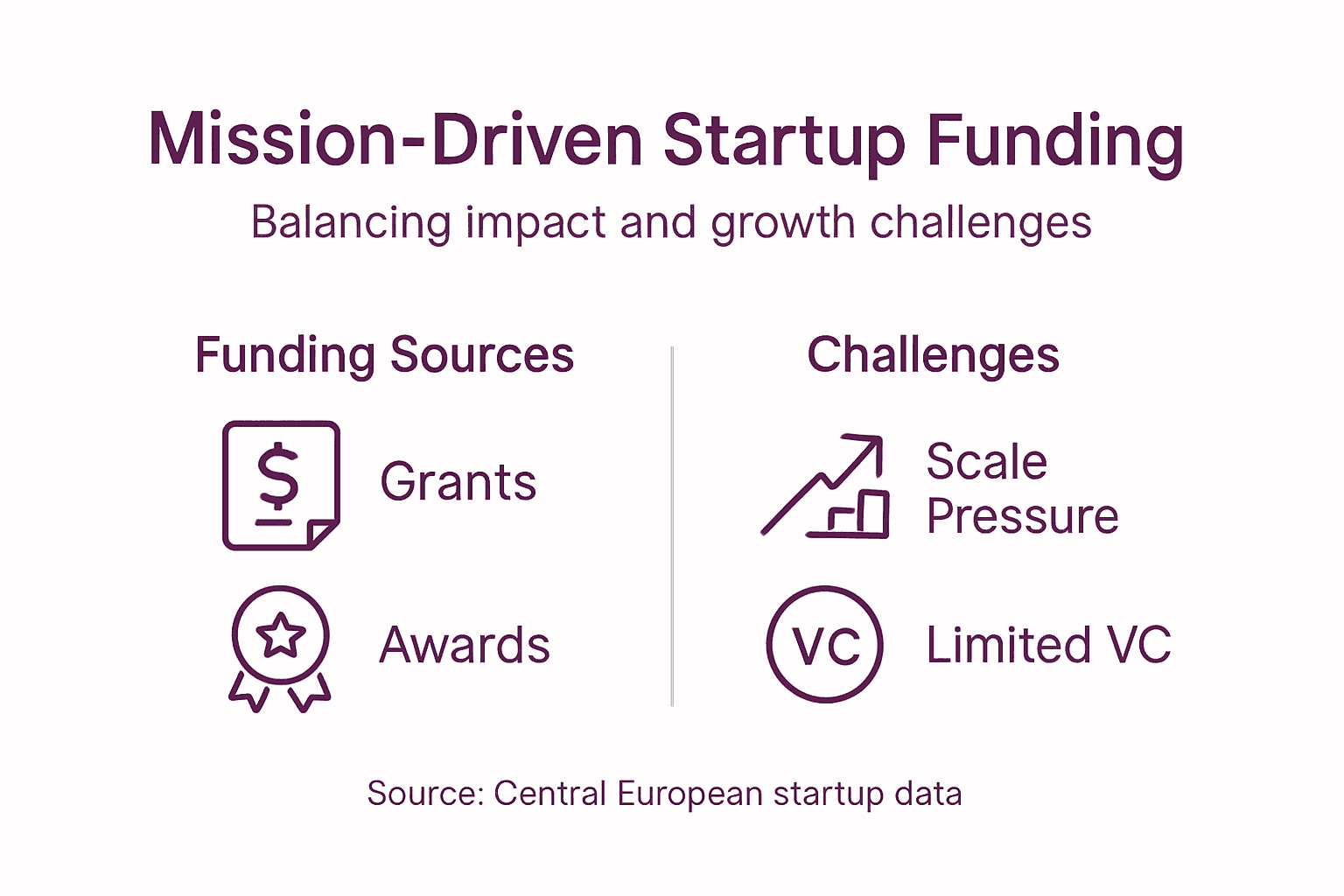
Early survival depends heavily on non-equity grants and awards rather than venture capital alone. This seems counterintuitive, but it reflects how mission-driven startups actually work. Impact funds, government grants, and awards keep you alive long enough to prove your model.
Equity capital matters too, but it comes with pressure to scale fast. Mission-driven founders often face a choice: take VC money and risk diluting your mission, or grow slower and retain control.
Where the Real Gaps Appear
Sustainable European startup funding shows a critical pattern: early-stage founders get support, but growth-stage funding vanishes. Once you move beyond initial proof of concept, money dries up unless you fit a traditional growth profile.
The challenges pile up:
-
Fragmented funding sources - You’re piecing together capital from grants, impact investors, traditional VCs, and sometimes personal savings. Exhausting and distracting.
-
Compliance costs rising - Regulatory requirements for startups keep increasing. Smaller teams absorb these costs differently than well-funded competitors.
-
Negative cash flow operating model - Many mission-driven startups run at a loss longer than traditional startups. Balancing this with investor expectations creates constant tension.
The Broader European Context
European startup funding conditions are tightening overall. Venture capital is decreasing across the continent. Mission-driven startups compete for declining funding pools while facing steeper regulatory burdens.
This affects your region differently depending on local support programs and investor networks. Central Europe has fewer institutional impact investors than Western Europe, but growing numbers of founders who understand the mission-first approach.
The funding challenge isn’t unsolvable. It’s just different. Mission-driven startups often need blended capital, not just venture money.
Think beyond traditional VC. Explore impact investors, grants from EU programs, government support for green innovation, and angel networks aligned with your mission. Diversified funding is slower to assemble but more stable long-term.
Pro tip: Before chasing venture capital, calculate exactly how much non-dilutive funding (grants, awards, government support) exists for your specific startup type and region. You might reach profitability faster through a blend of smaller funding sources than waiting for one big check.
Critical factors for lasting impact and avoiding burnout
Building a mission-driven startup is emotionally demanding. You care deeply about your work, which means the stakes feel personal. This passion is your strength, but it also creates risk—burnout sneaks up on founders who don’t set boundaries.
The difference between sustainable impact and collapse often comes down to one thing: recognizing that you can’t pour from an empty cup.
Understanding Burnout in Mission-Driven Work
Burnout in mission-driven organizations stems from chronic stress combined with emotional fatigue. You overcommit because the cause matters. You skip breaks because someone else is counting on you. You absorb stress from the mission itself—compassion fatigue.
This differs from burnout in traditional startups. You’re not just burned out from overwork; you’re emotionally exhausted from caring too much.
How It Happens
Mission-driven leaders often face pressures balancing impact with operations. Building resilience through sustainable practices requires aligning strategy with actual capacity—not just what you wish was possible.
The warning signs arrive gradually:
- Working nights and weekends becomes your default
- You make decisions from exhaustion, not strategy
- Your passion starts feeling like obligation
- Team members mirror your unhealthy patterns
- Impact suffers because you’re running on fumes
What Actually Prevents Burnout
Avoiding burnout requires organizational responsibility, not just individual willpower. This means your team culture must actively support sustainable practices.
Specific actions that work:
-
Set operational boundaries - Define what you will and won’t do. Communicate this clearly to your team and stakeholders.
-
Balance workload deliberately - Burnout happens when one or two people absorb all the load. Distribute responsibility, even if it means moving slower.
-
Embed self-care into culture - Make rest and recovery normal, not shameful. Model taking time off. Encourage your team to do the same.
-
Create support systems - Sustainable growth strategies work best when founders have mentors, coaches, or peer communities to process challenges and stay grounded.
-
Measure impact realistically - Burnout intensifies when goals feel impossible. Set metrics that reflect real progress, not fantasy scaling.
The Paradox
Resting isn’t laziness. Taking a real vacation isn’t abandoning your mission. Building a sustainable pace makes you more effective long-term, not less.
Your health is foundational to your impact. You cannot serve your mission if you destroy yourself doing it.
Founders who build healthy organizations create better products, make wiser decisions, and keep their teams intact. This is strategic, not soft.
Pro tip: Schedule one non-negotiable day off per week right now. Protect it like you’d protect a client meeting. Notice what happens to your thinking, your mood, and your decision quality when you actually rest. That clarity is what sustainable impact requires.
Build Your Mission-Driven Startup with Confidence and Clarity
The challenges of balancing sustainable impact with profitable growth can feel overwhelming. You want to stay true to your mission without burning out or losing focus on what truly matters. If you are ready to clarify who you are building for and align every decision with your purpose then Starfireblast is designed exactly for you.
With Starfireblast you gain access to practical AI-assisted tools that help you make consistent progress every day and a community that supports sustainable business growth instead of chasing fleeting trends. Avoid common pitfalls mission-driven startups face around funding, burnout, and unclear impact by starting with clear strategy and realistic execution. Discover how to embed your mission into your business model from day one and grow with intention. Start your journey now by exploring how to turn ideas into meaningful action and build a living business that supports the planet and your well-being.
Frequently Asked Questions
What is a mission-driven startup?
A mission-driven startup prioritizes a clear, sustainable mission beyond just profit. These companies integrate their purpose into every aspect of their operations, including product design and hiring.
How do mission-driven startups measure their impact?
Mission-driven startups track their environmental, social, and governance (ESG) outcomes along with financial metrics. They believe that what gets measured gets managed, ensuring they maintain their commitments to their mission.
What are the challenges faced by mission-driven startups in securing funding?
Mission-driven startups often struggle to find growth-stage funding and may rely on non-equity grants and awards. The fragmented funding sources and regulatory compliance can create additional pressures on their financial stability.
How can founders avoid burnout while building a mission-driven startup?
Founders can prevent burnout by setting operational boundaries, distributing workloads, incorporating self-care into the company’s culture, and creating support systems. Regularly measuring realistic impact can also help maintain motivation and prevent overwhelming expectations.
Recommended
- Purpose-Driven Entrepreneurship: Building Impactful Businesses – Starfireblast
- 7 Steps to a Purpose-Driven Entrepreneurship Checklist – Starfireblast
- Why Purpose Matters in Branding for Entrepreneurs – Starfireblast
- Action Planning for Entrepreneurs: Achieve Sustainable Progress – Starfireblast
- 7 Essential Startup Marketing Checklists for Scalable Growth - Kadima