Holistic business growth: a sustainable path for entrepreneurs
TL;DR:
- Holistic business growth integrates purpose, sustainability, and interconnected systems across all functions.
- It prioritizes resilience, long-term value, and community loyalty over short-term revenue spikes.
- Implementation involves assessing current practices, defining core values, and fostering continuous feedback and alignment.
Most entrepreneurs assume growth means running more ads, closing more deals, or hitting a bigger revenue number each quarter. That assumption is understandable, but it leaves out most of what actually makes a business last. Holistic business growth integrates all aspects of a business, including marketing, product, operations, culture, team, and customer experience, aligning them with long-term principles of sustainability, purpose, and universal values. This guide breaks down what that really means, how it compares to traditional models, and what concrete steps you can take to build a business that holds up over time.
Table of Contents
- Understanding holistic business growth
- How holistic growth compares to traditional growth models
- Real-world examples of holistic business growth
- How to implement holistic growth in your business
- Why most businesses still miss the mark on holistic growth
- Take the next step toward sustainable, holistic growth
- Frequently asked questions
Key Takeaways
| Point | Details |
|---|---|
| Align all business areas | True holistic growth requires connecting marketing, operations, people, and purpose. |
| Prioritize long-term sustainability | Balance profit goals with ecological, team, and community needs for lasting success. |
| Learn from real leaders | Companies like Patagonia show holistic growth can drive both impact and financial health. |
| Start with clear steps | Every entrepreneur can adopt holistic practices with intentional, step-by-step changes. |
Understanding holistic business growth
To understand how this approach works in practice, it is crucial to first grasp the basics of holistic business growth.
Holistic business growth is not a single tactic or framework. It is a way of running a business where every part, from your supply chain to your team culture to your customer relationships, is connected to a clear purpose and a set of long-term values. It combines three distinct dimensions: science (systems, data, and measurable outcomes), art (storytelling, brand identity, and design), and soul (values, ethics, and purpose). Each dimension depends on the others.
The core principles of holistic growth are balance, reciprocity, and ongoing development. Balance means no single part of the business is optimized at the expense of another. Reciprocity means the business gives back to its community, team, and environment, not just to shareholders. Ongoing development means the business treats learning as a structural priority, not a nice-to-have.
Here is how holistic growth elements compare to traditional growth elements:
| Element | Traditional approach | Holistic approach |
|---|---|---|
| Primary metric | Revenue, market share | Purpose alignment, resilience |
| Team culture | Productivity-focused | Values-driven, collaborative |
| Customer relationship | Transactional | Long-term, community-based |
| Decision-making | Quarterly targets | Long-term impact lens |
| Sustainability | Optional or PR-driven | Embedded in operations |
Key principles that define this model include:
- Aligning internal operations with external purpose
- Building team culture around shared values
- Treating customer experience as a reflection of company identity
- Using data to support human decisions, not replace them
- Integrating ecological and social responsibility into daily choices
Pro Tip: Frame every strategic decision through the lens of purpose and long-term impact, not just quarterly growth. Ask: does this decision strengthen or weaken the whole system?
For a deeper look at how this connects to practical strategy, sustainable growth strategies and sustainability fundamentals offer useful context for small business owners building from the ground up.
How holistic growth compares to traditional growth models
Once we understand holistic growth at a high level, it is useful to see precisely how it stacks up against traditional growth models.
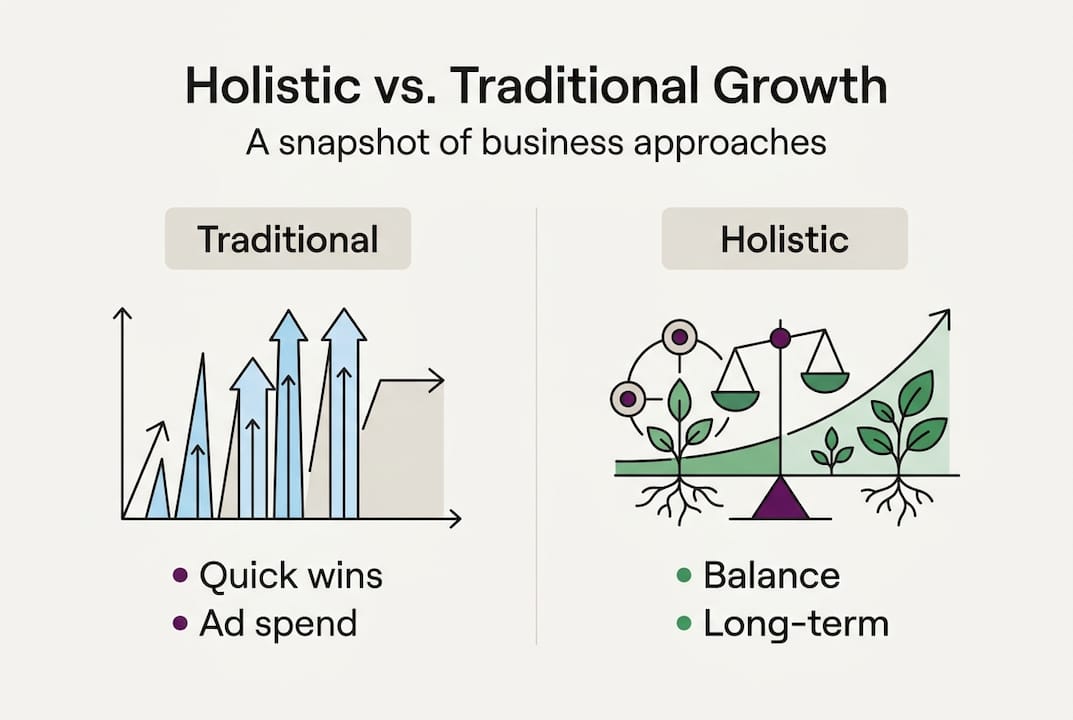
Traditional growth models are built around performance spikes. You run a campaign, sales go up. You hire a sales team, revenue increases. The problem is that these spikes rarely build anything durable. When the campaign ends, so does the momentum. Short-term spikes often lead to fragility, while holistic growth seeks sustainable, balanced expansion.
Holistic growth, by contrast, focuses on interconnectedness. Every function of the business is designed to reinforce every other function. Marketing reflects product values. Product decisions reflect customer feedback. Team culture reflects the brand promise. Nothing operates in isolation.
“Sustainable growth requires strengthening the core business, not just driving short-term revenue gains.”
Key outcomes of each approach:
Traditional growth:
- Fast results, but often unsustainable
- High dependency on ad spend or sales volume
- Vulnerable to market shifts and economic downturns
- Team burnout from constant performance pressure
Holistic growth:
- Slower initial traction, but compounding returns over time
- Resilient to disruption because the whole system is strong
- Community loyalty that reduces reliance on paid acquisition
- Team engagement tied to shared purpose, not just incentives
Here is a direct comparison across core business factors:
| Factor | Traditional growth | Holistic growth |
|---|---|---|
| Growth driver | Advertising, promotions | Systems, community, purpose |
| Risk profile | High (market-dependent) | Lower (diversified resilience) |
| Employee retention | Incentive-based | Values and culture-based |
| Customer loyalty | Price or convenience | Shared values and trust |
| Environmental impact | Externalized | Internalized and managed |
For entrepreneurs building with intention, sustainable entrepreneurship and understanding business evolution are directly relevant to making this shift in practice.
Real-world examples of holistic business growth
The differences become even clearer when looking at real businesses already putting these principles into action.
Patagonia is the most cited example for good reason. Since restructuring its ownership in 2022, the company has directed $180M to climate action while integrating sustainability across its product design, supply chain, and team policies. It uses B Corp metrics, repair programs, and ethical sourcing as core business tools, not marketing add-ons. The result is a brand with deep customer loyalty and a model that holds up under scrutiny.

But Patagonia is not the only data point. Research on high-growth businesses shows that 80% of top-performing companies excel in five or more business factors simultaneously, including talent strategy, educational diversity, and operational balance. They do not optimize one area at the expense of others. They build across the whole system.
Statistical callout: Organizations using Balanced Scorecard tools, which measure performance across financial, customer, internal process, and learning dimensions, report ROI improvements of up to 275% compared to single-metric approaches.
Common holistic practices found in successful businesses:
- Regular cross-functional team reviews that connect operational data to purpose metrics
- Supply chain audits that include social and environmental criteria
- Customer feedback loops that inform product and culture decisions, not just marketing
- Transparent reporting on both financial and non-financial outcomes
- Investment in team learning and development as a core budget line
Pro Tip: Build cross-functional teams to ensure every business area reinforces your company’s purpose. A weekly 30-minute sync between operations, marketing, and product can surface misalignments before they become expensive problems.
For entrepreneurs focused on building this kind of ecosystem, community-driven growth and purposeful growth offer practical starting points.
How to implement holistic growth in your business
If you are eager to start, here is how to begin weaving holistic growth into your own business, step by step.
The first move is not to add new tools or launch new campaigns. It is to assess where your business currently stands across four dimensions: operations, culture, customer experience, and values alignment. Most businesses find gaps immediately. That is normal and useful.
High-growth businesses excel in holistic talent strategies, educational diversity, and balance between multiple growth levers. The pattern is consistent: breadth across systems, not depth in a single tactic.
Here are the concrete steps to adopt holistic growth:
- Audit your current state. Map how each business function (marketing, product, operations, HR, finance) currently connects to your stated purpose. Identify where the gaps are.
- Define your non-negotiables. Decide which values and principles are fixed, regardless of market pressure. Write them down and share them with your team.
- Build feedback systems. Create regular channels for input from your team, customers, and community. Make it structured, not occasional.
- Align your metrics. Add non-financial metrics to your dashboards, such as team well-being, customer trust scores, and environmental impact indicators.
- Review and adjust quarterly. Holistic growth is not a one-time project. It requires ongoing recalibration as your business evolves.
Quick wins to start with:
- Replace one vanity metric with a purpose-aligned one this week
- Schedule a cross-team conversation about values and current operations
- Ask three customers what they value most about working with you
Pitfalls to avoid:
- Treating sustainability as a marketing message rather than an operational commitment
- Skipping the audit phase and jumping straight to new tactics
- Measuring holistic growth only by revenue outcomes
For structured support on this process, the balanced growth guide, clarity in growth, and positioning workflow are all directly applicable.
Why most businesses still miss the mark on holistic growth
But why do so many businesses, even with all this knowledge, still default back to traditional, short-term tactics?
The honest answer is pressure. Quarterly targets, investor expectations, and the constant visibility of competitors running ads create a pull toward fast action. Holistic growth requires patience and structural changes that do not show up on a dashboard in 30 days. Most teams are not rewarded for that kind of work.
There is also a metrics problem. If you only measure revenue and conversion rates, you will only optimize for revenue and conversion rates. True transformation requires changing what counts as success. That means new KPIs, new conversations, and sometimes, saying no to growth opportunities that do not fit the model.
Some experts question endless growth, advocating for value creation beyond mere expansion. That is not a fringe view. It is a practical one. Not all growth is worth chasing. A contract that strains your team, a product line that contradicts your values, or a partnership that prioritizes speed over integrity can all damage the system you are trying to build.
Real holistic growth requires backbone. It means staying committed to the whole system even when fast results are not visible. That is the part most business advice skips. For entrepreneurs working on balancing priorities, this is where the real work begins.
Take the next step toward sustainable, holistic growth
If you are ready to apply holistic growth principles with expert guidance, here is where to start.
Understanding the model is one thing. Putting it into practice across your actual business, with your actual customers and constraints, is another. Starfireblast is built specifically for entrepreneurs who want to grow with purpose, not just scale with noise.
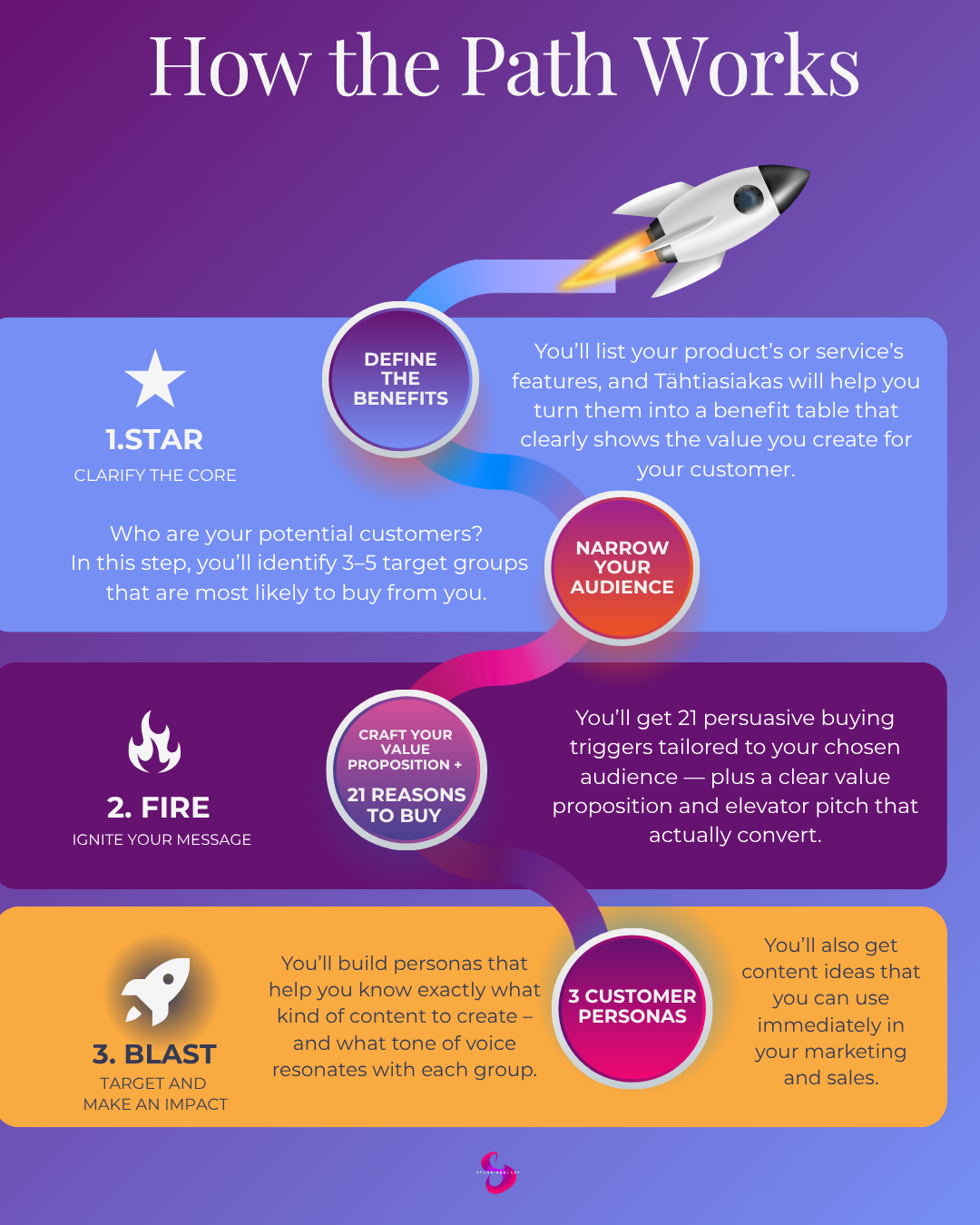
The Customer StarMap™ Power Workshop is a structured session designed to help you clarify who you are building for, what they actually need, and how your business can align around that with precision. It connects directly to the holistic growth principles covered in this guide, starting with customer understanding before scaling anything else.
Frequently asked questions
What are the main features of holistic business growth?
Holistic business growth aligns operations, culture, and strategy with long-term purpose, sustainability, and human well-being, not just profits. It treats every business function as connected to every other.
How can a small business start implementing holistic growth?
Begin by defining clear core values, integrating feedback from your team and customers, and embedding sustainability in decision-making. High-growth businesses consistently balance talent strategy, educational diversity, and multiple growth levers at once.
Does holistic growth guarantee faster business results?
No. Holistic growth focuses on resilience and long-term success, which sometimes means slower but more durable progress than quick-win tactics. Short-term spikes often create fragility rather than lasting strength.
Can holistic business growth work for solopreneurs or only larger companies?
Holistic growth principles apply to businesses of any size. For solopreneurs, the focus on values, community, and long-term systems is especially practical because it reduces dependence on paid acquisition. Strengthening the core business matters at every scale.
Recommended
- Your guide to sustainable growth: balanced, profitable, responsible – Starfireblast
- Business Evolution Explained: Sustainable Growth for Entrepreneurs – Starfireblast
- Sustainable growth strategies for entrepreneurs in 2026 – Starfireblast
- Purposeful growth for sustainable entrepreneurs 2026 – Starfireblast
- Why More Clients Means More Chaos (And How to Scale Without It)
- Growing Business with SEO: Proven Steps for Results