7 Growth Strategies for Creators to Build Sustainable Brands
Trying to grow a brand as a solo creator in Central Europe can feel overwhelming. Without a clear direction, it’s easy to waste time on noisy trends, end up with scattered messaging, or burn out before real progress happens. You want to create something sustainable and meaningful, not just chase the next algorithm update.
This guide will show you how to build a resilient brand that truly connects with your audience and reflects your unique voice. You’ll get actionable steps that help you move beyond surface-level tactics and focus on what actually works. Get ready to discover specific insights—each designed to help you create lasting impact, stay true to your values, and make steady growth a reality.
Table of Contents
- 1. Clarify Your Core Audience And Purpose
- 2. Develop A Distinctive Brand Position
- 3. Create Value-Driven Content Consistently
- 4. Leverage AI Tools For Smarter Execution
- 5. Foster Community Engagement Over Followers
- 6. Integrate Well-Being Into Your Workflow
- 7. Prioritize Sustainable, Incremental Growth
Quick Summary
| Key Insight | Clarification |
|---|---|
| 1. Define Your Core Audience | Know specific details about your ideal customer to create targeted content that resonates with them. |
| 2. Clarify Your Purpose | Establish a clear reason for your work to attract a loyal audience aligned with your values. |
| 3. Create Value-Driven Content | Focus on consistently producing content that genuinely solves problems and meets audience needs. |
| 4. Foster Community Engagement | Build a two-way relationship with your audience to create loyalty instead of just chasing followers. |
| 5. Integrate Well-Being Into Your Workflow | Design your processes to prioritize your well-being, ensuring sustainability and preventing burnout. |
1. Clarify Your Core Audience and Purpose
You cannot build a sustainable brand without knowing exactly who you’re speaking to and why it matters. Many creators skip this step entirely, assuming they’ll figure it out as they grow. That assumption costs them months of wasted effort, misaligned messaging, and an audience that doesn’t stick around.
Your core audience and purpose are not the same thing. Your purpose is the reason you create. Your audience is who benefits from that creation. Both must be crystal clear before you build anything else.
Why does clarity matter so much? When you understand who your readers are and what they want to learn, your communication becomes sharper. You stop creating generic content that appeals to nobody. Instead, you build things that solve actual problems for actual people.
Consider what happens when you know your audience deeply:
- Your messaging resonates because it speaks to real concerns they face
- Your content strategy becomes focused instead of scattered
- Your brand builds loyalty because people feel truly understood
- Your growth becomes sustainable because it comes from real value, not algorithm tricks
- Your own work feels more meaningful because you’re serving someone you understand
This is especially important for Central European creators working solo. You don’t have large teams to split your focus across multiple audience segments. Every piece of content, every project, every decision must serve your core audience and reinforce your purpose. Clarity makes that possible.
Define Your Core Audience
Start by getting specific. Not “people interested in creative writing.” Not “entrepreneurs.” Those are too broad. You need to know their age range, their struggles, what they’re trying to build, where they spend time online, and what they’re willing to pay for.
Ask yourself these questions about your ideal person:
- What problem am I solving for them?
- What would they pay for this solution?
- Where do they already spend time online?
- What do they already know about this topic?
- What keeps them up at night that relates to my work?
The more specific you are, the better. Instead of “small business owners,” you might define your audience as “solo consultants in Eastern Europe who have 3 to 7 years of experience, earn €30,000 to €100,000 annually, and want to build their own personal brand without hiring agencies.”
That level of specificity changes everything about how you talk to them, what problems you address, and how you price your work.
Clarify Your Purpose
Your purpose isn’t your business goal. Making money isn’t a purpose. Growing your followers isn’t a purpose. Those are outcomes.
Your purpose is the impact you want to create. Why do you do this work at all? What would you still create even if nobody was watching?
For creators and solo entrepreneurs, purpose often looks like one of these:
- You want to help people solve a specific problem they’ve struggled with
- You want to prove a different way of working is possible
- You want to show that success doesn’t require burning yourself out
- You want to create work that feels meaningful rather than just profitable
- You want to build a living, evolving business instead of a scaled-up machine
Your purpose is what keeps you creating during the months when growth is slow. It’s what differentiates you from competitors who are solving the same problem. And it’s what attracts an audience that stays loyal because they believe in something, not just what you’re selling.
When your audience understands your purpose and feels aligned with it, they become advocates rather than just consumers.
Connect Audience to Purpose
The magic happens when your audience and purpose overlap perfectly. You’re solving a specific problem (purpose) for a specific person (audience) because it matters to you both.
Make this connection explicit in your mind first. Write it out. “I help [specific audience description] solve [specific problem] because [your reason why this matters].”
Example: “I help solo entrepreneurs in Central Europe build sustainable brands without outsourcing their values because I believe growth shouldn’t require sacrificing personal well-being or outsourcing meaning to agencies.”
Notice how that statement tells you everything you need to know about content decisions, pricing, brand voice, and marketing strategy. Someone writing that statement would never create a guide on growth hacking. They’d never push aggressive scaling tactics. They’d never recommend hiring someone to run your social media if it meant losing connection to your own brand.
Once you’ve clarified both your audience and purpose, every other growth decision becomes easier. You stop asking “Should I do this?” in the abstract. You ask “Does this serve my core audience and reinforce my purpose?” If it does, you do it. If it doesn’t, you skip it.
Pro tip: Write a one-sentence audience description and a one-sentence purpose statement. Read both out loud once a week. Let them guide every content decision you make for the next month, then revisit them to see what’s shifted as you learn more about who you’re serving.
2. Develop a Distinctive Brand Position
Knowing your audience and purpose isn’t enough. You also need to own a specific space in their minds. Brand position is how you want people to think about you compared to everyone else doing similar work. Without a clear position, you blend into the noise.
Many creators make the mistake of trying to appeal to everyone. They soften their message, remove opinions, and become generic. The result is a brand nobody remembers. A distinctive position does the opposite. It makes you unforgettable because you stand for something specific.
For solo creators in Central Europe, a strong brand position solves a real problem. It helps you compete on meaning rather than price. It attracts the right clients and audience members without relying on algorithms or advertising budgets. And it makes your marketing work feel authentic instead of forced.
Find Your Unique Strengths and Differentiators
Your position must be built on something real about you. Not a made-up personality or a trend you think will work. Something genuine that sets you apart.
Start by listing what makes you different from others in your space:
- Your specific experience or background that shaped how you see problems
- The methodology or approach you use that differs from the mainstream
- Your values and what you refuse to do or recommend
- Your particular personality traits that show up in your work
- Your constraints or limitations that actually became strengths
- The specific results you consistently deliver
When you identify unique institutional strengths and differentiators, you create a foundation that feels authentic and defensible. You’re not claiming to be the cheapest or the biggest. You’re claiming to be the one who does this specific thing in this specific way.
Example: You might not position yourself as “a content strategist.” That’s too broad. Instead, you position yourself as “the strategist who helps solo entrepreneurs in tech build sustainable audiences without gaming algorithms.” Notice how specific that is. Now potential clients know exactly who you help, how you help them, and what you believe about the work.
Define Your Core Values and Voice
Your position lives in how you communicate, not just what you offer. This means defining your voice and values clearly.
Think about what you stand for and what you refuse to do. Some examples:
- You refuse to recommend scaling tactics that burn people out
- You only work with clients or audiences who share your values
- You communicate directly and plainly rather than using corporate jargon
- You prioritize long-term sustainability over short-term growth
- You believe that success should feel good, not exhausting
Your voice is the personality that comes through in your writing, how you explain things, and how you interact with your audience. When you’re developing your brand position, your voice and values must be consistent everywhere. In your emails, your social media, your website, your products. Consistency builds recognition.
A distinctive position requires clarifying your professional identity and expertise so people know exactly what to expect from you.
Communicate Your Position Everywhere
Once you’ve identified your position, you need to express it consistently. This doesn’t mean repeating the same sentence everywhere. It means making sure every piece of communication reinforces the same core idea.
Your position should show up in:
- Your website headline and about section
- How you describe what you do in conversations
- The types of content you create and topics you focus on
- The examples you use and the problems you highlight
- Who you choose to work with or serve
- The results you emphasize and measure
- Your pricing structure and how you package your work
Consistency across these channels is what builds recognition. When someone sees your name or encounters your work, they immediately know what you stand for. They don’t have to guess or wonder.
For solo creators, this consistency is your competitive advantage. You can’t compete on production scale or marketing budget like larger companies. But you can be so clear and consistent about your position that you become the obvious choice for the people who need what you offer.
Test Your Position Against Reality
A strong position isn’t something you declare once and keep forever. As you work with more people and learn more about your audience, your understanding of your position might shift.
Pay attention to patterns in your best work:
- What projects or clients energized you most?
- Where did you see the biggest impact or results?
- What kept coming up as a common problem you solved?
- What feedback did you receive repeatedly?
- Who kept coming back and referring others?
Your position should reflect where you do your best work and where you create the most value. If you’re getting hired for something that doesn’t match your stated position, that’s useful information. Either adjust your position to match reality, or intentionally turn down work that doesn’t fit.
This is especially important for solo entrepreneurs with limited time and energy. Every project you take is a choice not to work on something else. Making sure your work aligns with your position means you’re investing your effort where it matters most.
Pro tip: Write down your brand position in one clear sentence, then test it by sharing with five people in your target audience and asking what they think you do and what you stand for. If their answer matches your sentence, you’ve got clarity. If not, refine until the positioning lands.
3. Create Value-Driven Content Consistently
Content is how you prove your position and build trust with your audience. But not all content is created equal. The difference between content that builds a sustainable brand and content that gets lost in the noise comes down to one thing: value.
Value-driven content means you’re solving a real problem, teaching something useful, or entertaining in a way that actually matters to your audience. Consistency means you show up regularly with that same level of value. Together, they create the foundation for sustainable growth.
Many creators burn out because they chase content trends or try to post everywhere at once. They publish without thinking about whether it actually helps anyone. The result is exhaustion with nothing to show for it. Value-driven consistency works differently. You focus on creating fewer pieces of content that genuinely help your audience, then you show up regularly with that work.
What Actually Counts as Value-Driven Content
Value isn’t about being entertaining or polished. It’s about being useful. When you prioritize providing real, tangible benefits to your audience, you’re answering questions people actually have, teaching them something they can use, or helping them feel less alone in a struggle.
Value-driven content looks different depending on your audience and purpose. But it generally falls into these categories:
- Educational content that teaches a skill or explains a concept your audience needs to understand
- Problem-solving content that addresses a specific challenge your audience faces
- Perspective content that shares your unique viewpoint or experience on something relevant
- Practical tools or frameworks that people can apply immediately to their own work
- Honest reflection that shows the real journey, not the polished highlight reel
Notice what’s not on that list. Content that exists just to get attention. Content that has no point beyond filling your publishing schedule. Content about what you think will trend rather than what your audience actually needs.
If you’re creating because you think you should, your audience will feel that emptiness. If you’re creating because you have something that will actually help them, that shows too.
Build a Sustainable Content System
Consistency breaks most solo creators. They start strong, publishing three times a week, then burn out in month two. Suddenly they go silent for months, and their audience loses interest.
Sustainability doesn’t mean publishing frequently. It means publishing on a schedule you can maintain indefinitely without sacrificing the quality or the rest of your life. For many solo creators, that’s one piece of substantial content per week. For others, it’s twice monthly. The frequency matters less than the fact that you actually show up.
Build your content system around three key elements:
-
Decide your format and frequency before you start. One long-form essay every two weeks? Weekly short posts? Monthly video? Monthly podcast? Choose what you can sustain and what your audience actually prefers.
-
Batch your creation process. Set aside specific time blocks to create multiple pieces at once rather than creating one at a time. This reduces decision fatigue and makes the process more efficient.
-
Use a simple template or framework for your content creation. This isn’t about making everything the same. It’s about having a structure that helps you create faster and more consistently. When you ensure consistency in delivering well-researched and relevant content, you build trust with your audience over time.
For a solo creator in Central Europe, this might look like dedicating four hours every other week to creating one substantial article, one email, and one social post. You’re not grinding every day. You’re batching your work and making it manageable.
Connect Your Content to Your Position
Every piece of content you create should reinforce your distinctive position. It should show your values, demonstrate your expertise, and prove that you understand your audience.
Before you publish, ask yourself:
- Does this help my core audience solve a real problem?
- Does this demonstrate my unique perspective or approach?
- Does this reflect my values and the way I want to be known?
- Would I be proud to show this to a prospective client or audience member?
- Does this connect to the bigger picture of what I’m building?
If you’re answering yes to most of those questions, it’s worth publishing. If you’re defending it or making excuses for why it’s good enough, save your energy for something better.
Creating content that actually helps people builds trust faster than trying to optimize for algorithms or trends.
Start Small and Prove It Works
You don’t need a massive content library to start building a brand. You need proof that your content actually serves your audience. Start with a small, manageable commitment. Publish one valuable piece per week for three months. Track what resonates. Pay attention to which pieces get responses, shares, or comments. Note which topics your audience comes back to.
After three months, you’ll have real data about what works. You’ll have built a small but loyal audience that knows what to expect from you. And you’ll have proven to yourself that you can sustain the pace you chose.
Then you can decide to scale, maintain, or shift your approach based on what you’ve learned. Most creators skip the proving phase and jump straight to scaling. That’s when burnout happens.
Start where you are with the time you actually have. Create content that matters. Show up consistently. Let that build your brand.
Pro tip: Create a simple content calendar for the next three months with just one piece per week. Choose one format you enjoy (writing, video, audio), and stick with it. This removes the friction of deciding what to create and when, so you can focus your energy on making it valuable.
4. Leverage AI Tools for Smarter Execution
AI tools have changed what’s possible for solo creators. You can now accomplish tasks in hours that used to take days. The key is using them strategically to handle the repetitive work so you can focus on what only you can do.
This isn’t about replacing your thinking or outsourcing your brand voice. It’s about removing friction from execution. When you use AI smartly, you reclaim time and mental energy for the high-value work that actually builds your business.
What AI Actually Does Well for Creators
AI excels at specific tasks that tend to slow creators down. Understanding where it adds real value helps you avoid wasting time on gimmicks.
AI tools work best for:
- Research and information gathering by quickly synthesizing information from multiple sources
- First drafts and outlines that you then refine with your own voice and perspective
- Organization and summarization of complex information into digestible formats
- Repetitive writing tasks like email templates, social media captions, or product descriptions
- Brainstorming and idea exploration when you’re stuck or need to see problems from different angles
- Data analysis and pattern recognition across large amounts of information
- Editing and refinement through grammar checking, clarity suggestions, and structure improvements
What AI doesn’t do well is replacing your judgment, your unique perspective, or your relationship with your audience. It can’t tell you who to serve or why your work matters. It can’t make strategic decisions about your brand. It can’t create authentic connection.
Think of AI as your execution assistant, not your strategist.
Choose Tools Based on Your Actual Workflow
There are hundreds of AI tools out there. Most creators waste time trying tools instead of building their business. The solution is to identify the specific bottleneck in your workflow, then find the right tool for that problem.
When you need to optimize your research workflow and task completion, start with tools that address your biggest time drain. For many creators, that’s research and content development. For others, it’s administrative work or email management.
Some widely used options include:
- ChatGPT or Claude for writing, brainstorming, and content development
- Perplexity AI for research and synthesizing information from multiple sources
- Notion AI or similar tools if you’re already using a workspace platform
- Grammarly for editing and clarity suggestions
- Zapier or Make for automating repetitive workflows between tools
But the specific tools matter less than the principle. Choose one tool that solves one real problem in your workflow. Learn it deeply. Use it consistently. Then evaluate whether it’s actually saving you time and improving your work.
Many creators adopt new AI tools constantly without ever measuring the return. That’s just another form of busywork disguised as productivity.
Build a Process That Keeps Your Voice Intact
The biggest risk with AI is ending up with content that sounds generic and corporate. That happens when you just paste AI output directly into your work without adding your thinking and voice.
Instead, use AI as part of a process where you stay in control:
-
Start with your thinking. What do you actually want to say about this topic? What’s your angle? Write that down first, even if it’s rough.
-
Use AI for support. Have it research examples, organize your ideas, find data, or create a first draft based on your direction.
-
Add your perspective. Go through everything AI generated and keep only what aligns with your voice and thinking. Rewrite sections that don’t sound like you.
-
Verify and fact-check. AI sometimes generates information that sounds plausible but is wrong. Check anything factual before publishing.
-
Make it yours. Add specific examples, personal experience, or unique insights that only you have.
When you integrate AI tools into your practice while preserving quality and rigor, you end up with content that’s both efficient to produce and authentically yours. That’s the sweet spot.
AI should remove friction from execution, not replace your thinking or your voice.
Start With One Tool and One Workflow
The trap most creators fall into is trying to optimize everything at once. They sign up for five new AI tools, spend weeks configuring them, then abandon everything when they get overwhelmed.
Start smaller. Pick one workflow that’s genuinely slowing you down. Find one AI tool that could help. Spend two weeks using it consistently. Keep a simple note about whether it’s actually saving time or just adding complexity.
If it works, keep using it. If it doesn’t, try something else. Only after you’ve solidly integrated one tool should you consider adding another.
For solo creators in Central Europe managing limited time and energy, this approach prevents your tool stack from becoming another job. You’re not running AI experiments. You’re strategically removing friction so you can focus on building your brand.
AI is a utility, like email or a document editor. It should be invisible and just work. If you’re thinking about it constantly or spending more time configuring it than using it, it’s not right for your workflow yet.
Pro tip: Choose one time-consuming task you do weekly, find one AI tool that could handle it, and test it for exactly two weeks. Track how much time you actually save. This gives you real data instead of assumptions about what will help.
5. Foster Community Engagement Over Followers
A follower count is vanity. Community engagement is currency. You can have 100,000 followers and zero sustainable business. You can have 500 engaged community members and a thriving, profitable brand. The difference is whether people actually care about you and your work.
Building community means creating space for two-way conversation instead of broadcasting at people. It means responding to comments, asking questions, remembering what people tell you, and making them feel seen. This takes more time than chasing follower growth, but it builds the loyalty that actually sustains a brand through algorithm changes and market shifts.
Why Community Beats Followers
Followers are passive. They appear in a number. Community members are active. They show up, engage, support, and advocate for your work.
When you prioritize authentic community over follower counts, you get tangible benefits that actually matter to your business:
- Loyal audience. People who engage stay with you through algorithm changes, platform shifts, and quiet periods. They don’t disappear when Instagram stops showing your content.
- Better feedback. Your community tells you what’s working and what’s not. You learn faster than you would analyzing metrics alone.
- Word-of-mouth growth. Engaged community members refer others, recommend your work, and amplify your message without you asking.
- Sustainable monetization. People buy from creators they trust and feel connected to. Community members are your easiest sales, your repeat customers, and your highest-value clients.
- Real motivation. Building for community keeps you grounded in why you do this work. You’re not chasing vanity metrics. You’re serving real people.
This matters especially for solo creators. You don’t have a large team to manage relationships at scale. But you can build a smaller, fiercely loyal community that sustains your business and makes your work more meaningful.
Create Genuine Connection Points
Community doesn’t happen by accident. You need to create deliberate spaces and rituals where connection can occur.
Some creators do this through email. Others use Discord or Slack communities. Some leverage social media in a way that encourages conversation instead of just broadcasting. The platform matters less than the intention.
What matters is giving people reasons and opportunities to engage:
- Ask real questions in your content and actually respond to answers. Not rhetorical questions. Questions you genuinely want answered.
- Share behind-the-scenes moments that show you as a real person, not a polished persona. Your struggles, your process, your thinking.
- Create spaces for people to connect with each other, not just with you. Communities are strongest when members relate to each other.
- Remember details about people and reference them. This shows you’re actually present, not just automating engagement.
- Respond to messages and comments personally. At least at first, before you scale. People remember how you make them feel.
- Ask for feedback and act on it. When someone suggests something and you implement it, they feel invested in your work.
These aren’t growth hacks. They’re just treating people like actual humans instead of metrics.
Measure Engagement, Not Just Growth
The metrics you track shape what you focus on. If you’re obsessed with follower count, you’ll chase trends and optimize for viral moments. If you measure engagement, you’ll focus on building relationships.
Track metrics that matter:
- Response rate. What percentage of people who see your content actually engage with it?
- Conversation depth. Are people just liking, or are they commenting and having actual conversations?
- Repeat engagement. Do the same people show up for your content regularly, or is your audience always changing?
- Community-generated content. Are people sharing your work, referencing your ideas, or creating related content?
- Monetization metrics. How many community members become paying customers or clients?
You can have a small audience with incredible engagement, and that’s more valuable than a large audience with passive followers.
Build Through Genuine Relationship
When you emphasize two-way communication and trust through meaningful interactions, you create conditions where collaboration and innovation happen. People want to work with you. They want to help. They want to see you succeed.
This is especially powerful for solo creators. You can’t compete with large companies on resources. But you can compete on relationship. People will go out of their way for someone they feel genuinely connected to.
Start where you are. If you have 50 engaged followers, focus on those 50. Reply to their comments. Learn their names. Ask them questions. Build a real relationship. When those 50 people care deeply about you, they’ll invite their friends. Your community grows through genuine connection, not through chasing numbers.
A community of 100 people who care deeply about your work is worth infinitely more than 10,000 passive followers.
Protect Your Community From Burnout
One warning: community engagement can consume all your time if you’re not careful. You can end up responding to messages and comments constantly, leaving no time for the actual work that created the community in the first place.
Set boundaries. Decide which platforms you’ll engage on and which you won’t. Set office hours when you respond to messages. Create templates for common questions so you’re not reinventing responses. Use automation where it makes sense, but always add a personal touch.
Your community doesn’t want you burned out. They want you creating good work and showing up sustainably. Sometimes the most community-focused thing you can do is protect your own well-being so you can keep doing this long-term.
Pro tip: Pick one platform where you’ll genuinely engage with your community for 15 minutes per day, and ignore all others for now. Build depth in one place instead of spreading yourself thin across five platforms.
6. Integrate Well-Being Into Your Workflow
You cannot build a sustainable brand if you burn yourself out in the process. Yet this is exactly what happens to most creators. They pour everything into their work, sacrifice sleep and health, and then wonder why they lose motivation after six months.
The solution isn’t working harder or longer. It’s building your workflow around your actual capacity as a human being. Well-being isn’t a luxury or something you add later. It’s a strategic foundation that makes everything else work better.
When you design your work around what actually sustains you, you create a business that you can run indefinitely. You avoid burnout. You stay creative. You show up consistently. Your audience gets the best version of you, not an exhausted version. It’s the opposite of sacrifice. It’s smart business.
Recognize the Real Cost of Burnout
Burnout isn’t just a feeling. It has real consequences for your work and your brand.
When you’re burned out, you lose the creativity and insight that made your work valuable in the first place. Your content suffers. Your decision-making suffers. You stop showing up consistently. Your audience notices.
For solo creators, burnout is especially dangerous. You don’t have a team to pick up the slack. When you go down, everything stops. And unlike organizations with multiple people, sustained innovation and excellence require attention to mental health and work-life integration. Without these, you can’t maintain the quality that built your brand in the first place.
The financial cost matters too. When you burn out and stop working, you lose income. When your quality drops, you lose clients or audience engagement. When you leave your business for months to recover, you lose momentum.
Preventing burnout isn’t selfish. It’s the most important thing you can do for your business.
Design Your Workflow Around Real Constraints
Most creators fail because they design their workflow around an ideal version of themselves. They plan to work 12 hours a day. They commit to posting daily. They promise to be available constantly.
Then reality happens. They have a bad day. They get sick. They have family obligations. Life happens. And suddenly they feel like they’re failing.
Start differently. Design around your actual constraints and capacity, not an imaginary ideal.
Think about your real situation:
- How many hours per week can you realistically work without burning out?
- What time of day are you most creative and focused?
- What other commitments compete for your time and energy?
- What activities recharge you versus what drains you?
- What would make your work feel sustainable long-term?
Now build your workflow around those answers. If you have 15 hours per week, build a business that works with 15 hours. If you’re most creative in the morning, protect morning time for creative work and move administrative tasks to afternoon. If you need days off to function, build those into your schedule from the start.
A sustainable workflow is one you can actually maintain, not one that looks impressive on paper but destroys you in practice.
Build in Regular Recovery and Rest
Creators often treat rest as failure. They see time off as lost productivity. But effective interventions and a supportive culture that promotes work-life balance enhance mental health and overall well-being. Rest isn’t lost time. It’s essential maintenance.
Your brain and body need recovery to function well. Without it, you can’t produce good work. You can’t think clearly. You can’t make good decisions. You get irritable and lose perspective.
Build rest into your workflow intentionally:
- Daily rest. Stop working at a specific time each day, not when you run out of energy. This prevents the cumulative exhaustion that leads to burnout.
- Weekly rest. Take at least one full day off per week where you don’t work. Use it for activities that genuinely recharge you, not just other obligations.
- Monthly breaks. Take a longer break once a month, even if just a weekend. Use it to step back and see the bigger picture.
- Quarterly resets. Every few months, take a week or two to rest, reflect, and plan. This prevents small problems from becoming crises.
- Annual vacations. Take real time off where you’re completely unavailable. This is non-negotiable.
When you integrate human-centered productivity into how you work, you discover that rest actually makes you more productive, not less. You come back refreshed with better ideas. You make fewer mistakes. You stay excited about your work.
Protect Your Energy Like You Protect Your Time
Time isn’t your only limited resource. Energy is equally important. You can have 40 hours available but only 20 hours of actual creative capacity if you’re drained.
Pay attention to what energizes you and what drains you. Some creators get energy from engaging with their community. Others find it draining and need solo time to recharge. Some people thrive on variety. Others need deep focus time. There’s no right answer. The point is understanding yourself.
Now design your workflow to maximize energy-giving activities and minimize energy-draining ones where possible.
Examples:
- If responding to emails drains you, batch them once per day instead of constantly.
- If your community energizes you, build more time for engagement.
- If you dread certain tasks, consider whether you can eliminate them, automate them, or batch them.
- If you need focus time to do your best work, protect that time religiously.
- If you get energy from seeing results, build in regular check-ins where you measure progress.
You can’t eliminate every draining task. But you can structure your work so that energy-draining activities don’t consume most of your day.
Track Your Well-Being Like You Track Business Metrics
What gets measured gets managed. Most creators obsessively track business metrics but ignore well-being metrics. Then they’re shocked when burnout appears suddenly.
Instead, track simple indicators of your well-being:
- How many hours are you sleeping per night on average?
- How many days per week do you feel energized versus drained?
- How many times per week are you moving your body?
- How connected do you feel to people you care about?
- What percentage of your work feels aligned with your values?
Check in on these weekly. When you notice a trend of declining well-being, adjust something before it becomes a crisis. Maybe you need to reduce your workload temporarily. Maybe you need to change what you’re working on. Maybe you need more community or more alone time. The point is noticing early and adjusting.
Your well-being isn’t a distraction from building your business. It’s the foundation everything else is built on. When you protect it, everything works better.
Pro tip: Identify one well-being practice that you know genuinely recharges you, then schedule it weekly as non-negotiable. Whether it’s a walk, time with friends, exercise, or creative play, protect this like you would protect a client meeting.
7. Prioritize Sustainable, Incremental Growth
Everyone wants overnight success. The reality is that sustainable brands are built slowly, deliberately, and consistently over time. Incremental growth might sound boring, but it’s the only growth that actually sticks.
When you chase rapid expansion, you often sacrifice quality, your values, or your well-being to get there. Then the growth collapses because it wasn’t built on a solid foundation. Incremental growth is slower, but it compounds. It builds resilience. And it lets you keep improving as you grow.
This matters especially for solo creators and small teams. You don’t have the resources to sustain explosive growth anyway. Your advantage is the ability to move carefully, stay authentic, and build something that actually feels good to run.
Understand Why Slow Growth Wins
There’s a psychological pull toward fast growth. It feels like proof that you’re doing something right. Slow growth can feel like failure. But the data tells a different story.
When growth is too fast, you encounter problems. Your systems break down. Your quality suffers because you can’t maintain standards at scale. Your team or you personally becomes overwhelmed. You start making compromises just to keep up.
Incremental growth allows you to solve problems as they emerge rather than being crushed by them. When you foster trust, shared ownership, and consistent, incremental progress, you create conditions where quality actually improves as you grow. You learn what works. You refine your process. You build systems that actually function.
Think of it like building a house. Rapid growth is trying to build 10 stories at once without proper foundations. Incremental growth is building solid foundations first, then adding one story at a time, making sure everything is stable before you move higher.
Define What Growth Actually Means to You
Before you can prioritize sustainable growth, you need to define what growth means for your specific business. Not what growth looks like for other creators. What matters for your goals and values.
Growth might mean:
- More revenue so you can support yourself or your family
- More engaged community members who genuinely care about your work
- More impact, reaching more people who benefit from what you create
- More freedom and flexibility in how you spend your time
- More collaboration opportunities and interesting projects
- Better work-life balance while maintaining income
Notice that “more followers” probably isn’t on that list. Neither is “be the biggest.” Real growth is tied to outcomes that actually matter to your life and values.
When you define growth clearly, you can measure it properly. You stop comparing yourself to creators with different goals. And you can make intentional decisions about what trade-offs you’re willing to make.
Set Realistic Benchmarks and Track Progress
Without clear benchmarks, you can’t tell if you’re actually making progress. And without measuring progress, you lose motivation.
Set specific, measurable targets that align with your definition of growth. Examples:
- Increase revenue from €2,000 to €3,000 per month within 12 months
- Build community from 500 to 750 engaged members in six months
- Reach 10 new clients per month through referrals
- Create 52 pieces of valuable content that each get 100 views
- Grow email list from 200 to 500 subscribers in one quarter
Notice these are concrete and tied to real outcomes, not vanity metrics. And they’re realistic increments, not 10x growth promises.
Track progress monthly. When you see consistent incremental growth, you stay motivated. When growth stalls, you notice early and can adjust. This is how you catch problems before they derail you.
Sustainable growth compounds over years. Explosive growth is exciting but rarely sustainable without compromising something important.
Build Systems That Scale With You
One reason rapid growth fails is that systems don’t scale. You do everything manually for your first 100 clients. Then you hit 500 clients and everything falls apart because you’re still using manual processes.
With incremental growth, you have time to build systems as you need them. When you notice a process becoming a bottleneck, you solve it. This might mean automating something, creating a template, documenting a workflow, or outsourcing a task.
As you grow incrementally, your systems improve incrementally too. This creates a sustainable business that actually works.
Think about the key workflows in your business:
- How do you work with clients or serve your audience?
- How do you create and publish content?
- How do you handle administrative work?
- How do you manage finances?
- How do you handle inquiries and communication?
Right now, document how you do each of these. As you grow, revisit these processes and improve them. Automate where possible. Delegate where you can. But always maintain quality and your values.
Focus on Retention Before Acquisition
Most creators obsess over getting new audience members or clients. But retention matters more. Keeping one customer is cheaper and easier than constantly finding new ones.
When you focus on retention, you also get better feedback. Your existing community tells you what’s working. They give you ideas. They refer others. They become your advocates.
Instead of always chasing new growth, sustain your career through balancing professional development, collaboration, and quality output over time. Make sure your existing community is thriving before you focus all energy on expansion.
Asking yourself these questions regularly helps:
- Are your current community members engaged and happy?
- Are you delivering on your promises to them?
- Are they referring others naturally?
- Would they recommend you without you asking?
- Are you getting feedback on what they need?
When the answer to these is yes, growth becomes natural. People you serve tell others. You don’t have to constantly hustle for new attention.
Celebrate Small Wins and Momentum
Incremental growth can feel slow if you only look at the big picture. This is why celebrating small wins matters. It keeps you motivated and shows you that the approach is actually working.
Every month, identify one win to celebrate. Maybe you got five new email subscribers. Maybe someone left a comment saying your work helped them. Maybe you created something you’re proud of. Maybe you made €100 more than last month.
These seem small. But compounded over a year, they become significant. Five email subscribers per month becomes 60 per year. One piece of great feedback per month becomes 12 people telling you how much you helped them.
When you look at incremental growth over months and years rather than weeks, you see the real progress. You stay motivated. You keep showing up.
Pro tip: Set one specific, measurable growth metric for the next three months, then check it weekly. Seeing consistent small progress is far more motivating than vague goals, and it helps you catch problems early before they become crises.
Below is a comprehensive table summarizing the main strategies and principles an individual can implement to build a sustainable brand, as discussed throughout the article.
| Principle | Description | Outcome |
|---|---|---|
| Clarify Your Audience and Purpose | Define who you serve and why your work matters; ensure your audience and purpose align before creating or communicating. | Sharper messaging, focused content strategy, and meaningful brand growth aligned with values. |
| Develop a Distinctive Brand Position | Identify unique strengths and values, define a clear voice, and differentiate your offerings from others. | Enhanced brand recognition and stronger connection with the target audience based on uniqueness. |
| Create Consistent Value-Driven Content | Prioritize content that solves problems, educates, or entertains—produced consistently and sustainably based on a schedule that matches your capacity. | Trust cultivation and sustained audience engagement through meaningful content that resonates. |
| Leverage AI Tools Strategically | Use artificial intelligence to streamline repetitive tasks, enhance efficiency in content creation, and support research and summaries without losing authenticity. | Time savings and maintained focus on creative and strategic endeavors while improving workflow. |
| Foster Community Engagement | Create spaces for two-way conversations, build loyalty through interaction, and emphasize community over follower counts. | Active, supportive, and loyal community that advocates for your brand and fosters sustainable growth. |
| Integrate Well-Being into Workflow | Structure workflows that respect human limits; implement regular rest periods and align work habits to actual capacity. | Improved mental and physical health leading to consistent, high-quality output over time. |
| Focus on Sustainable Growth | Prioritize incremental growth by setting realistic goals, refining processes, and ensuring retention over rapid acquisition. | Stable brand development with reduced burnout risk and improved customer loyalty. |
This table distills the core ideas presented in the article to provide actionable insights.
Build Your Sustainable Brand with Purpose and Clarity
Many creators struggle with understanding exactly who they are building for and how to maintain growth without burnout. This article highlights key challenges like defining your core audience, developing a distinctive brand position, and creating consistent value-driven content while protecting your well-being. It also emphasizes using AI tools strategically and fostering genuine community engagement instead of chasing empty follower numbers.
If you want to turn these growth strategies into meaningful, sustainable action Starfireblast is designed precisely for creators like you. Our platform helps you clarify your brand and purpose so you can build loyalty with your ideal audience. You can explore practical, AI-assisted tools for smarter execution and tap into community-driven growth that aligns with your values. Whether you are a solo creator or part of a small team discover how to grow without sacrificing your well-being or outsourcing your meaning.
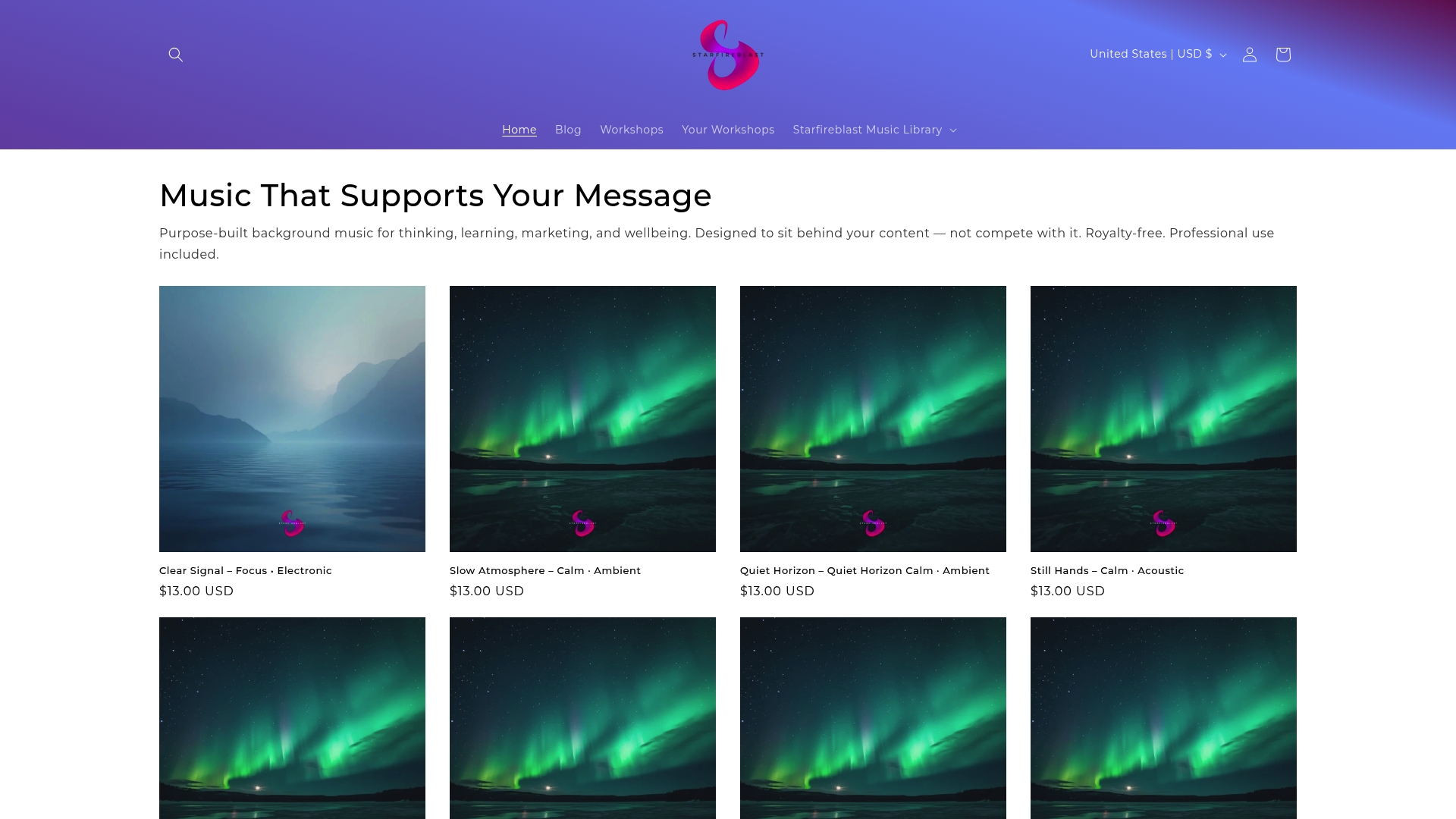
Take the next step in building a living, evolving business by visiting Starfireblast and start with our Starfireblast Music Library to add authentic creative resources to your brand. Clarify who you serve why it matters and how to act next today.
Frequently Asked Questions
How can I clarify my core audience and purpose for building a sustainable brand?
To clarify your core audience and purpose, start by identifying who benefits from your creations and why you create. Conduct research to define specific characteristics like age, struggles, and what they need. Write a clear statement about the audience you serve and your main purpose to guide your content.
What steps should I take to develop a distinctive brand position?
To develop a distinctive brand position, begin by listing your unique strengths, values, and methodologies that differentiate you from competitors. Communicate these elements consistently across all platforms, ensuring your messaging reflects your brand’s core idea. Test your position with your audience and refine it based on their feedback.
How do I create value-driven content that resonates with my audience?
Creating value-driven content means addressing real problems your audience faces with educational, practical, or reflective pieces. Focus on quality over quantity and maintain a consistent publishing schedule, like one substantial piece per week. Measure the engagement on your content to ensure it meets your audience’s needs and adjust as necessary.
What methods can I use to foster community engagement instead of just chasing followers?
To foster community engagement, create opportunities for two-way conversations by asking genuine questions and responding to comments personally. Share behind-the-scenes content to build connection and remember details about your audience. Establish a routine for engaging with your community regularly to strengthen relationships over just accumulating follower numbers.
How can I prioritize well-being in my workflow as a creator?
To prioritize well-being, design your workflow around your actual capacity and build in regular breaks. Schedule dedicated time for self-care activities that recharge you, ensuring you don’t sacrifice your health for productivity. Track your well-being metrics, such as sleep and energy levels, and make adjustments to your workload to maintain a sustainable balance.
What steps can I take to promote sustainable, incremental growth for my brand?
Promote sustainable, incremental growth by defining what growth means for you and setting realistic benchmarks to track progress over time. Focus on improving systems that support your work as you expand, and prioritize retaining existing community members before seeking new ones. Celebrate small wins regularly to maintain motivation and stay on track with your growth goals.
Recommended
- Top 8 Starblaze.co Alternatives in 2026 for Creative Teams Seeking Sus – Starfireblast
- Business Evolution Explained: Sustainable Growth for Entrepreneurs – Starfireblast
- Creating Community-Driven Brands for Sustainable Impact – Starfireblast
- How to Define Brand Strategy for Lasting Impact – Starfireblast