Founder-led strategy: how hands-on leadership drives growth
TL;DR:
- Founders who stay actively involved in customer, product, and decision-making often outperform those who delegate early.
- Founder-led strategy is most effective in early stages but requires careful transition as the company scales.
- Balancing involvement with system building reduces risks like burnout and decision bottlenecks, enabling sustainable growth.
Many successful startups achieve rapid growth not through formal hierarchies, but through founder-led, hands-on leadership that defies traditional management wisdom. The common assumption is that scaling a business requires founders to step back, delegate everything, and become pure strategists. The data tells a different story. Founders who stay closely involved with customers, product, and people often outperform those who hand off control too early. This guide breaks down what founder-led strategy actually means, why it works, where it breaks down, and how you can apply it to build a business that grows without losing its core mission.
Table of Contents
- What is founder-led strategy?
- How does founder-led strategy work in practice?
- Pros, risks, and limitations of founder-led strategy
- How to balance founder involvement for sustainable growth
- What most guides miss about founder-led strategy
- Ready to apply founder-led strategy to your growth journey?
- Frequently asked questions
Key Takeaways
| Point | Details |
|---|---|
| Hands-on leadership | Founder-led strategy means direct involvement in product, people, and customers fuels early growth. |
| Rapid adaptation | Personal engagement lets founders react quickly and steer the business toward market fit. |
| Limits and risks | Founder-led approaches risk burnout and bottlenecks, requiring transition as companies scale. |
| Balance for sustainability | Sustainable growth combines founder strengths with team empowerment and systems. |
What is founder-led strategy?
Founder-led strategy is a leadership approach where the founder stays actively involved in core business decisions, customer relationships, and product direction rather than delegating these functions to a management layer. It is not about micromanaging. It is about maintaining direct contact with the people and problems that define your business.
This approach stands in contrast to classic managerial structures, where a founder hires executives and steps into a purely oversight role early on. In a traditional setup, layers of management filter information before it reaches the top. In a founder-led model, that filtering is minimized.
Paul Graham, co-founder of Y Combinator, articulated this distinction clearly with the concept of “Founder Mode” versus “Manager Mode.” Founder Mode describes hands-on involvement, direct customer engagement, bias for action, speed in decision-making, and staying close to product, people, and customers rather than delegating through rigid hierarchies.
“The most effective early-stage founders are not managing from a distance. They are inside the work, talking to customers, making product calls, and moving fast.”
Here is what founder-led strategy looks like in practice:
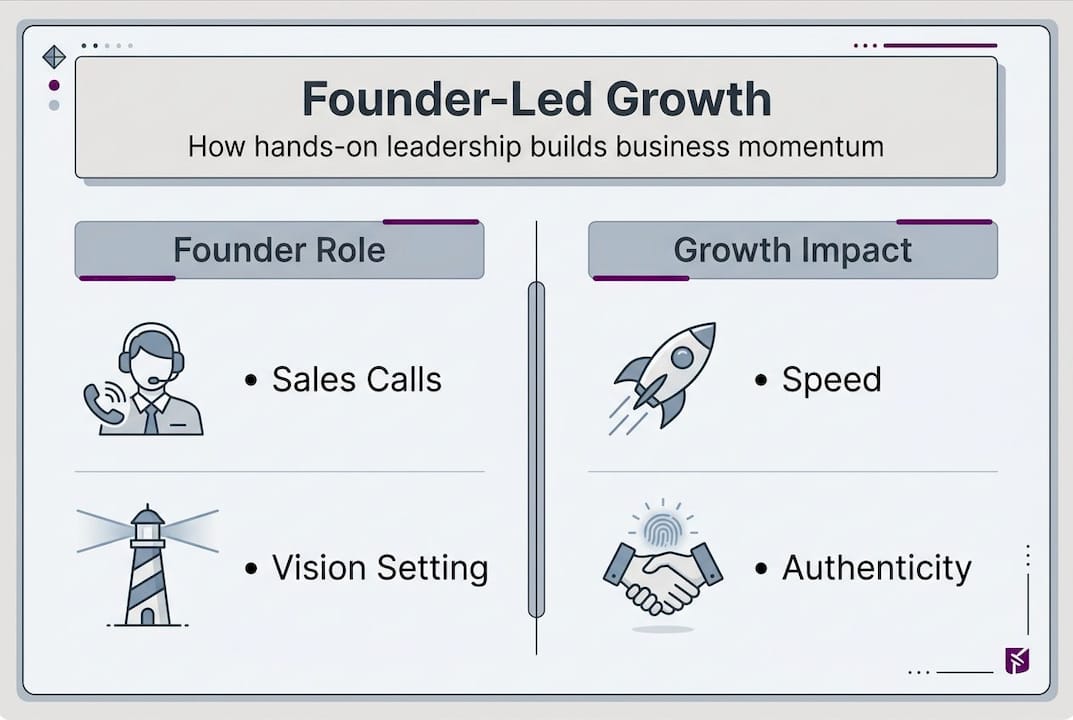
- Direct customer contact: Founders personally run sales calls, handle support, and gather feedback.
- Fast decision cycles: No committee approvals. Decisions happen quickly because the founder has full context.
- Product proximity: Founders stay close to what is being built, often contributing to design or feature decisions.
- Mission alignment: Every action connects back to why the company exists.
- Flat communication: Teams hear strategy directly from the founder, not through layers of management.
Research consistently shows this approach works well in early stages. When founders embed vision in community growth, they create trust and momentum that hired managers often cannot replicate. The founder carries credibility that no job title can manufacture.
How does founder-led strategy work in practice?
Defining the concept is important, but how does founder-led strategy actually come to life once you are building a company?
In the earliest stages, founders personally drive sales. They make the calls, send the emails, run the demos, and close the deals. This is not just about saving money on a sales team. It is about learning. Every conversation with a potential customer teaches you something about positioning, objections, and product gaps that no market research report can replicate.

Founder-led sales closes 94% of deals under $1M revenue. That number alone should reframe how early-stage founders think about hiring a sales team too soon.
Here is a typical progression for founder-led strategy from zero to scale:
- Validate demand: Founders conduct direct outreach and close the first 10 to 20 customers personally.
- Build feedback loops: Every customer interaction feeds directly into product iteration.
- Establish positioning: Personal brand and founder credibility drive early marketing.
- Hit initial revenue targets: Transition to team-led approaches as revenue scales, typically around $1M ARR.
- Systemize what works: Document the sales and marketing playbooks built from founder experience.
- Hire into proven processes: Bring in people to run systems you have already validated.
Here is a simple benchmark table for founder-led sales progression:
| Stage | Revenue range | Founder involvement | Primary focus |
|---|---|---|---|
| Early validation | $0 to $100K | Very high | Direct outreach, closing deals |
| Growth | $100K to $500K | High | Coaching first hires, refining process |
| Scaling | $500K to $1M+ | Moderate | Systems, delegation, strategy |
Leveraging sustainable growth strategies alongside founder-led sales creates compounding momentum. Your personal network is your first distribution channel. Use it.
Pro Tip: Before hiring your first salesperson, document every objection you hear and every message that converts. That knowledge is the foundation of your sales playbook, and it only exists because you were in the room.
Strong positioning in sales is another area where founder involvement pays dividends. Founders understand the “why” behind the product better than anyone, and that clarity translates directly into more persuasive conversations.
Pros, risks, and limitations of founder-led strategy
While founder-led leadership brings speed and energy, it is not all upside. What should entrepreneurs watch for as companies scale?
The advantages are real and well-documented. But so are the failure modes. Here is a direct comparison:
| Factor | Founder-led | Manager-led |
|---|---|---|
| Decision speed | Fast | Slower, more process-driven |
| Customer proximity | High | Variable |
| Mission alignment | Strong | Depends on hiring quality |
| Scalability | Limited without systems | Higher with right structure |
| Risk of burnout | High | Lower |
| Talent retention | Can struggle at scale | Generally stronger |
Common risks include:
- Founder bottleneck: When every decision requires founder input, growth stalls.
- Burnout: Sustained high involvement without support structures leads to exhaustion.
- Over-centralization: Teams stop thinking independently because they wait for founder direction.
- Talent exodus: Senior hires leave when they have no real authority. 38% shorter exec tenure is a documented risk in founder-dominated environments.
Founder-led strategy works best in high-growth tech startups and mission-driven small businesses where speed and authenticity matter more than process. It becomes a liability when the company grows beyond what one person can meaningfully influence.
The path forward is not abandoning founder involvement. It is evolving it. Explore how business evolution works in practice to understand when and how to shift your leadership model.
The key signal to watch: if your team is consistently waiting for you before moving forward, you have crossed from asset to obstacle. That is the moment to redesign your involvement, not eliminate it.
How to balance founder involvement for sustainable growth
Given the risks, how can founders keep the strengths of their involvement while building a resilient, scalable business?
The best examples come from founders who made deliberate transitions. Jeff Bezos at Amazon and Brian Chesky at Airbnb both stayed deeply involved in product and culture while building systems that extended their influence beyond their direct reach. Poor transitions, like those seen at Uber in its early scaling years, show what happens when leadership evolution is reactive rather than planned. Founder-to-manager transitions succeed when founders prioritize reinvestment in systems, people, and long-term capability rather than short-term control.
Here are practical steps for balancing founder involvement:
- Identify your highest-leverage activities: Which tasks only you can do well right now? Focus there.
- Document before delegating: Turn your instincts into written processes before handing them off.
- Hire for mission fit: People who understand why you exist will extend your vision without constant guidance.
- Build decision frameworks: Give your team clear criteria for making calls without you.
- Schedule strategic withdrawal: Deliberately reduce involvement in areas where your team is ready.
- Protect your energy: Treat your attention as a finite resource, not an infinite one.
A purpose-driven strategy guide can help you clarify which parts of your business genuinely need your direct involvement versus which parts just feel that way.
Pro Tip: Use a simple weekly audit. List every decision you made that week. Flag any that someone else could have made with the right context. That list becomes your delegation roadmap.
Sustainable growth requires founders to invest as much in enabling others as in personal execution. Action planning for progress is not just about doing more. It is about designing systems that keep moving when you step back.
What most guides miss about founder-led strategy
Most popular startup books frame founder-led versus manager-led as a binary choice. You are either in the trenches or you are leading from above. That framing is too simple and often harmful.
The real mistake founders make is not staying too long or leaving too soon. It is making leadership transitions based on urgency rather than design. A funding round arrives, headcount grows, and suddenly the founder hands off sales or product without embedding the knowledge, values, or decision criteria that made those functions work.
The most sustainable growth happens when founders invest in making themselves transferable before they step back. That means embedding mission and learning into the company’s DNA, not just its pitch deck. It means building teams that can think like the founder, not just execute founder instructions.
There is also a cultural dimension most guides ignore. When founders stay involved in the right ways, they signal what matters. When they disappear too fast, the culture drifts toward whoever fills the vacuum. Purposeful growth is not an accident. It is the result of deliberate founder choices about where to stay present and where to let go.
Ready to apply founder-led strategy to your growth journey?
If you are ready to put these strategies into action in your own entrepreneurial journey, there are specialized resources that can help.
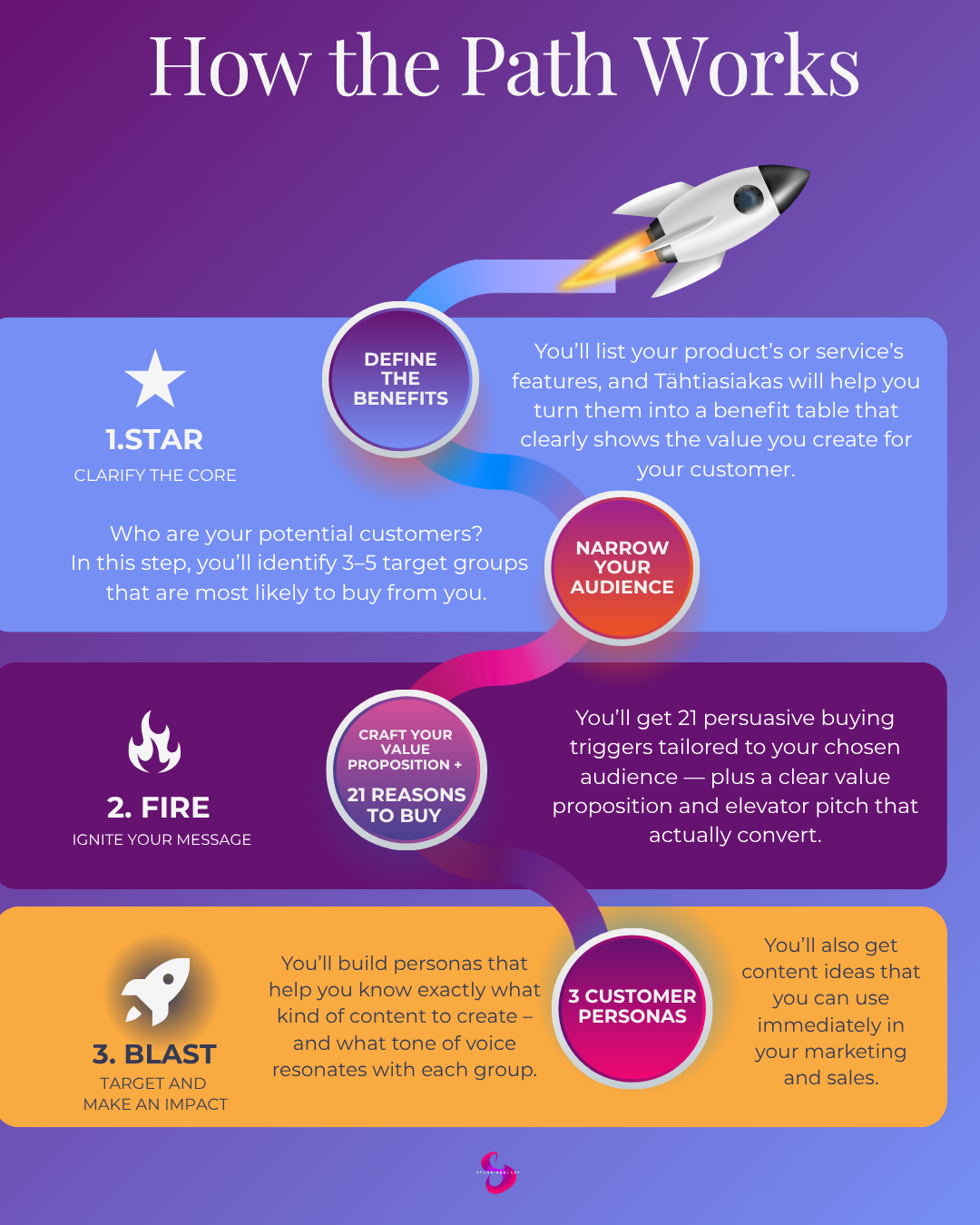
Starfireblast is built for founders who want to lead with clarity, not just hustle. The platform offers practical tools, workshops, and guides designed for mission-driven entrepreneurs at every stage. The Customer StarMap™ AI Power Workshop helps you clarify who you are building for and how to position your founder involvement for maximum impact. Whether you are in early validation or approaching your first major transition, these resources help you operationalize what you have learned here and build a business that scales without losing what makes it yours.
Frequently asked questions
Is founder-led strategy only for startups?
Founder-led strategy is most common in startups and high-growth companies but can be adapted by small businesses at various stages as long as the model evolves with the company’s needs.
When should a founder transition out of direct leadership?
Transition as you approach product-market fit, consistently hit revenue milestones, or when you become a bottleneck. Most founders begin this shift around $1M ARR when team-led structures become more effective.
What are the main risks of founder-led strategy?
Burnout, talent turnover, and over-centralized decision-making are the most common risks. Founder bottleneck and talent exodus become serious problems when founders do not evolve their leadership style as the company grows.
Can founder-led strategy work in non-tech industries?
Yes. Founder-led strategy drives strong results in any field where trust, authenticity, and adaptability matter. 94% close rates in early-stage sales apply across industries, not just software.
Recommended
- Founder Vision Drives 40% More Community Growth in 2026 – Starfireblast
- Master key leadership skills for innovators to drive impact – Starfireblast
- Sustainable growth strategies for entrepreneurs in 2026 – Starfireblast
- Harness the role of vision in growth: sustainable success – Starfireblast
- Unlock Business Growth: Leadership and Team Development – The Sixth Pillar of Mastery