How content drives authentic brand building and community
TL;DR:
- Content now builds trust, brand equity, and community for small businesses.
- Different formats like blogs, videos, social, and email serve specific brand-building purposes.
- Authenticity and genuine engagement are essential for long-term brand success and loyalty.
Content is not just a marketing channel anymore. For purpose-driven entrepreneurs and small teams, it has become the primary way audiences decide whether to trust you, follow you, and eventually buy from you. 71% of marketers report content marketing is more important now than it was two years ago, and 58% link it directly to increased sales. Yet most small business owners still treat content as an afterthought, something to post when there is time. This guide breaks down how to use content as a deliberate, values-led strategy that builds real brand equity and a community that grows with you.
Table of Contents
- Why content is essential for modern brand building
- How different types of content shape brand perception
- Content as a vehicle for purpose, values, and community
- Measuring content success: ROI, growth and authenticity
- A fresh perspective: Why authenticity is the only path to lasting brand value
- How we help you build authentic brand growth
- Frequently asked questions
Key Takeaways
| Point | Details |
|---|---|
| Content builds trust | Authentic content helps small businesses connect deeply with their audience and grow lasting trust. |
| Multiple formats matter | Mixing blogs, video, social, and email maximizes brand credibility and community engagement. |
| Measure both ROI and impact | Track tangible returns and audience sentiment to refine strategies and fuel sustainable growth. |
| Interaction is crucial | Two-way dialogue and community involvement set purpose-driven brands apart in saturated markets. |
Why content is essential for modern brand building
Content used to mean blog posts and press releases. Today it is the foundation of how your brand thinks, speaks, and shows up for the people it serves. For entrepreneurs and small teams, this shift is not a burden. It is an advantage.
Large companies spend millions on advertising to manufacture trust. You can build it organically through consistent, honest content that reflects who you are and what you stand for. That is not a small thing. Companies running blogs see 13x positive ROI compared to those that do not. That gap exists because content compounds over time. Each article, video, or post adds to a body of work that signals credibility.
“Content is no longer a megaphone. It is a handshake.”
Here is what strategic content does for your brand that paid ads simply cannot:
- It attracts the right audience by reflecting your actual values
- It builds authentic brand connection before a single sale is made
- It reduces the cost of customer acquisition over time
- It creates a searchable, shareable record of your expertise
- It generates word-of-mouth because people share what resonates
Entrepreneurs who use content strategically often outperform larger competitors in niche markets. The reason is specificity. A solo founder who speaks directly to a defined audience will always outperform a corporate brand broadcasting to everyone. Brand clarity and trust are not byproducts of good content. They are the goal.
The shift to treat content as a brand foundation rather than a marketing add-on is the single biggest leverage point available to small teams in 2026. With that foundation in place, the next step is understanding which content formats do what job best.
How different types of content shape brand perception
Not all content works the same way. Each format serves a different purpose in how your audience experiences your brand. Knowing the difference helps you invest your limited time where it counts most.
Blogs establish expertise and help your audience find you through search. A well-written post answers a real question and positions you as a reliable source. Over time, a library of posts becomes a searchable asset that works for you around the clock.
Videos build emotional connection faster than any other format. When someone sees your face, hears your voice, and watches how you explain something, trust forms quickly. Building trust with video is one of the most underused tools for small brand builders.

Social content invites real-time engagement. It turns passive followers into active participants. Comments, shares, and replies are data points showing what your audience actually cares about.
Email is the most personal channel you own. Unlike social platforms, your list belongs to you. It allows for direct, personalized communication that deepens relationships over time.
Video and email deliver the highest ROI for small and medium business brand building. That does not mean you ignore blogs or social. It means you prioritize based on where your audience already spends time.
| Content type | Primary brand benefit | Best for |
|---|---|---|
| Blog | Authority and search visibility | Long-term discoverability |
| Video | Emotional trust and authenticity | Fast relationship building |
| Social | Engagement and community feedback | Real-time interaction |
| Personalized nurture and loyalty | Retention and conversion |
Here is a simple way to sequence your content investment:
- Start with the format your audience already uses most
- Build one core piece of content per week at depth
- Repurpose that core piece across other formats
- Track what generates conversation, not just clicks
- Double down on formats that produce real responses
Pro Tip: Look at personal branding examples from creators in adjacent spaces to identify which formats your audience trusts most before you commit your time.
With the right formats identified, the next layer is making sure your content actually transmits your values and builds community, not just an audience.
Content as a vehicle for purpose, values, and community
Content that only promotes products creates a one-way relationship. Content that shares your mission, shows your values in action, and invites participation creates something more durable: community.
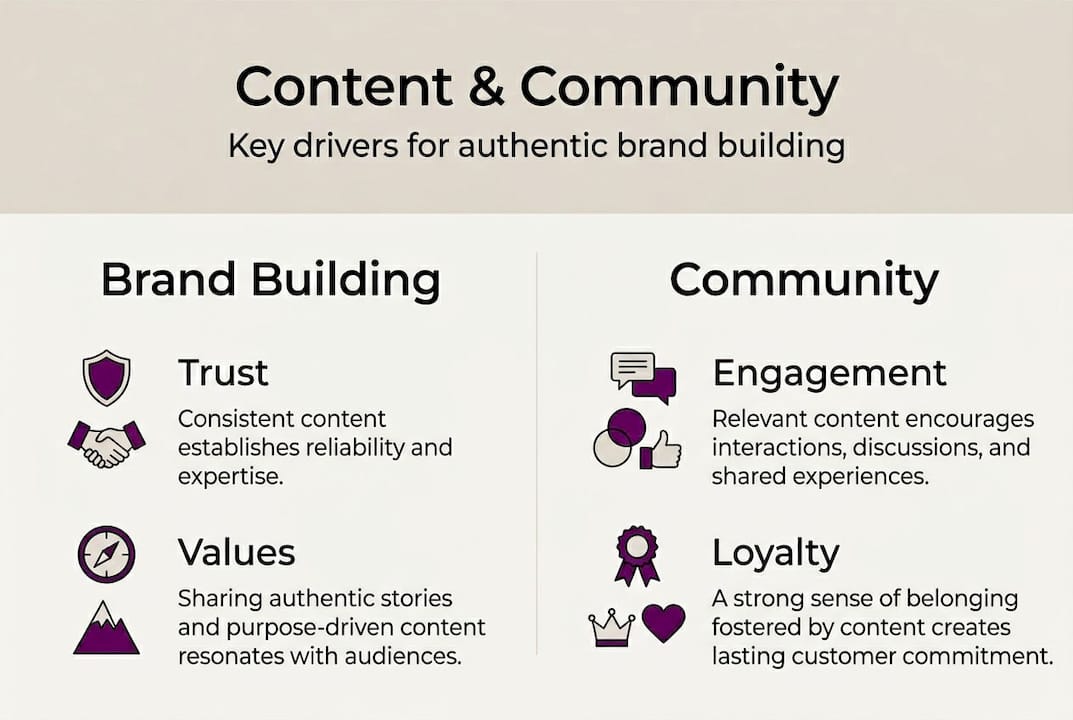
Digital content enables SMEs to build brands through orientation, identity, marketing, and performance, with a specific focus on interactivity, corporate social responsibility, and community formation. In practical terms, this means your content can do more than sell. It can orient new visitors to your worldview, reinforce identity for existing followers, and signal your responsibility to something larger than revenue.
The brands that build the most loyal communities are the ones that balance broadcasting with two-way interaction. Posting content and never responding to comments is the fastest way to create a disengaged audience. Asking questions, featuring community voices, and responding to feedback signals that you are listening.
- Share behind-the-scenes decisions that reflect your values
- Highlight community members and their contributions
- Ask your audience what they need before you create new content
- Use engagement metrics and sentiment to track community health
- Acknowledge mistakes publicly when they happen
Pro Tip: Encourage audience contributions such as stories, questions, or responses to prompts. User-generated content grows trust faster than brand-created content because it shows real people believe in what you are building. This is core to community-driven brand impact.
| Community signal | What to track | Why it matters |
|---|---|---|
| Comments and replies | Volume and tone | Shows active engagement |
| User-generated content | Frequency and reach | Indicates advocacy |
| Repeat engagement | Return visits and opens | Signals loyalty |
| Sentiment | Positive vs. negative tone | Reflects brand trust |
Values-driven branding is not a positioning strategy. It is a daily practice visible in every piece of content you publish. And purpose-driven branding starts with being clear on what you stand for before you decide what to say.
With your values embedded in your content and community signals in place, the next step is measuring whether it is actually working.
Measuring content success: ROI, growth and authenticity
Most small teams measure content by vanity metrics: likes, impressions, follower counts. These numbers feel good but rarely connect to business outcomes. Real measurement tracks both quantitative and qualitative results.
On the quantitative side, track leads generated, email list growth, conversion rates from content pages, and revenue attributed to content channels. Content marketing ROI averages $3 to $7.65 per $1 spent, is 62% cheaper than outbound marketing, and generates three times more leads. Those are benchmarks worth knowing.
“Chasing reach without depth is the fastest way to build an audience that never buys.”
On the qualitative side, look at:
- Community stories: Are people sharing how your content helped them?
- Sentiment in comments: Is the tone positive, curious, or critical?
- Repeat engagement: Are the same people coming back?
- Direct messages: Are readers reaching out with real questions?
- Referrals: Are community members bringing others in?
Authenticity shows up in engagement patterns. A post with 50 genuine comments from real community members outperforms one with 5,000 passive impressions. Growth strategies for creators that prioritize depth over reach consistently produce better long-term results.
Continuous optimization means learning from what resonates and building on it. Not chasing trends. Not copying what worked for someone else. Looking at your own data and asking: what did our community respond to, and why?
The biggest pitfall is pursuing viral reach at the expense of trust with your actual audience. Community marketing tactics built on genuine interaction will always outperform broadcast strategies over a 12-month horizon.
A fresh perspective: Why authenticity is the only path to lasting brand value
There is a growing temptation to use AI tools to produce more content faster, optimize every headline for algorithms, and chase platform trends. Some of that is useful. But it misses the point.
Audiences are not passive. They notice when content feels generated rather than genuine. They notice when a brand talks about values but never shows them in action. AI can help moderate content, but only humans can bring empathy and authenticity. Inauthentic claims risk brand trust in ways that are very hard to recover from.
Long-term brand equity comes from vulnerability, real values, and actual conversation. Not from broadcasting polished content into the void. The brands that will matter in five years are the ones building real relationships now, not the ones with the most posts.
This is the core of purpose-driven entrepreneurship: building something that reflects who you are and who you serve, with honesty as the strategy.
How we help you build authentic brand growth
Knowing what to do with content is one thing. Knowing where to start, who you are building for, and how to connect your content to real business outcomes is another.
At Starfireblast, we built the Customer StarMap™ Power Workshop specifically for entrepreneurs and small teams who want to stop guessing and start building with clarity. It helps you map your ideal customer, align your content with your brand values, and create a strategy that drives community-led growth. If you are ready to turn your content into a genuine brand asset, this is where to start.
Frequently asked questions
What is the most effective content type for building brand trust?
Video and email deliver the highest trust and ROI for small businesses because they combine personal connection with direct, owned communication channels.
How does content marketing ROI compare with traditional advertising?
Content marketing is 62% cheaper than outbound methods and generates three times more leads, making it the more efficient long-term investment for small teams.
How can small teams keep content authentic?
Prioritize two-way engagement, align every piece of content with your real values, and avoid copying industry buzzwords that risk inauthenticity in purpose-driven claims.
What’s a common mistake entrepreneurs make with brand content?
Focusing on reach and quantity instead of building genuine connections. Balancing broadcasting with two-way interaction is key to preventing a disengaged audience.
Recommended
- Authentic Branding: Building Real Connection and Trust – Starfireblast
- Creating Community-Driven Brands for Sustainable Impact – Starfireblast
- 7 Growth Strategies for Creators to Build Sustainable Brands – Starfireblast
- Role of Mission in Branding: Building Authentic Impact – Starfireblast
- Brand storytelling ideas to boost recognition in 2026