Brand clarity guide for purpose-driven entrepreneurs 2026
Building a purpose-driven business without clear brand identity is like navigating without a compass. You know your destination matters, but unclear messaging confuses your audience, dilutes loyalty, and stalls growth. Many solo entrepreneurs and small teams struggle to articulate who they serve and why it matters, leaving revenue and impact on the table. This guide provides actionable steps to clarify your brand identity, align your messaging with your mission, and strategically engage your target market for sustainable growth in 2026.
Table of Contents
- Understanding Brand Clarity: What It Is And Why It Matters
- Preparing For Brand Clarity: Internal Audits And Identity Foundations
- Executing Brand Clarity: Strategic Frameworks And Messaging Alignment
- Verifying And Sustaining Brand Clarity Over Time
- Boost Your Brand Clarity With The Customer Starmap™ AI Power Workshop
- Frequently Asked Questions
Key takeaways
| Point | Details |
|---|---|
| Clarity drives measurable growth | Brand clarity boosts loyalty by 37% and revenue by 23% through consistent messaging. |
| Internal work precedes external positioning | Define purpose, values, and identity internally before crafting market-facing messages. |
| Frameworks simplify execution | Use structured approaches like Brand DNA pillars or 5-step guides to build clarity systematically. |
| Testing eliminates ambiguity | Apply the one-sentence test to ensure messaging avoids jargon and multiple interpretations. |
| Quarterly reviews sustain alignment | Regular audits prevent brand drift and keep your identity sharp as you grow. |
Understanding brand clarity: what it is and why it matters
Brand clarity means your business presents a unified, consistent identity that your target audience immediately understands. It’s the difference between customers saying “I get what you do” versus “What exactly do you offer?” When your messaging, visuals, and actions align, people recognize your value faster and trust you more deeply.
Data proves clarity pays off. Brands with high clarity see 37% higher loyalty and 23% higher revenue growth compared to competitors with muddled positioning. One case study showed how a brand identity overhaul resulted in 47% lead increase and close rates jumping to 68%. These numbers matter because purpose-driven solo entrepreneurs operate in crowded markets where differentiation determines survival.
Without clarity, you face specific challenges. Your marketing feels scattered because you haven’t defined who you’re talking to. Sales conversations drag because prospects don’t understand your unique value. Customer loyalty suffers when people can’t explain what makes you different. For purpose-driven businesses, unclear branding also undermines your mission, making it harder to attract aligned customers who share your values.
Brand clarity delivers tangible benefits beyond revenue:
- Faster customer decision-making because your value proposition is obvious
- Stronger word-of-mouth referrals when customers can easily explain what you do
- More efficient marketing spend by targeting the right people with precise messages
- Enhanced team alignment when everyone understands the brand’s core identity
- Sustainable growth rooted in authentic connections rather than algorithmic tricks
“Clarity isn’t about being simple. It’s about being unmistakable. Your audience should never have to guess what you stand for or who you serve.”
For solo entrepreneurs and small teams, clarity becomes your competitive advantage. You can’t outspend larger competitors, but you can out-clarify them. When your brand clarity guide shows exactly who benefits from your work and why, you attract customers who value your unique approach. This alignment fuels sustainable growth without burning out or chasing trends.
Preparing for brand clarity: internal audits and identity foundations
Before you craft external messages, you need rock-solid internal foundations. Start with an audit that answers fundamental questions about your business identity. This process clarifies your purpose, values, and the unique perspective you bring to your market.
Follow this numbered sequence for your internal audit:
- Document your core purpose by completing this sentence: “We exist to help [specific audience] achieve [specific outcome] because [deeper reason].”
- List your non-negotiable values, limiting yourself to three to five principles that truly guide decisions.
- Identify your unique perspective or methodology that differentiates your approach from competitors.
- Define your ideal customer with specificity, going beyond demographics to include psychographics, challenges, and aspirations.
- Articulate the transformation you deliver, describing both the before state and after state of working with you.
The Brand DNA framework provides structure for this internal work. Purpose-driven approaches emphasize internal identity integration using three pillars: Identify, Define, Align. The Identify phase uncovers your authentic brand essence. Define translates that essence into clear language and visual systems. Align ensures every touchpoint reinforces the same identity.

This inside-out approach matters because external positioning built on shaky foundations crumbles under market pressure. When you clarify brand purpose internally first, your messaging stays consistent even as tactics evolve. Research shows 85% of entrepreneurs who complete internal clarity work succeed within three months, compared to scattered efforts that drag on indefinitely.
Quarterly reviews prevent brand drift as your business grows. Schedule 90-day check-ins to assess whether your messaging still reflects your core identity. Ask yourself: Have we stayed true to our purpose? Do our recent decisions align with our stated values? Are we still serving our defined ideal customer? These reviews catch misalignment early, before confusion spreads to your audience.
Pro Tip: Create a one-page brand clarity guide that distills your purpose, values, audience, and key messages. Share this document with anyone who represents your brand, from contractors to partners. This simple tool keeps everyone aligned without lengthy brand manuals. Update it quarterly as you refine your understanding, but resist changing core elements unless truly necessary. Consistency builds recognition, and recognition builds trust. When purpose matters in branding, this internal alignment becomes your strategic foundation for every external decision.
Executing brand clarity: strategic frameworks and messaging alignment
Once your internal foundations are solid, translate that clarity into external-facing brand elements. Strategic frameworks guide this translation, ensuring your positioning and messaging resonate with your target market while staying true to your core identity.
Practical frameworks vary in complexity and focus. Some emphasize visual identity and voice, while others prioritize positioning and promises. Choose the approach that matches your current needs and resources. A five-step method might include defining purpose, establishing visual identity, developing brand voice, creating core messages, and testing comprehension. A four-part framework could focus on foundation, positioning, messaging, and brand promises.
Here’s how different frameworks compare:
| Framework Type | Best For | Key Advantage | Time Investment |
|---|---|---|---|
| 5-step comprehensive | New brands building from scratch | Covers all elements systematically | 8-12 weeks |
| 4-part strategic | Established brands refining clarity | Focuses on market-facing elements | 4-6 weeks |
| Quarterly review | Ongoing alignment maintenance | Prevents drift with regular check-ins | 2-4 hours per quarter |
| One-sentence test | Quick clarity verification | Immediately identifies ambiguity | 30 minutes |
Common methodologies for brand clarity include these structured approaches, each offering different entry points depending on where confusion exists in your current brand.
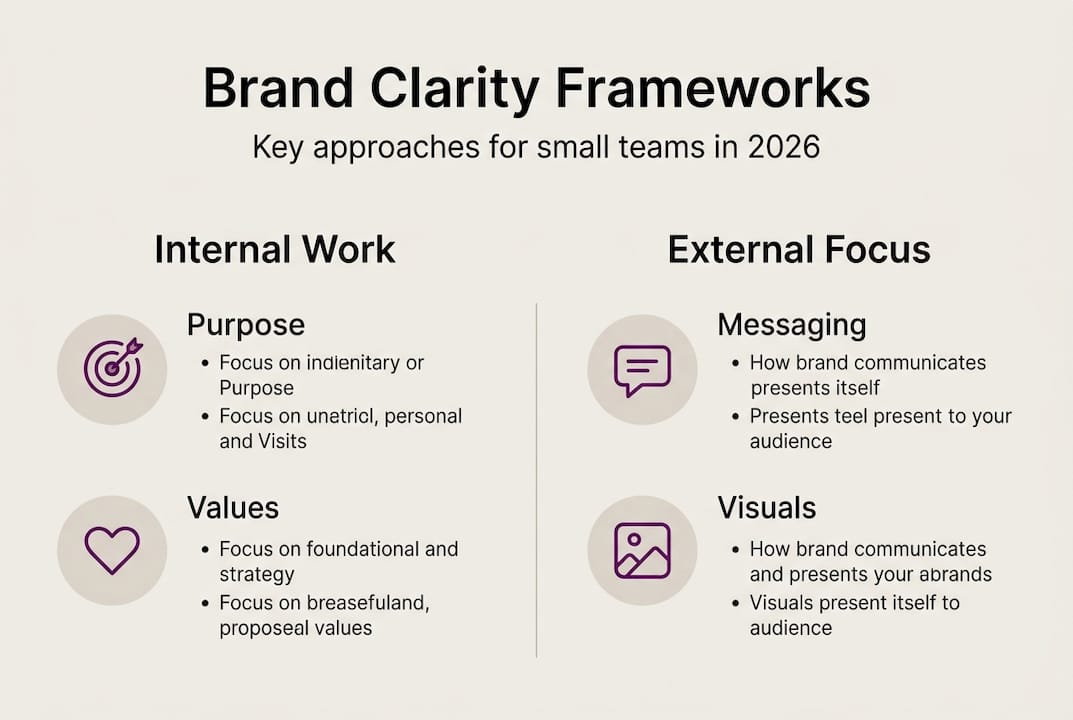
Aligning visual identity, voice, and messaging requires intentional coordination. Your visual elements should reinforce your core purpose, not contradict it. If your purpose centers on accessibility, complex graphics undermine that message. If you value transparency, corporate jargon in your copy creates dissonance. Every element must point in the same direction.
Key alignment considerations include:
- Visual consistency across all platforms, from website to social media to email
- Voice that matches your audience’s communication style while reflecting your values
- Messaging hierarchy that leads with your strongest value proposition
- Story elements that humanize your purpose without distracting from practical benefits
Pro Tip: Apply the one-sentence test to eliminate jargon and ambiguity. Can someone unfamiliar with your industry explain what you do after reading one sentence? If not, simplify. Avoid terms that carry multiple interpretations or require insider knowledge. Your grandmother and a industry expert should both grasp your core value, even if they understand different layers of depth. This test forces clarity by exposing assumptions you didn’t know you were making.
Consistent, repeatable communications build recognition over time. Develop core message templates for common scenarios: introductions, elevator pitches, social media bios, email signatures. When you repeat the same positioning across contexts, people start to remember and repeat it themselves. This repetition isn’t boring; it’s strategic. Brand positioning step by step shows how clear messaging compounds, turning confused prospects into confident advocates.
Your brand story development should emerge naturally from this framework work. Stories illustrate your purpose and values through real examples, making abstract concepts concrete. But stories serve clarity, not replace it. Lead with your clear value proposition, then use stories to deepen understanding and emotional connection. This sequence ensures people grasp what you do before they get invested in why it matters.
Verifying and sustaining brand clarity over time
Clarity isn’t a one-time achievement. Markets shift, businesses evolve, and messaging can drift without active maintenance. Verification methods and ongoing reviews keep your brand sharp as you scale.
Measure brand clarity through specific data points that reveal how well your audience understands your identity. Customer comprehension surveys ask people to describe your business in their own words. If responses vary wildly, your messaging lacks clarity. If most people use similar language, you’ve achieved consistent positioning. Track this metric quarterly to catch drift early.
Additional measurement tools include:
- Net Promoter Score segmented by customer understanding levels
- Time to close in sales cycles, which shortens with clearer positioning
- Referral quality, measuring whether new customers match your ideal profile
- Content engagement patterns showing which messages resonate most
- Customer lifetime value to customer acquisition cost ratios
Clarity scales via systems and data observation, measured by scorecards, comprehension surveys, and LTV:CAC ratios. These metrics transform subjective feelings about brand health into objective insights you can act on.
Common pitfalls undermine even well-intentioned clarity efforts. Jargon creeps in when you spend too much time in industry circles, making insider language feel normal. Multiple interpretations emerge when you try to appeal to everyone, diluting your core message. Inconsistent execution happens when team members lack clear guidelines, creating fragmented brand experiences.
Avoid these traps by:
- Testing all messaging with people outside your industry before publishing
- Choosing one primary audience and serving them exceptionally well
- Creating simple brand guidelines that anyone can follow
- Auditing customer-facing materials quarterly for consistency
Quarterly brand reviews formalize this verification process. Set aside two to four hours every 90 days to assess your brand health. Review customer feedback, analyze messaging performance, check visual consistency, and update your one-page brand guide if needed. These sessions prevent the slow drift that happens when daily operations consume your attention.
Here’s what key metrics reveal about brand clarity:
| Metric | Strong Clarity Indicator | Weak Clarity Indicator | Action Needed |
|---|---|---|---|
| Customer comprehension | 80%+ describe you similarly | Under 60% alignment | Simplify core message |
| Sales cycle length | Shortening over time | Lengthening or stagnant | Clarify value proposition |
| Referral match rate | 70%+ fit ideal profile | Under 50% match | Refine audience definition |
| LTV:CAC ratio | 3:1 or higher | Under 2:1 | Improve positioning or targeting |
Address the edge case of short-term confusion during rebrands with transparent communication. When you evolve your brand, existing customers may feel disoriented. Acknowledge the change, explain why it serves them better, and give them time to adjust. The brand identity overhaul case study showed initial confusion resolved within weeks when companies communicated clearly about changes. Long-term gains in clarity and growth far outweighed temporary uncertainty.
Sustained clarity requires treating your brand as a living system, not a fixed asset. Your step by step branding process should include regular check-ins and adjustments. Markets change, customer needs evolve, and your business grows. Clarity means adapting while maintaining core identity, not rigidly clinging to outdated positioning. The brand clarity in one sentence test provides a quick verification tool you can apply anytime you question whether your messaging still works.
Boost your brand clarity with the Customer StarMap™ AI Power Workshop
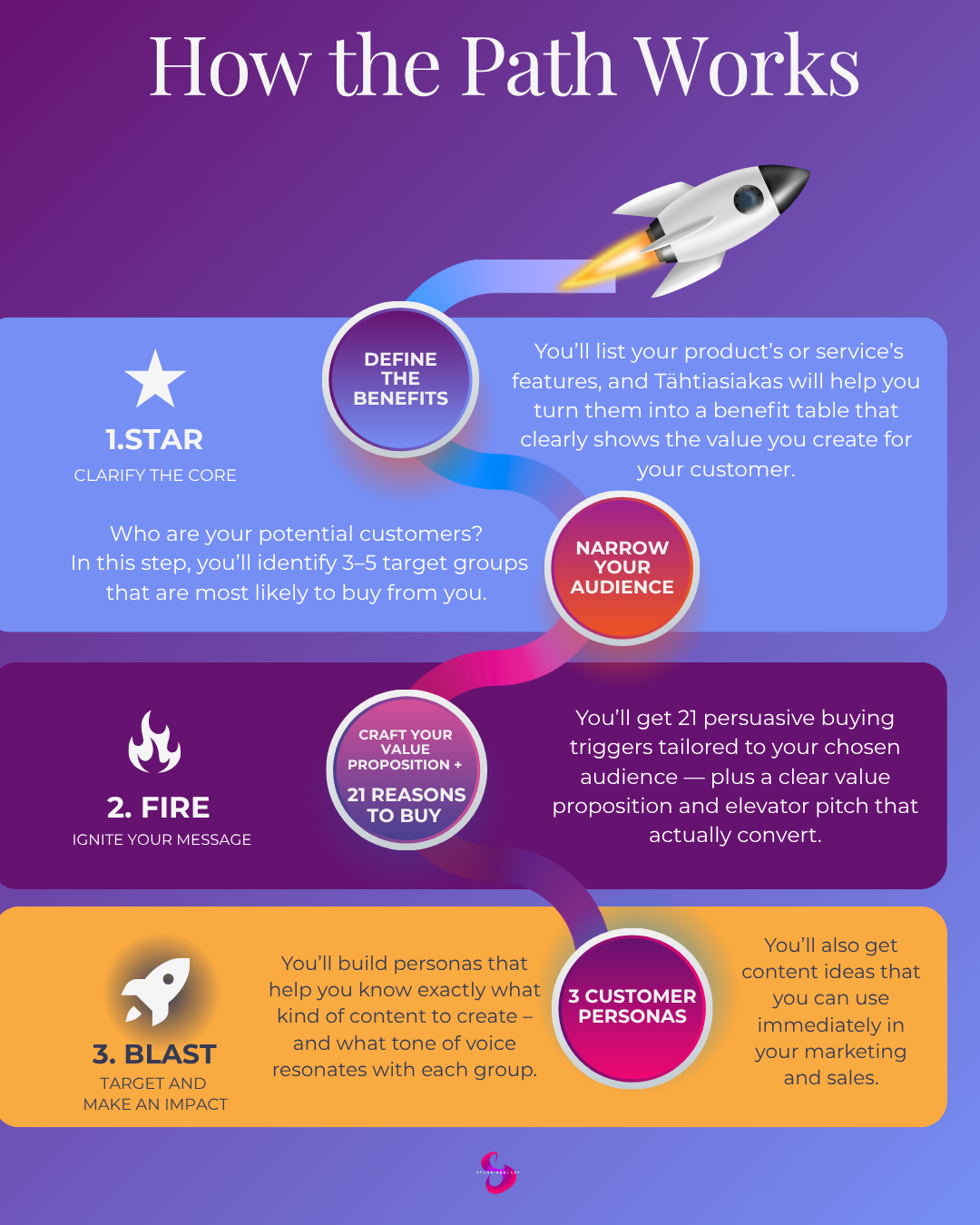
You’ve learned the frameworks and steps for building brand clarity, but executing them alone can feel overwhelming. The Customer StarMap™ Power Workshop accelerates your clarity journey by combining AI-powered insights with proven positioning strategies.
This workshop helps you map your ideal customer with precision, connecting your purpose to their specific needs and aspirations. You’ll uncover the exact language your audience uses, identify their decision-making patterns, and craft messaging that resonates immediately. The AI-assisted process saves weeks of trial and error, giving you clarity that typically takes months to achieve through traditional methods.
Pro Tip: The workshop works best after you’ve completed your internal brand audit. Come prepared with your purpose statement and core values defined, then use the workshop to translate that internal clarity into external positioning that attracts your ideal customers.
Purpose-driven solo entrepreneurs and small teams benefit most from this structured approach. You gain a clear roadmap for who you serve, why they need you, and how to communicate your unique value. Instead of guessing at messaging or copying competitors, you build positioning rooted in genuine customer understanding. Explore more resources and tools at Starfireblast to support your brand clarity journey beyond this workshop.
Frequently asked questions
What are the key steps to achieve brand clarity as a solo entrepreneur?
Start with an internal audit defining your purpose, values, and ideal customer. Then apply a strategic framework to develop positioning and messaging. Test everything with the one-sentence test to eliminate jargon. Finally, implement quarterly reviews to maintain alignment as you grow. This brand clarity guide provides detailed steps for each phase.
How long does it take to develop clear brand identity?
Most entrepreneurs achieve foundational clarity within four to twelve weeks using structured frameworks. The internal audit takes one to two weeks, framework execution requires four to six weeks, and testing adds another week. However, sustaining clarity is ongoing work requiring quarterly reviews. Rushing the process produces superficial results, while overthinking delays action indefinitely.
What’s the biggest mistake entrepreneurs make with brand clarity?
Skipping internal work and jumping straight to external messaging. When you haven’t defined your purpose and values internally, your positioning shifts with every market trend. This creates confusion for your audience and exhaustion for you. Solid internal foundations let you adapt tactics while maintaining consistent identity, which builds trust over time.
How do I know if my brand messaging is clear enough?
Apply the one-sentence test: can someone unfamiliar with your industry explain what you do after one sentence? Also track customer comprehension through surveys asking people to describe your business. If 80% or more use similar language, you’ve achieved clarity. Sales cycle length and referral quality provide additional signals about how well people understand your value.
Should I rebrand if my current identity feels unclear?
Not necessarily. Often you need refinement, not complete reinvention. Start by clarifying your internal foundations and testing new messaging before changing visual identity. Full rebrands create short-term confusion and require significant investment. Evolutionary clarity work preserves recognition while sharpening positioning, delivering better results with less disruption for most purpose-driven businesses.