How to balance business priorities for sustainable growth
Running a solo business or leading a small team means juggling competing demands every single day. You face urgent client requests, long-term strategic projects, operational tasks, and personal well-being, all vying for attention. Without a clear system to organize and prioritize, you risk burning out while your most important goals stall. This guide walks you through proven frameworks to categorize tasks, set measurable goals, focus on high-impact work, and delegate strategically so you can grow sustainably without sacrificing what matters most.
Table of Contents
- Key takeaways
- Understand and categorize your priorities effectively
- Set clear goals with OKRs for alignment and focus
- Prioritize high-impact tasks using the 80/20 and impact/effort matrices
- Boost productivity and well-being through delegation and balanced work arrangements
- Take your prioritization skills further with expert AI-powered workshops
- Frequently asked questions about balancing business priorities
Key Takeaways
| Point | Details |
|---|---|
| Eisenhower Matrix prioritization | Sort tasks into four quadrants and use urgency and importance to guide where you spend time. |
| OKRs for quarterly alignment | Set 2 to 4 quarterly objectives with 3 to 5 measurable key results to guide focus and track progress. |
| Weekly progress reviews | Schedule 30 minute weekly check ins to review progress, celebrate wins, and adjust tactics as needed. |
| High impact focus | Prioritize high impact work by dedicating time to strategic activities and minimizing busywork. |
Understand and categorize your priorities effectively
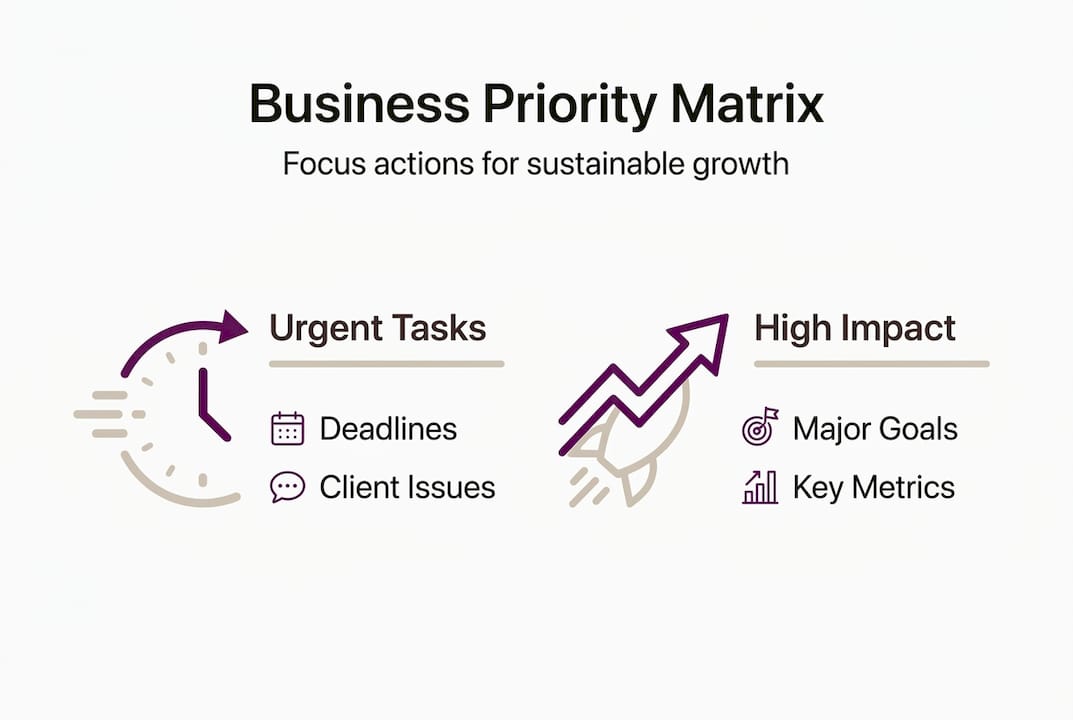
The first step to regaining control is understanding what actually deserves your attention right now. The Eisenhower Matrix helps solo entrepreneurs prioritize by sorting tasks into four quadrants based on urgency and importance. This simple framework prevents you from treating every task as equally critical, which leads to decision fatigue and scattered effort.
Quadrant 1 holds urgent and important tasks: client emergencies, critical deadlines, or pressing problems that directly impact revenue or reputation. Handle these immediately. Quadrant 2 contains important but not urgent work: strategic planning, relationship building, skill development, and action planning for entrepreneurs that drives long-term growth. Schedule dedicated time blocks for these activities because they determine your future success. Quadrant 3 includes urgent but unimportant tasks like most emails, interruptions, and other people’s priorities. Delegate these when possible or batch them into short windows. Quadrant 4 covers neither urgent nor important activities: mindless scrolling, excessive meetings, or busywork that creates the illusion of productivity. Eliminate or minimize these ruthlessly.
Clear categorization transforms overwhelming to-do lists into actionable priorities. When you know which quadrant a task belongs to, you make faster, more confident decisions about what to tackle next. This clarity reduces stress and helps you protect time for the strategic work that actually moves your business forward.
Pro Tip: Review your task categories every Friday afternoon. Spend 15 minutes reassessing what belongs in each quadrant based on changing business conditions and upcoming deadlines to stay aligned with your current goals.
Set clear goals with OKRs for alignment and focus
Once you understand your task landscape, you need a system to direct your energy toward meaningful outcomes. OKRs (Objectives and Key Results) provide that structure by defining 2 to 4 ambitious objectives each quarter, with 3 to 5 measurable key results per objective. This approach keeps you focused on what truly matters instead of reacting to whatever feels urgent today.
An objective answers “what do I want to achieve?” and should inspire action. A key result answers “how will I know I succeeded?” and must be quantifiable. For example, an objective might be “establish thought leadership in sustainable business practices,” with key results like “publish 12 expert articles,” “gain 500 newsletter subscribers,” and “speak at 2 industry events.” Teams with weekly OKR check-ins improve goal completion by 43%, boosting focus and execution. Even as a solo founder, regular reviews keep you accountable and allow you to adjust tactics when results lag.
Start each quarter by identifying your top priorities. What 2 to 4 achievements would create the biggest impact? Write objectives that excite you but feel challenging. Then break each objective into specific, measurable key results with clear deadlines. Schedule weekly 30-minute check-ins to review progress, celebrate wins, and troubleshoot obstacles. This rhythm creates momentum and prevents goals from becoming forgotten aspirations.
OKRs work especially well when combined with AI in solo entrepreneurship tools that track metrics automatically and surface insights about what’s working. The key is making objectives ambitious enough to stretch your capabilities while keeping them realistic enough to maintain motivation. If you consistently hit 100% of your targets, you’re probably aiming too low. If you rarely reach 60%, you may need to scale back or extend timelines.
Pro Tip: Share your OKRs with an accountability partner or mentor who can provide outside perspective and encouragement when progress stalls.
Prioritize high-impact tasks using the 80/20 and impact/effort matrices
Knowing your goals is one thing. Identifying which daily tasks actually move you toward those goals is another. The 80/20 rule (Pareto Principle) reveals that roughly 20% of your activities generate 80% of your results. Your job is finding and protecting that critical 20%. Applying the 80/20 rule drives 80% of transformation from 20% efforts, making it essential for resource-constrained entrepreneurs.

The impact/effort matrix helps you visualize this principle by plotting tasks on two axes: potential impact (high or low) and effort required (high or low). This creates four categories. Quick wins deliver high impact with low effort, so tackle these first. Major projects require high effort but generate high impact, so schedule dedicated time blocks for them. Fill-ins need low effort and create low impact, so batch these during low-energy periods. Time wasters demand high effort for low impact, so eliminate or drastically redesign them.
Here’s how to apply this framework systematically:
- List all pending tasks and projects for the next two weeks
- Estimate the potential impact of each on your quarterly OKRs (high, medium, low)
- Estimate the time and energy required for each (high, medium, low)
- Plot tasks on the impact/effort matrix to visualize priorities
- Schedule quick wins for immediate execution this week
- Block calendar time for major projects based on available capacity
- Delegate or automate fill-ins whenever possible
- Question every time waster: can you eliminate, simplify, or outsource it?
| Task category | Impact | Effort | Action |
|---|---|---|---|
| Quick wins | High | Low | Do first |
| Major projects | High | High | Schedule blocks |
| Fill-ins | Low | Low | Batch or delegate |
| Time wasters | Low | High | Eliminate or redesign |
This systematic approach ensures you invest energy where it counts. When you consistently prioritize high-impact work, you make faster progress toward goals while avoiding the trap of staying busy with low-value activities. Combine this with business positioning workflow clarity so you’re not just efficient, but efficient at the right things.
Boost productivity and well-being through delegation and balanced work arrangements
Even with perfect prioritization, you can’t do everything yourself. Delegation and outsourcing can increase productivity by 30% and reduce stress for 70% of solo entrepreneurs. The key is identifying tasks that drain your energy or fall outside your core competencies, then finding trusted specialists to handle them.
Start by listing everything you do in a typical week. Mark which tasks only you can do because they require your unique expertise, relationships, or decision-making authority. Everything else is a candidate for delegation. Common examples include bookkeeping, social media scheduling, graphic design, customer service responses, and administrative tasks. You don’t need full-time employees. Freelancers, virtual assistants, and specialized agencies offer flexible, cost-effective solutions.
When delegating, provide clear instructions, examples of desired outcomes, and access to necessary tools or information. Check in regularly at first to ensure quality, then step back as trust builds. The time you invest in training someone else pays dividends when you reclaim hours each week for strategic work.
Flexible work arrangements boost productivity but require regulated onsite days to preserve collaboration and innovation. If you lead a small team, consider hybrid models that allow focused remote work for individual tasks while scheduling regular in-person sessions for brainstorming, relationship building, and complex problem solving. This balance supports both efficiency and creativity.
Delegation best practices:
- Start small with low-risk tasks to build confidence in outsourcing
- Create standard operating procedures for recurring tasks to simplify handoffs
- Use project management tools to track delegated work without micromanaging
- Pay fairly for quality work to attract reliable specialists
- Build relationships with freelancers so they understand your business context
Pitfalls to avoid:
- Delegating without clear expectations leads to disappointing results and wasted time
- Choosing the cheapest option often costs more in revisions and stress
- Failing to provide feedback prevents improvement and damages relationships
- Delegating strategic decisions you should own undermines creative entrepreneurship tips and business direction
Successful delegation isn’t about offloading work you don’t want to do. It’s about building a support system that amplifies your impact while protecting your energy for high-value activities. This approach aligns perfectly with human-centered productivity principles that prioritize sustainable growth over hustle culture burnout.
Pro Tip: Use trusted freelancers or part-time specialists to scale without hiring overhead. Platforms like Upwork and Fiverr help you test relationships before committing to ongoing arrangements.
Take your prioritization skills further with expert AI-powered workshops
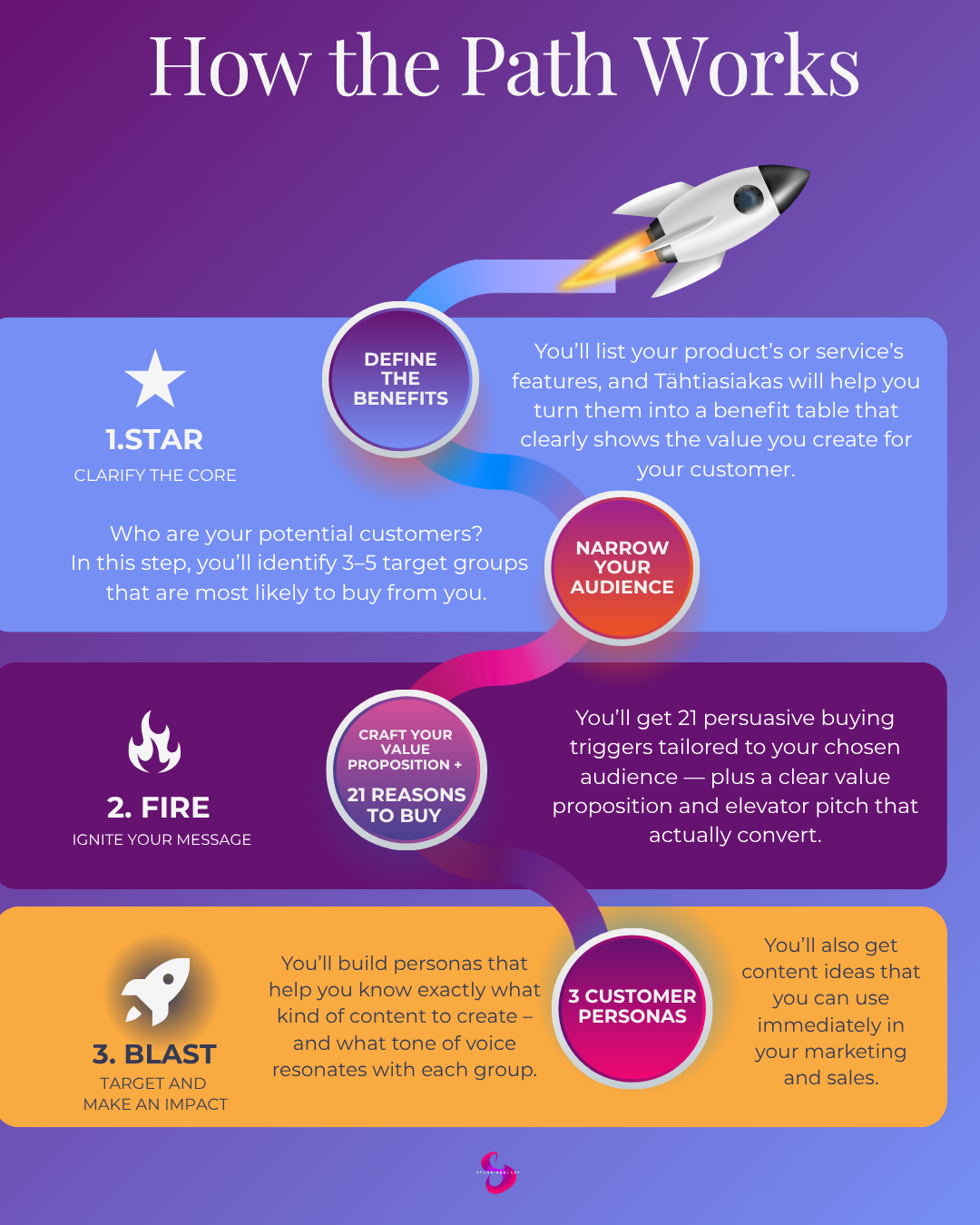
You now have frameworks to categorize tasks, set measurable goals, focus on high-impact work, and delegate strategically. But mastering these skills in the context of your unique business challenges takes practice and expert guidance. The Customer StarMap™ AI workshop helps you apply these prioritization principles to your specific customer needs and business positioning, using AI to surface insights you might miss on your own.
AI tools don’t just save time. They improve decision-making by analyzing patterns across your tasks, goals, and outcomes to recommend where you should focus next. AI tools for entrepreneurs can automate routine workload and free you to concentrate on strategy and relationships. When you combine human judgment with AI-powered analysis, you make faster, more confident prioritization decisions that drive sustainable growth.
Explore additional resources at Starfireblast to deepen your understanding of planetary productivity, customer-centered strategy, and practical tools for everyday execution. Building a sustainable business means continuously refining how you allocate your most precious resource: your time and attention.
Frequently asked questions about balancing business priorities
How do I know which tasks to delegate first?
Start with tasks that are time-consuming but don’t require your unique expertise, like data entry, scheduling, or social media posting. Look for recurring activities where you can create clear instructions and measure quality easily. Administrative work and specialized skills outside your core competencies are ideal first candidates.
What’s the best way to keep OKRs manageable as a solo founder?
Limit yourself to 2 or 3 objectives per quarter with no more than 3 key results each. This constraint forces you to identify what truly matters most. Choose objectives that align directly with revenue growth or customer satisfaction, and make key results specific enough that you can measure progress weekly without complex tracking systems.
How often should I review and update my prioritization framework?
Conduct a quick weekly review every Friday to adjust task categories and check OKR progress. Do a deeper monthly review to assess whether your prioritization approach is working and make framework adjustments. Quarterly reviews should align with OKR cycles and include evaluating which high-impact tasks delivered the best results.
Can flexible work hurt my small team’s innovation?
Flexible arrangements boost individual productivity but can reduce spontaneous collaboration that sparks innovation. Balance remote work with scheduled onsite days for brainstorming, problem-solving, and relationship building. Aim for at least one or two days per week when the whole team is physically together to maintain creative energy and shared culture.
How does AI improve prioritization and decision-making for entrepreneurs?
AI analyzes patterns across your tasks, goals, and past outcomes to recommend where effort will generate the biggest returns. It automates data collection and reporting so you spend less time tracking and more time acting. AI tools also surface insights about customer needs and market trends that inform which priorities deserve your attention right now.
What if urgent tasks constantly derail my important long-term work?
Protect time blocks for Quadrant 2 activities by treating them as non-negotiable appointments. Communicate boundaries clearly with clients and team members about when you’re available for urgent issues. Build buffer time into your schedule for unexpected problems so they don’t consume time reserved for strategic work. If urgencies persist, investigate root causes and implement systems to prevent recurring crises.
Recommended
- Business sustainability fundamentals for small entrepreneurs in 2026 – Starfireblast
- Sustainable growth strategies for entrepreneurs in 2026 – Starfireblast
- How to Clarify Business Vision: 66% More Customer Growth – Starfireblast
- How community drives sustainable business growth in 2026 – Starfireblast