Align your values with business for purpose-driven growth
TL;DR:
- Clarifying and embodying core values builds trust and long-term business resilience.
- Embedding values into operations and stakeholder engagement ensures authentic alignment.
- True values alignment serves as a strategic growth lever over immediate, superficial branding efforts.
Growing a business without losing what it stands for is one of the hardest challenges entrepreneurs face. Many founders start with strong convictions, then quietly trade them away under the pressure of revenue targets, competition, or the next shiny tactic. This guide gives you a direct, practical path: from identifying your real core values to making those values drive your strategy, operations, and community growth. If you want your business to be something worth building, not just something worth scaling, this is where that work starts.
Table of Contents
- Clarifying your core values and vision
- Translating values into actionable business practices
- Engaging your team, suppliers, and community
- Measuring alignment and continuous improvement
- Why true values alignment is your most powerful growth lever
- Take action: Align your business for impact
- Frequently asked questions
Key Takeaways
| Point | Details |
|---|---|
| Define your values | Clarity on your core values and vision anchors every decision and builds trust. |
| Embed values in operations | Daily business actions must consistently express your values, not just your words. |
| Engage all stakeholders | Suppliers, team, and community drive greater impact when fully bought into your values. |
| Measure and adjust | Regular audits and stakeholder feedback help sustain alignment and continuous progress. |
Clarifying your core values and vision
Values are not a marketing exercise. They are the criteria you use to make hard decisions. When your values are vague or aspirational but untested, they will not hold up when trade-offs arrive. That is why clarity here is the foundation of everything else.
Purpose-driven business research consistently shows this matters at scale too. Purpose-driven firms show higher growth, retention, and trust compared to competitors operating without a defined values foundation. The data is clear. The mechanism is simple: when your values are real, they create consistency, and consistency builds trust with customers, employees, and partners over time.
To get started, work through these questions honestly:
- What decisions have you made in the past year that you felt genuinely good about? What made them feel right?
- What decisions have you delayed or avoided because they conflicted with something important to you?
- If your business disappeared tomorrow, what would you want people to remember about how you operated?
- What does your business refuse to do, regardless of the financial upside?
- Who are you building this for, and what does success look like for them, not just for you?
These questions surface your real values, not the polished ones. The gap between stated values and revealed values (what you actually do) is where alignment work begins.
After your values are defined, craft a vision statement. A vision statement is not a tagline. It describes a specific future state your business is working toward. It gives your team a shared north star and makes decision-making faster because any major choice can be evaluated against it directly.
Pro Tip: Every quarter, set aside 30 minutes to review your key decisions from the previous 90 days. Ask: did those decisions reflect your stated values? Where did you drift? This quarterly reflection keeps alignment active rather than theoretical. It is especially useful for solo entrepreneurs and small teams where no formal accountability structure exists.
Purpose-driven entrepreneurship is not about being perfect. It is about being honest about where you stand and consistently working toward better alignment. That practice, repeated over time, is what separates businesses that last from those that burn out or hollow out.
Translating values into actionable business practices
With your core values defined, the next challenge is putting them into practice across your business. This is where most entrepreneurs stall. Values stay on a website or a slide deck while daily operations run on habit and convenience. Closing that gap requires deliberate structural choices.
Here is a step-by-step approach for embedding values into your culture, hiring, and operations:
- Write values into hiring criteria. For each role, define what values-aligned behavior looks like in that function. Ask interview questions that reveal how candidates have acted in past situations, not how they describe their beliefs.
- Tie onboarding to values. New team members should understand your values through specific stories and examples, not abstract principles. Share real decisions that illustrate what your business does and does not do.
- Audit existing operations. Review your top 10 recurring business decisions. Supplier selection, pricing structure, customer communication, and content creation. For each, identify whether your current process reflects your values or contradicts them.
- Create decision frameworks. For high-frequency decisions, build a short checklist that includes a values check. Does this choice align with our stated commitments? Does it create real benefit or just the appearance of one?
- Reward values-consistent behavior. In team settings, recognize and reinforce examples where someone made a values-aligned choice, especially when it was the harder option.
The table below separates surface-level signal actions from substantive, measurable ones. This distinction matters because signal actions can create the appearance of alignment without delivering real impact.
| Action type | Example | Outcome |
|---|---|---|
| Signal (surface level) | Adding a sustainability page to your website | Perception benefit, no operational change |
| Signal (surface level) | Donating 1% of revenue to a cause | Goodwill gesture, disconnected from core operations |
| Substantive | Evaluating suppliers on environmental criteria | Operational change, measurable improvement |
| Substantive | Publishing annual impact reports with real data | Accountability, transparency, stakeholder trust |
| Substantive | Tying employee performance reviews to values metrics | Cultural reinforcement, behavioral change |
The gap between signal and substance is often called greenwashing (presenting a positive image without delivering real change). It is more common than most founders realize, including in businesses with good intentions. Companies with SBTi-validated targets reduce Scope 1 and 2 emissions 8.8% annually compared to the 2.3% average for companies without validated targets. Validated, measurable commitments produce real results. Vague pledges do not.
Pro Tip: Schedule a biannual values audit. Pull a random sample of 10 decisions from the past six months and score each one: did this decision reflect your values, contradict them, or was it neutral? Over time, this builds a concrete picture of where your culture is actually heading. For more detail on this process, the sustainable business practices resource covers specific audit frameworks you can adapt.
If you want a broader framework for structuring this work across your whole business model, the sustainable strategy guide lays out a practical planning approach for entrepreneurs building with long-term alignment in mind.
Engaging your team, suppliers, and community
Once internal processes reflect your values, the next step is to engage everyone your business touches. Values alignment that stops at your own door has limited impact. The businesses that build lasting community-driven growth are the ones that extend alignment outward, consistently and transparently.

Building internal buy-in starts with transparent communication. Share the why behind your values decisions, not just the what. When your team understands the reasoning, they can make aligned decisions independently, which scales your values into every corner of your operations without requiring constant oversight.
For suppliers, direct engagement produces measurable results. Unilever integrated sustainability scores into their procurement process, moving beyond audits alone, which had historically driven performance improvements of only 8 to 12 percent. By embedding sustainability criteria directly into supplier selection and scoring, they created structural incentives for improvement rather than relying on inspection cycles.
You can apply the same logic at any scale. A small business can ask suppliers for environmental and labor practice disclosures as part of onboarding. A solo creator can choose platforms and tools based on their stated values. The scale changes, but the principle holds.
The table below summarizes stakeholder engagement methods and their relative impact on values alignment:
| Stakeholder group | Engagement method | Impact level |
|---|---|---|
| Employees | Values-based onboarding and quarterly reviews | High |
| Suppliers | Sustainability scoring in procurement | High |
| Customers | Transparent reporting and community updates | Medium to High |
| Community | Collaborative projects and shared goal-setting | Medium |
| Investors/partners | Values alignment in term negotiations | High |
Values-aligned businesses attract talent and clients, mitigate risks, and drive innovation, with an empirical link to financial outperformance. That last point often surprises entrepreneurs who assume values and profit are in tension. They are not. They are compounding factors when alignment is genuine.
Authentic engagement looks different from superficial engagement. Here are the signals to watch for:
- Authentic: Sharing failure stories alongside success stories in communications
- Authentic: Inviting community members to co-create offerings or provide input on key decisions
- Superficial: Using values language only in marketing materials, not in operations
- Superficial: Reporting only positive outcomes without acknowledging where improvement is needed
- Authentic: Adjusting supplier relationships based on values audits, even when it costs more
Long-term impact comes from integrated, not isolated, stakeholder involvement.
For a structured approach to making this work at the strategy level, the purpose-driven strategy guide provides a roadmap for entrepreneurs in 2026. Strong leadership for alignment also plays a critical role in keeping stakeholder engagement consistent as your business scales.
Measuring alignment and continuous improvement
With your whole ecosystem activated, ongoing measurement ensures alignment is not just a one-time initiative. Without feedback loops, values drift happens slowly and silently. You end up with a business that talks about alignment but no longer practices it.
Here is a numbered process for reviewing, adjusting, and reinforcing values alignment over time:
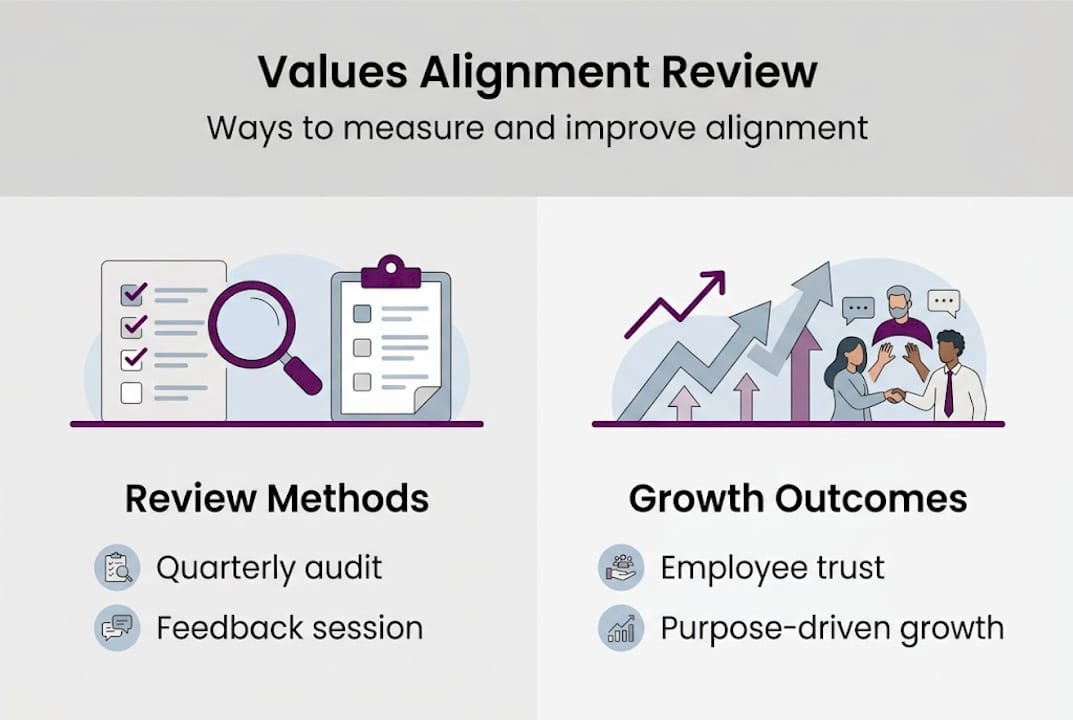
- Set values-based KPIs. Define two to four key performance indicators (KPIs) that directly reflect your values. Examples include the percentage of suppliers with documented sustainability practices, employee satisfaction scores on culture surveys, or the ratio of decisions that passed a values audit in a given quarter.
- Collect structured feedback. Run short customer surveys that ask directly about values appreciation: do customers feel the business is honest, responsible, and consistent? Employee surveys should ask the same about internal culture.
- Conduct decision audits. Purpose integration outperforms pure hustle approaches. Use decision audits to check that 50 percent or more of your major quarterly decisions were values-influenced. This specific threshold, sourced from research on purpose-driven transformation, gives you a concrete benchmark rather than a vague aspiration.
- Review and adjust quarterly. After each quarter, look at your KPIs, survey results, and audit data together. Identify one to two specific areas where alignment slipped. Define one concrete action to address each gap before the next review.
- Share results internally. Tell your team what you found, including the gaps. This builds trust and reinforces that alignment is a real operating practice, not a set-and-forget statement.
Tips for sustaining progress over the long term:
- Document alignment wins specifically. Record the decision, the values it reflected, and the outcome. This builds a reference library that new team members and partners can learn from.
- Share lessons from misalignment without blame. When a decision did not reflect values, analyze why and communicate the lesson. This prevents the same drift from recurring.
- Link alignment progress to your vision statement annually. Ask: is the business closer to or further from the future state described in our vision? Use the answer to recalibrate priorities.
- Celebrate progress publicly where appropriate. Sharing genuine improvement with your community builds accountability and strengthens trust.
Understanding why clarity matters in this context is important. Measurement without clarity about what you are measuring produces noise, not insight. Get specific about what your values look like in action before you try to track them.
Pro Tip: Block two hours every quarter for a formal alignment review session. Treat it as a fixed calendar appointment. Review your KPIs, read through your decision audit notes, and write a single-page summary of where alignment is strong and where it needs work. Over a year, these four documents become a powerful record of your business’s actual values trajectory.
Why true values alignment is your most powerful growth lever
Most entrepreneurs approach values as a branding decision. They pick words that sound good, put them on an about page, and move on. That approach misses something significant.
Values alignment, done seriously, is a strategic advantage. It changes who you attract, how they talk about you, and how resilient your business is when things go wrong. But most founders underestimate it because the results are not immediate. They show up over months and years, in compounding trust, word-of-mouth referrals, and team members who stay because the work means something.
The counterintuitive truth is this: genuine alignment will cost you in the short term. Choosing the sustainable supplier over the cheaper one, turning down a client whose work contradicts your values, investing in transparent communication when silence is easier. These choices have real costs. They also build something that paid advertising and growth hacking cannot buy: earned loyalty.
Most businesses optimize for the next 90 days. Values-aligned businesses optimize for the next five years. The compound interest of trust and reputation is slow at the start and enormous at the end.
Alignment is also not about perfection. A business that acknowledges its gaps publicly and works to close them earns more trust than one that projects an immaculate image. Transparency about the distance between your stated values and your current reality is itself a values act. Customers and communities respect honesty more than they respect polish.
Purpose over profit does not mean ignoring revenue. It means recognizing that purpose-driven decisions, made consistently over time, generate the kind of growth that survives market shifts, algorithm changes, and competitive pressure because they are built on genuine relationships.
The businesses that last are not the ones that scaled fastest. They are the ones that stayed true longest.
Take action: Align your business for impact
Building values alignment into your business is not a one-time exercise. It requires the right tools, frameworks, and support to keep it active as your business grows and changes.
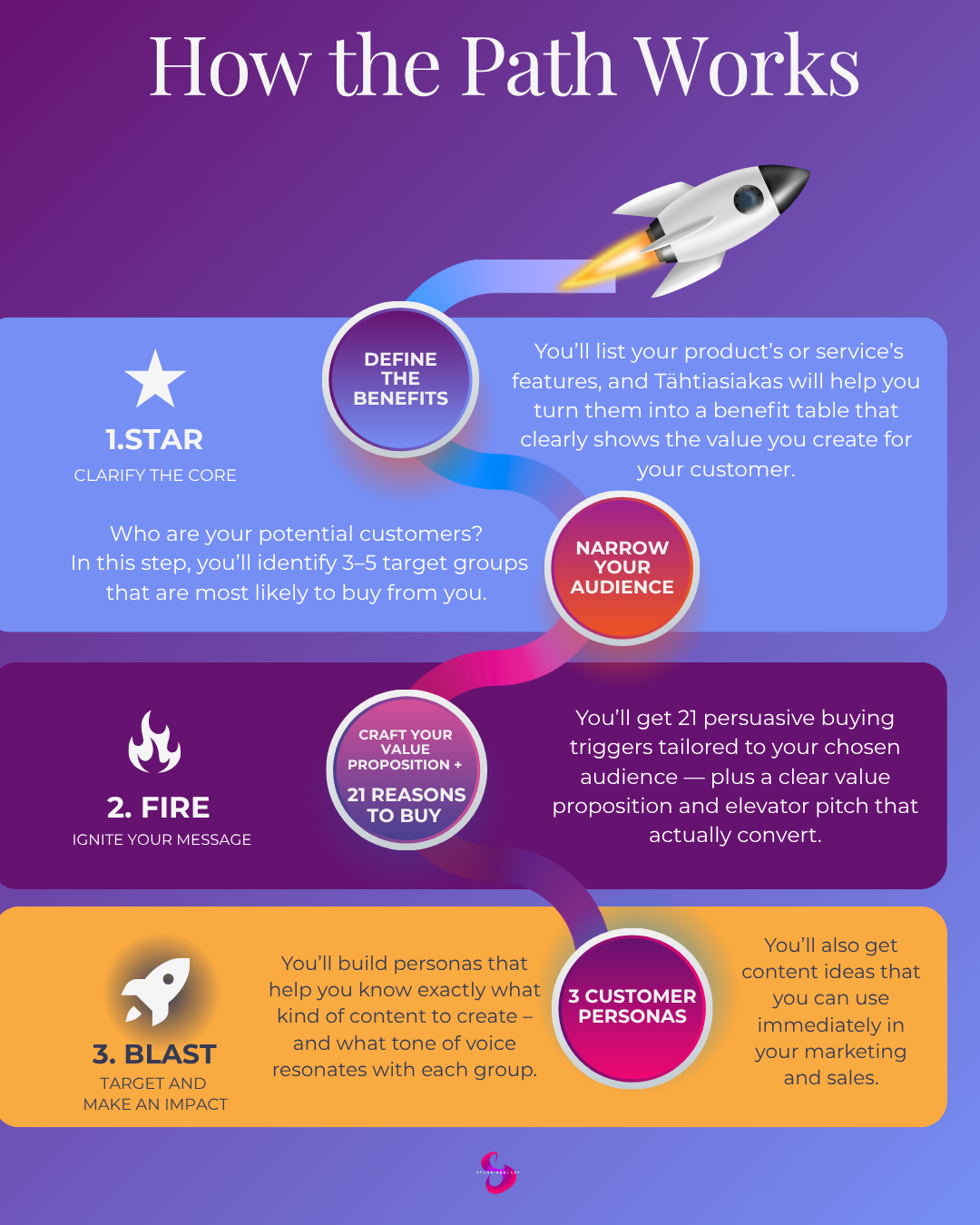
Starfireblast is built specifically for entrepreneurs and creators who want to build with meaning, not just momentum. The Customer StarMap™ Workshop is one of the core tools on the platform. It helps you clarify who you are building for, what they actually need, and how your values connect to the positioning decisions that drive real growth. It is the practical starting point for turning the principles in this guide into a working strategy. If you are ready to move from values as aspiration to values as operation, this is a direct next step.
Frequently asked questions
How do you identify your business’s core values?
Reflect on which principles have guided your most important past decisions, then test those principles against real stakeholder feedback to confirm they hold up in practice.
What’s an example of values-aligned business practice?
Evaluating suppliers on sustainability criteria, not just cost, directly connects procurement decisions to stated values. Unilever’s supplier engagement model demonstrates how integrating sustainability scores into procurement drives measurable performance improvements beyond what audits alone can achieve.
How can values alignment help business growth?
Purpose-driven firms consistently show higher growth rates, stronger employee retention, and greater customer trust than competitors who operate without a clear values foundation.
What common mistakes should be avoided when aligning values?
Avoid surface-level changes made primarily for appearance. Research on purpose-driven transformation recommends balancing substance and signal specifically to avoid greenwashing, which means prioritizing measurable, operational changes over optics-driven ones.