Build an actionable marketing workflow: scale smarter in 2026
TL;DR:
- A clear, repeatable marketing workflow is essential for sustainable growth and avoiding burnout.
- Focus on one primary goal and build strategies around small, measurable wins.
- Regular tracking and iteration based on data are key to improving marketing results over time.
Most solo entrepreneurs and small business leaders are not short on marketing ideas. They are short on a system. You try a new tool, follow a trending tactic, post consistently for two weeks, then stall out. The cycle repeats. The real problem is not effort. It is the absence of a clear, repeatable workflow that connects your goals to your daily actions. This guide gives you exactly that: a step-by-step marketing workflow built for 2026, designed for solo operators and small teams who want sustainable scale without the chaos, the burnout, or the endless tab-switching.
Table of Contents
- What you need before you start: Mindset, goals, and must-have tools
- Step-by-step actionable marketing workflow for 2026
- Avoiding common pitfalls: What derails marketing workflows
- Measuring success: Tracking ROI and making improvements
- Why most marketing workflow ‘hacks’ fall short — and what actually works
- Supercharge your workflow with expert guidance
- Frequently asked questions
Key Takeaways
| Point | Details |
|---|---|
| Start with clear goals | Begin your workflow by clarifying your main marketing objectives to stay focused and measure impact. |
| Keep your tech stack simple | Use only essential, proven tools to save money and time, avoiding unnecessary complexity. |
| Automate with intention | Leverage AI and automation for repetitive tasks, but always verify outputs and maintain a personal touch. |
| Measure and iterate weekly | Track results consistently and adjust your workflow to build on small, compound wins for sustainable growth. |
What you need before you start: Mindset, goals, and must-have tools
Let’s make sure you’re set up for success before diving into daily actions.
Before you run a single ad or write a single email, you need to know what you are actually trying to accomplish. Vague goals produce vague results. Pick one primary marketing objective for the next 90 days. It could be growing your email list by 500 subscribers, generating 20 qualified leads per month, or increasing brand awareness in a specific niche. One goal. One direction.
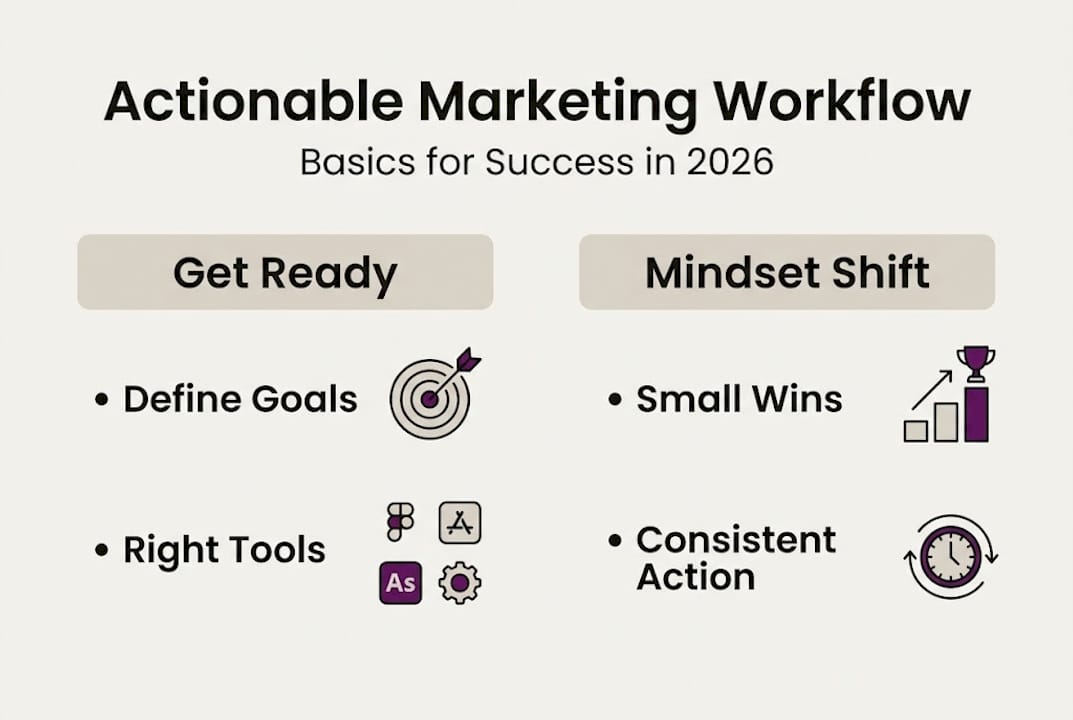
The mindset shift that matters most here is this: sustainable scale is built on compounding small wins, not on one viral moment. Test a tactic at a small scale first. If it works, expand it. If it does not, cut it fast and move on. This approach saves time, money, and energy.
Now for the tools. A lean, effective marketing stack for solo operators in 2026 does not need to cost a fortune. A recommended low-cost stack for solos includes ActiveCampaign at $49/month for email and CRM, Zapier at $20/month for workflow automation, and AdCreative.ai for ad generation, totaling around $150/month. This combination saves 15 or more hours per week and drives up to 47% revenue growth through AI personalization. You can also explore AI tools for entrepreneurs to see how others are automating their workloads effectively.
| Tool | Function | Monthly cost |
|---|---|---|
| ActiveCampaign | Email marketing and CRM | $49 |
| Zapier | Workflow automation | $20 |
| AdCreative.ai | AI-powered ad creation | ~$80 |
| Total | Full marketing stack | ~$150 |
Before you activate any tool, complete these one-time prep tasks:
- Define your target audience clearly (demographics, pain points, buying triggers)
- Write out your core offer and what makes it different
- Craft your primary message in one sentence
- Set up basic audience research using surveys, interviews, or social listening
- Establish your baseline metrics so you can measure change
For creative entrepreneurship tips on positioning your offer before scaling, that groundwork makes every downstream tactic more effective.
Pro Tip: Do not invest in tools you are not ready to measure. Start with what you will actually use in the next 30 days. Add tools only when you have a clear use case and a way to track the result.
Step-by-step actionable marketing workflow for 2026
With the foundation in place and tools ready, here’s how to get your marketing moving step-by-step.
- Create cornerstone content. Produce one high-value piece per week: a blog post, video, or podcast episode that directly addresses your audience’s core problem. This anchors everything else.
- Repurpose across channels. Break that cornerstone piece into three to five micro-content items: social posts, email snippets, short clips. One idea, multiple touchpoints.
- Build and automate your email sequence. Set up a five to seven email welcome sequence in ActiveCampaign. This runs automatically and nurtures new subscribers without your daily involvement.
- Run targeted ads. Use AdCreative.ai to generate ad variations and test two to three versions on one platform. Start with a small daily budget ($10 to $20) before scaling.
- Monitor results weekly. Block 60 minutes every Monday to review open rates, click rates, ad performance, and list growth. Adjust based on data, not gut feel.
- Iterate monthly. At the end of each month, review what worked, cut what did not, and carry the winner into the next cycle.
AI is a genuine multiplier here. According to solopreneur workflow data, AI saves 15 to 20 hours per week, but only when your underlying processes are already solid. AI amplifies what exists. If your process is broken, AI makes the broken parts faster. Test small, then scale what works. You can also review AI in entrepreneurship for more on how solo founders are applying these tools in 2026.

| Factor | Manual workflow | AI-powered workflow |
|---|---|---|
| Time per week | 25 to 35 hours | 10 to 15 hours |
| Content output | Low to medium | Medium to high |
| ROI tracking | Manual spreadsheets | Automated dashboards |
| Learning curve | Low | Medium |
| Personalization | Limited | High |
Pro Tip: Automate the repeatable tasks: email sequences, ad scheduling, reporting. Keep founder-led content personal and unscripted. Your audience can tell the difference, and authenticity converts. For more on work smarter tips, sustainable output beats sprint-and-crash every time.
Avoiding common pitfalls: What derails marketing workflows
Executing workflow steps is only half the battle. Here’s how to avoid getting sidetracked.
The most common workflow killers are not lack of effort. They are structural mistakes that quietly drain results over time. Here is what to watch for:
- Over-segmentation. Splitting a small list into too many segments dilutes performance. Over-segmentation kills performance in cases like running 23 segments on a 4,000-person list. Each segment gets too little data to optimize. Start with two or three segments maximum.
- Set-and-forget automation. Automations need regular review. An email sequence that worked six months ago may be outdated or misaligned with where your audience is now.
- Unchecked AI outputs. AI hallucinations are real. Every AI-generated piece of content, copy, or data point needs a human review before it goes live. Always verify.
- Channel overload. Trying to be active on five platforms simultaneously spreads your attention too thin. Pick one primary channel and build depth before adding a second.
Here is a real-world example. A solo consultant with 4,000 email subscribers created 23 audience segments based on behavior tags. The result was that no single segment had enough volume to generate statistically meaningful data. Open rates dropped. Conversions stalled. The fix was collapsing segments to three core groups and letting results accumulate before refining further.
Manual strategy always outperforms AI execution on its own. AI needs a human-defined direction to be useful. Without a clear strategy, automation just moves faster in the wrong direction.
For a closer look at AI pitfalls in branding and strategy, the pattern is consistent: tools without strategy produce noise. The founder-led growth model works because it keeps strategy human and uses automation only for execution. And for guidance on authentic brand building, community-rooted content consistently outperforms volume-driven output.
Measuring success: Tracking ROI and making improvements
Now that you’re avoiding the common traps, here’s how to measure and optimize your workflow for continuous improvement.
A workflow without measurement is just activity. Here is how to turn your marketing actions into trackable, improvable results:
- Set your metrics upfront. Before launching any campaign, define what success looks like. Email opt-ins per week, sales per month, hours saved, engagement rate.
- Schedule review sessions. Block time weekly (60 minutes) and monthly (2 hours) to analyze performance. Consistency here is what separates compounding growth from random results.
- Analyze results against baseline. Compare current numbers to your starting point. Are you moving in the right direction? By how much?
- Adjust your workflow. Based on data, make one or two specific changes per cycle. Do not overhaul everything at once. Small, targeted adjustments compound over time.
- Repeat the cycle. Measurement is not a one-time event. It is the engine of sustainable growth.
The 47% revenue growth reported by solo operators using AI personalization comes from this exact cycle: measure, learn, adjust, repeat. It is not a one-time setup.
| KPI | What it measures | Review frequency |
|---|---|---|
| Email opt-in rate | List growth speed | Weekly |
| Sales conversion rate | Revenue from marketing | Monthly |
| Hours saved per week | Workflow efficiency | Monthly |
| Email open rate | Audience engagement | Weekly |
| Ad click-through rate | Ad relevance and reach | Weekly |
For sustainable growth strategies that apply across markets, the tracking framework above adapts to any niche. And for community marketing tactics that extend your reach without paid ads, measurement still applies.
Pro Tip: Treat every iteration as a test, not a final answer. The goal is not perfection on the first try. It is learning faster than your competition and compounding those lessons into long-term scale.
Why most marketing workflow ‘hacks’ fall short — and what actually works
With your system dialed in, let’s examine what sets enduring success apart from the hype.
Most marketing workflow advice is built around shortcuts. Copy this funnel. Use this script. Plug in this tool. The problem is that shortcuts are designed for average conditions, and your business is not average. It has a specific audience, a specific offer, and a specific context that no plug-and-play system accounts for.
Chasing trends or copying big business playbooks almost always backfires for solos and small teams. Large companies have budget, headcount, and brand recognition to absorb failed experiments. You do not. Your advantage is different: speed, flexibility, and genuine personality. A solo founder can test an idea on Monday and have results by Wednesday. A corporate team takes months.
Sustainable scale comes from precise focus and genuine connection, not from more automation. The founders who build lasting traction are the ones who know exactly who they serve, communicate that clearly, and improve their system one iteration at a time. For more on this, startup strategy insights show that focused solo founders outperform scattered larger teams at a measurable rate.
Smart workflow is not about doing more. It is about doing the right things, in the right order, with clarity on why each step matters.
Supercharge your workflow with expert guidance
If you want expert support applying these systems to your brand, here’s a practical next step.
Building a marketing workflow that actually holds up takes more than a checklist. It takes clarity on who you serve, what you offer, and how your tools connect to your goals. Starfireblast provides exactly that kind of structured, hands-on support for solo entrepreneurs and small teams.
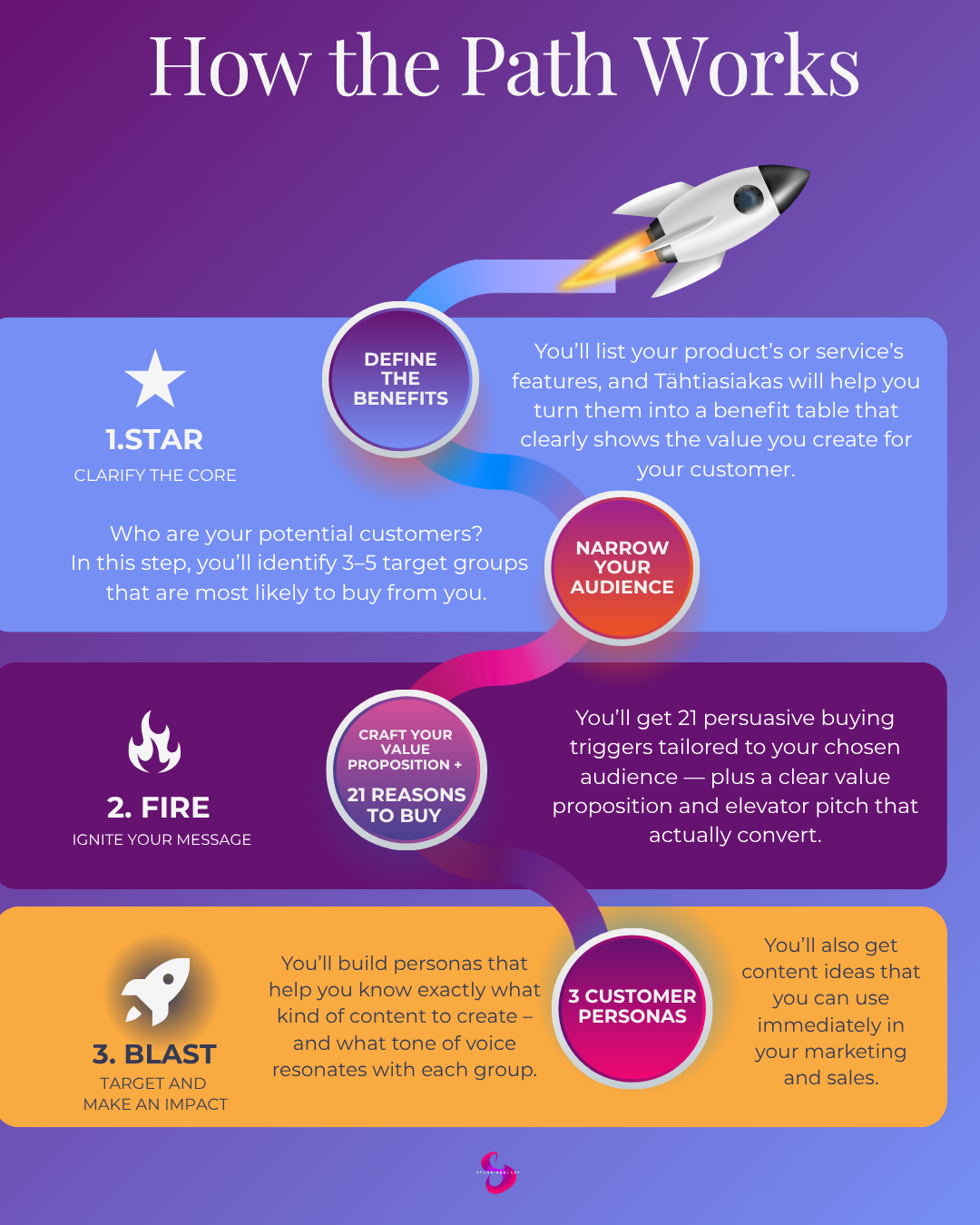
The Customer StarMap™ Power Workshop walks you through goal-setting, workflow design, customer positioning, and AI tool integration in a focused, practical format. It is built for founders who want a real system, not another course to collect. If you are ready to stop guessing and start compounding, this is where to begin.
Frequently asked questions
What is the most important step in a solo entrepreneur’s marketing workflow?
Focusing on one primary channel and building a solid manual strategy before automating is the most crucial step. Manual strategy outperforms AI execution on its own, and over-segmentation consistently kills performance for small lists.
How many marketing tools should small businesses use to start?
Start with a focused three-tool stack covering email/CRM, automation, and ad creation. A lean stack of three tools at around $150 per month covers the core functions without overwhelming your workflow or budget.
How much time can AI-powered marketing automation really save?
AI automation can save 15 to 20 hours per week for solo entrepreneurs, but only once underlying processes are clearly defined and tested.
How do I know if my marketing workflow is actually driving results?
Track metrics like email list growth, sales conversion, and hours saved on a weekly and monthly basis. 47% revenue growth from AI personalization comes from consistent measurement and iteration, not a one-time setup.