7 Essential Steps for a Resilient Entrepreneur Mindset List
Building a successful business is never just about having a great product or idea. The real challenge comes from translating inspiration into real-world value that connects with customers and stands the test of time. If you miss the key steps early on, you risk losing direction or failing to meet your audience’s true needs.
This guide delivers practical approaches for every stage, from clarifying your core purpose to understanding your ideal customer and mapping your growth strategy. You’ll find proven tools drawn from European entrepreneurial research that help you transform ideas into meaningful impact.
Keep reading to discover actionable insights designed to give your venture a solid foundation and help you avoid common hidden obstacles on the road to long-term success.
Table of Contents
- 1. Clarifying Your Core Purpose And Values
- 2. Understanding Your Ideal Customer Deeply
- 3. Visual Mapping For Strategic Clarity
- 4. Building Community-Driven Growth Foundations
- 5. Setting Sustainable Action Plans For Progress
- 6. Leveraging Ai Tools For Everyday Execution
- 7. Embracing Iteration And Real-Time Feedback
Quick Summary
| Takeaway | Explanation |
|---|---|
| 1. Clarify your core purpose and values | Understanding your motivations enables resilience and guides your entrepreneurial journey through challenges and doubts. |
| 2. Deeply understand your ideal customer | Conduct thorough research to uncover emotional needs and practical challenges, which leads to product-market fit. |
| 3. Use visual mapping for clarity | Visual tools simplify complex ideas, helping to communicate strategy effectively across teams and stakeholders. |
| 4. Build community-driven growth foundations | Fostering connections enhances collaboration, creating a supportive ecosystem that benefits all participants involved. |
| 5. Embrace iteration and real-time feedback | Treat every outcome as a learning opportunity, allowing your strategies to evolve with market needs and experiences. |
1. Clarifying Your Core Purpose and Values
Every meaningful entrepreneurial journey begins with understanding why you do what you do. At the heart of sustainable business creation lies a powerful connection between your personal values and professional mission.
The EntreComp framework highlights entrepreneurship as more than just financial pursuits—it’s about creating value that resonates with your deepest beliefs and societal needs. This means going beyond profit to understand the deeper impact you want to make.
To clarify your core purpose, consider exploring these key dimensions:
- Personal Values: What principles guide your decisions?
- Professional Mission: What specific problem do you solve?
- Societal Impact: How does your work contribute to broader human needs?
Your entrepreneurial purpose is the compass that will guide you through challenges, uncertainties, and moments of doubt.
Most entrepreneurs skip this foundational step, jumping straight into tactics and strategies. However strategic self reflection is crucial. By deeply understanding your motivations, you create a resilient framework that withstands market fluctuations and personal challenges.
Effective purpose clarification involves three critical steps:
- Conduct a personal values inventory
- Map your professional skills to meaningful problems
- Validate your purpose through conversations with potential customers and mentors
The European entrepreneurial ecosystem recognizes that purpose-driven entrepreneurs are more likely to create sustainable, impactful businesses. Your clarity becomes your competitive advantage.
Pro tip: Schedule a quarterly “purpose review” where you reassess your core mission, allowing your entrepreneurial vision to evolve and stay aligned with your growth.
2. Understanding Your Ideal Customer Deeply
Knowing your ideal customer is far more than demographic data—it’s about understanding the human story behind the need. Your business success hinges on your ability to deeply comprehend the motivations, challenges, and aspirations of those you aim to serve.
The EntreComp entrepreneurship framework emphasizes customer understanding as a critical competence for transforming ideas into meaningful value. This means going beyond surface-level market research to uncover the emotional and practical dimensions of your customer’s experience.
Effective customer understanding involves several key dimensions:
- Emotional Needs: What underlying feelings drive their decisions?
- Practical Challenges: What specific problems are they trying to solve?
- Latent Desires: What unspoken wants exist beneath their stated requirements?
True customer understanding is not about selling—it’s about solving genuine human problems with empathy and precision.
Most entrepreneurs make the mistake of assuming they know what customers want without rigorous investigation. Strategic customer research requires a systematic approach that combines multiple research methods:
- Conduct in-depth customer interviews
- Create detailed customer persona maps
- Develop hypothesis testing through small-scale experiments
Entrepreneurial success research consistently demonstrates that businesses with deep customer insights are more likely to create products and services that resonate powerfully in the market.
Pro tip: Schedule monthly customer listening sessions where you directly engage with your target audience, allowing their evolving needs to continuously shape your entrepreneurial strategy.
3. Visual Mapping for Strategic Clarity
Entrepreneurial success is not about having great ideas—it is about transforming complex thoughts into actionable strategies. Visual mapping provides a powerful framework for translating your entrepreneurial vision into clear strategic pathways.
Innovation ecosystem research demonstrates that visual mapping techniques help entrepreneurs and innovators navigate complex decision landscapes by representing relationships, flows, and potential barriers.
Visual mapping offers several critical advantages:
- Simplifies Complex Information: Breaks down intricate concepts into digestible visual elements
- Reveals Hidden Connections: Uncovers relationships between ideas that text alone might miss
- Facilitates Strategic Communication: Creates a shared understanding across teams and stakeholders
Strategic clarity emerges when complexity becomes visible and navigable.
Strategic mapping involves more than just drawing diagrams. It requires a structured approach to representation:
- Identify core components of your business ecosystem
- Define relationships and potential interactions
- Create multiple mapping perspectives
- Continuously update and refine your maps
Effective visual mapping tools include:
- Mind mapping software
- Business model canvases
- Value stream mapping techniques
- Stakeholder relationship diagrams
By transforming abstract concepts into visual representations, you create a dynamic strategic navigation tool that adapts with your entrepreneurial journey.
Pro tip: Dedicate 30 minutes weekly to updating your strategic map, treating it as a living document that reflects your evolving business landscape.
4. Building Community-Driven Growth Foundations
Growth is no longer about isolated entrepreneurial efforts—it is about creating meaningful connections that amplify collective potential. Community-driven growth transforms your business from a solitary venture into a collaborative ecosystem.
Local innovation research demonstrates that bottom-up approaches increase democratic engagement and long-term sustainability for entrepreneurial initiatives.
Building community-driven foundations requires strategic approaches:
- Collaborative Engagement: Create platforms for genuine dialogue
- Transparent Communication: Share your vision openly and authentically
- Mutual Value Creation: Design interactions that benefit all participants
True community growth emerges when individual success becomes interconnected with collective progress.
Community-driven foundations involve multiple stakeholder interactions:
- Identify potential community partners
- Establish clear mutual value propositions
- Create transparent communication channels
- Design collaborative engagement mechanisms
The SCALE-UP project highlights how multi-actor partnerships can transform regional economic landscapes by fostering open innovation and collaborative strategies.
Key community building strategies include:
- Hosting interactive workshops
- Creating collaborative digital platforms
- Developing shared learning experiences
- Facilitating knowledge exchange networks
Successful entrepreneurs recognize that community is not a marketing strategy—it is a fundamental approach to sustainable business development.
Pro tip: Dedicate 10% of your weekly work hours to community engagement activities that do not directly generate revenue but strengthen your long-term network connections.
5. Setting Sustainable Action Plans for Progress
Your entrepreneurial journey requires more than passion—it demands strategic and intentional planning that adapts to changing landscapes while maintaining core vision and integrity.
European entrepreneurship strategies emphasize creating comprehensive action plans that support sustainable growth and long-term competitiveness.
Sustainable action plans integrate multiple strategic dimensions:
- Flexibility: Ability to pivot and adjust
- Measurability: Clear metrics for tracking progress
- Alignment: Connection between short and long-term goals
Effective action plans transform abstract aspirations into concrete, executable strategies.
Developing a robust action plan involves systematic approaches:
- Define clear milestone objectives
- Create measurable key performance indicators
- Establish quarterly review mechanisms
- Build adaptive adjustment protocols
The European entrepreneurship learning resources recommend comprehensive planning that balances ambitious goals with realistic execution strategies.
Key components of sustainable action plans include:
- Scenario planning techniques
- Risk mitigation strategies
- Resource allocation frameworks
- Continuous learning integration
Successful entrepreneurs recognize that planning is a dynamic process, not a static document.
Pro tip: Schedule a monthly “strategy reset” where you critically review your action plan, allowing yourself permission to modify approaches without feeling attached to outdated strategies.
6. Leveraging AI Tools for Everyday Execution
Artificial intelligence is no longer a distant technological fantasy—it is a practical toolkit for everyday entrepreneurial challenges. AI transforms complex tasks into streamlined, intelligent processes that amplify human creativity and productivity.
European AI innovation initiatives are creating unprecedented opportunities for entrepreneurs to integrate cutting-edge technologies into daily business operations.
AI tools offer transformative capabilities across multiple domains:
- Task Automation: Eliminating repetitive administrative work
- Strategic Insights: Generating data-driven business intelligence
- Creative Augmentation: Expanding problem-solving capabilities
AI is not about replacing human intelligence but dramatically expanding its potential.
Successful AI integration involves strategic implementation:
- Identify repetitive or data-intensive processes
- Research AI tools specific to your business needs
- Start with small pilot projects
- Continuously evaluate and adjust implementation
The European Commission’s AI innovation package provides startups with resources to accelerate AI adoption while maintaining ethical standards.
Practical AI applications for entrepreneurs include:
- Automated customer support chatbots
- Predictive financial forecasting
- Content generation and editing
- Marketing strategy optimization
- Personalized customer experience design
Successful entrepreneurs recognize that AI is a collaborative intelligence that enhances human capabilities.
Pro tip: Dedicate one hour weekly to exploring and experimenting with new AI tools, treating technological learning as a continuous growth strategy.
7. Embracing Iteration and Real-Time Feedback
Success in entrepreneurship is not about perfect plans—it is about creating flexible strategies that evolve with experience. Real-time feedback transforms your business from a rigid concept into a dynamic learning ecosystem.
EntreComp entrepreneurship framework highlights continuous learning through iteration as fundamental to sustainable business growth.
Effective iteration involves multiple strategic dimensions:
- Rapid Experimentation: Testing ideas quickly and efficiently
- Transparent Learning: Openly acknowledging and analyzing outcomes
- Adaptive Responsiveness: Quickly adjusting strategies based on insights
Entrepreneurial resilience emerges when you treat every outcome as valuable information.
Implementing a robust iteration framework requires systematic approaches:
- Design small testable experiments
- Establish clear feedback collection mechanisms
- Create structured reflection processes
- Develop adaptive response protocols
Key iteration practices include:
- Regular customer feedback surveys
- Continuous product prototype testing
- Transparent performance metric tracking
- Open communication channels
Successful entrepreneurs recognize that failure is not a setback but a learning opportunity.
Pro tip: Implement a monthly “radical candor” review where you invite unfiltered feedback from customers and team members, treating criticism as your most valuable strategic asset.
Below is a comprehensive table summarizing the strategies and insights for entrepreneurial success discussed in the article.
| Topic | Description | Key Takeaways |
|---|---|---|
| Clarifying Core Purpose and Values | Understanding personal values and aligning them with professional goals and societal impact. | Develop a values inventory, map skills to meaningful problems, and validate with feedback. |
| Understanding Ideal Customers | Delving into customers’ emotional needs, practical challenges, and latent desires. | Conduct interviews, create personas, and test hypotheses. |
| Visual Mapping for Strategic Clarity | Creating visual frameworks to simplify information and strategic planning. | Use mind maps, business models, and update maps regularly. |
| Building Community-Driven Growth Foundations | Integrating collective collaboration into entrepreneurial efforts. | Host workshops, build networks, and design mutually beneficial engagements. |
| Setting Sustainable Action Plans | Designing adaptable and measurable business strategies. | Establish objectives, monitor performance, and revise strategies as needed. |
| Leveraging AI Tools | Incorporating AI for task automation and strategic insights. | Start with pilot projects, explore AI tools, and focus on enhancing productivity. |
| Embracing Iteration and Real-Time Feedback | Using experiments and feedback for continuous improvement. | Collect feedback, test prototypes, and remain adaptable in strategy modifications. |
Build a Resilient Entrepreneur Mindset with Purpose and Clarity
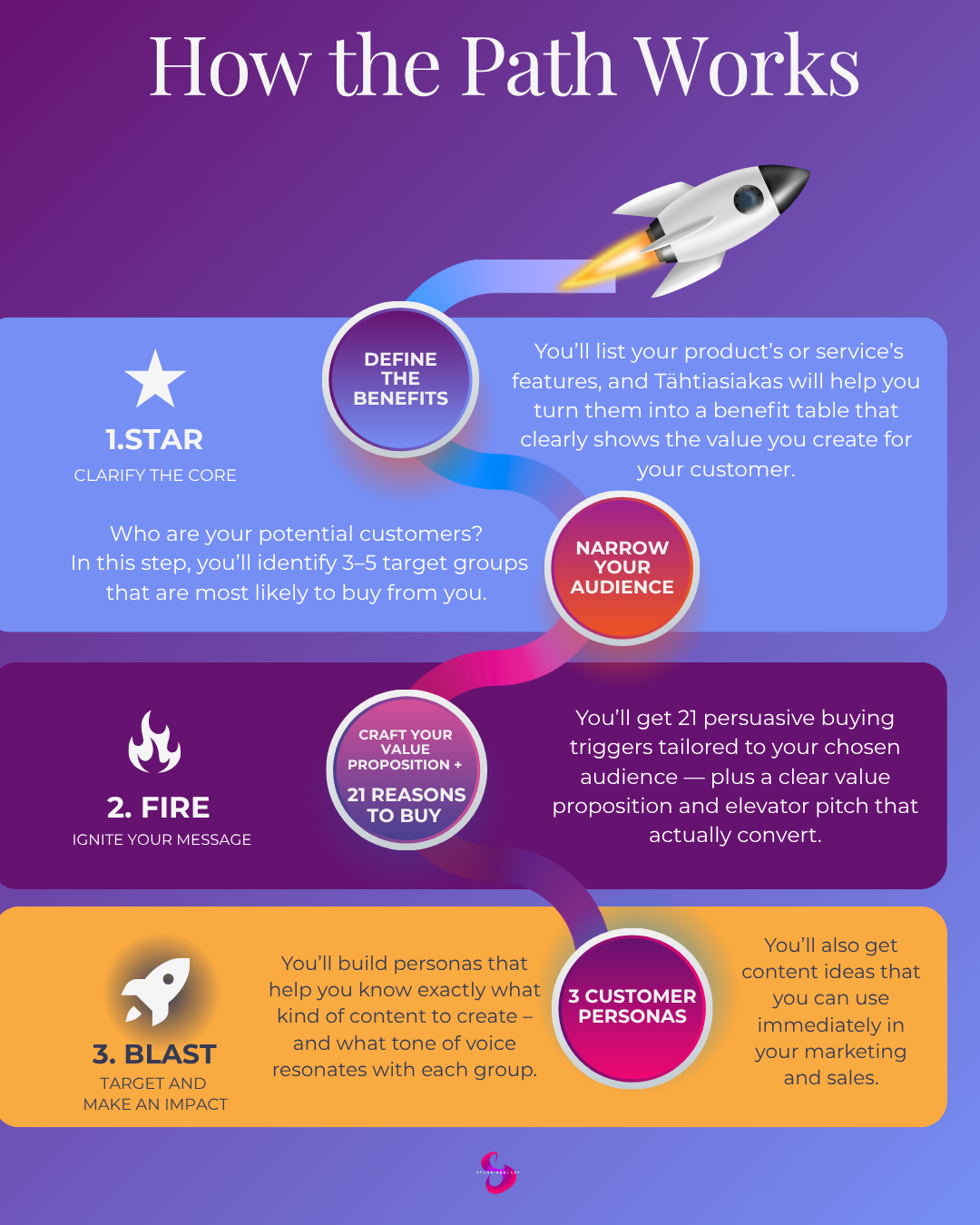
The challenge highlighted in the “7 Essential Steps for a Resilient Entrepreneur Mindset List” article is clear: many entrepreneurs struggle to stay grounded in their core purpose while navigating complex strategies and real-time feedback. Pain points like understanding your ideal customer deeply, clarifying your professional mission, and embracing iteration can seem overwhelming without a clear, supportive framework. Key concepts such as strategic self-reflection, community-driven growth, and AI-assisted tools for everyday execution are essential to overcoming these hurdles and building a sustainable business that aligns with your values.
Starfireblast is designed precisely to help entrepreneurs like you tackle these challenges. By combining tools for customer understanding and positioning with brand and strategy clarity, the platform empowers you to set clear, flexible action plans that evolve with your journey. Our purpose-driven approach ensures you avoid burnout or outsourcing meaning and instead cultivate a living, evolving business that puts human well-being and ecological responsibility at its core. Discover how to apply these transformative principles in your business today at Starfireblast.
Ready to turn your entrepreneurial vision into meaningful action? Explore how Starfireblast can help you clarify who you are building for, why it matters, and how to act next. Visit Starfireblast to get started and embrace a resilient mindset that grows with you. Learn more about creating strategic clarity and community-driven growth with our platform and start your sustainable journey now.
Frequently Asked Questions
What are the key steps to develop a resilient entrepreneur mindset?
Developing a resilient entrepreneur mindset involves clarifying your core purpose, understanding your ideal customer, visual mapping for strategic clarity, and building community-driven growth foundations. Start by defining your personal values and professional mission, then engage with your target audience to gain insights.
How can I identify my ideal customer effectively?
To identify your ideal customer, conduct in-depth interviews to uncover their emotional needs and practical challenges. Create detailed customer persona maps that highlight these insights, allowing you to tailor your offerings more effectively within the next few weeks.
What is visual mapping, and how can it benefit my business?
Visual mapping is a technique that helps translate complex ideas into clear, actionable strategies. Begin by identifying core components of your business ecosystem and creating visual representations of these elements, which can simplify decision-making and improve team communication.
How do I create a sustainable action plan for my entrepreneurial goals?
To create a sustainable action plan, define clear milestone objectives and establish measurable key performance indicators. Implement a quarterly review of your plan to adapt and ensure it aligns with your evolving business landscape.
What role does feedback play in developing a resilient entrepreneur mindset?
Feedback is crucial for creating flexible strategies that evolve with your experiences. Design and implement feedback collection mechanisms, and schedule regular reviews, allowing you to adapt your approach based on real-world insights and lessons learned.
How can I leverage AI tools to enhance my entrepreneurial execution?
You can leverage AI tools by identifying repetitive tasks that could benefit from automation and researching suitable tools for those needs. Experiment with small pilot projects to integrate AI into your operations and evaluate the results over the next few months.
Recommended
- 7 customer benefits that sell better than features – Starfireblast
- I Just Want to Help — But Marketing Feels Gross. Now What? – Starfireblast
- 10 Messaging Fixes That Changed Everything – Starfireblast
- Why your value gets lost (and how to fix it fast) – Starfireblast
- Financial Resilience: Why It Matters for Entrepreneurs